Part 2
There are moments in life when rage comes like fire.
Mine came like ice.
Chloe’s words stayed in my ear long after she hung up.
“At least now they’ll actually look at me.”
I stood in my childhood kitchen with my phone still pressed to my face, my butchered hair hanging in uneven clumps around my jaw, and something inside me became very, very quiet.
My mother was still talking.
Something about hats.
Something about photographers.
Something about how I should “stop being difficult” because the wedding was already stressful enough and Chloe had “waited her whole life for this day.”
My father finally looked up from his coffee.
His eyes traveled over my ruined hair, and his mouth twisted with disgust, not at what they had done, but at how badly I was reacting to it.
“Put on a hat, Harper,” he said. “Your sister is marrying a billionaire. Don’t embarrass this family more than you already have.”
That was when I understood.
They were not sorry.
They were not afraid.
They were not even ashamed.
They honestly believed my body was a family asset they had the right to alter if my appearance interfered with Chloe’s spotlight.
I looked at my mother.
“You came into my room while I was unconscious.”
She exhaled sharply. “You took a sleeping pill. Don’t make it sound sinister.”
“You cut off twenty inches of my hair.”
“For heaven’s sake, hair grows back.”
I looked at my father.
“And you helped?”
He tapped his spoon against the mug.
“I held the flashlight.”
My stomach turned.
There it was. Simple. Domestic. Ordinary.
My mother with scissors.
My father with a flashlight.
My sister with envy sharp enough to approve it.
The family I had spent my whole life protecting had waited until I could not defend myself and then taken a blade to the part of me they resented most.
I should have screamed.
I should have smashed the coffee mug against the wall.
I should have thrown every truth I knew about Chloe, the wedding, the money, and the Sterlings into that kitchen until their perfect little fantasy broke apart on the tile.
Instead, I looked down at my phone.
Then I unlocked it.
My father scoffed.
“What are you doing now?”
I did not answer.
Because when people have spent years training you to beg, silence scares them more than anger.
I opened the folder I had named “Catering Receipts.”
That was the lie I had used to hide it from myself.
It was not really catering receipts.
It was a month’s worth of invoices, wire confirmations, lien notices, canceled checks, altered vendor contracts, forged signatures, offshore routing numbers, emails from desperate subcontractors, and photographs of half-built Sterling properties that had been sold to investors as completed luxury developments.
I had not meant to build a fraud file.
Not at first.
I was a corporate compliance analyst. Numbers were my language. Patterns were my instinct. Give me a spreadsheet, and I could hear where it lied.
Six weeks earlier, Chloe had tossed me a stack of vendor contracts and said, “Since you’re good with boring stuff, can you look these over?”
Boring stuff.
That was what my family called the work that paid my bills, funded Chloe’s emergencies, fixed my parents’ mistakes, and quietly held their lives together.
I looked over the contracts because that was what I did. I looked over everything.
And that was when I saw it.
A floral invoice routed through a shell company connected to Sterling Holdings.
A luxury transportation deposit paid to an account that had also received investor funds from a real estate limited partnership.
A caterer whose original invoice had been changed after signing.
Then a venue charge paid twice, once by Chloe and once by a Sterling subsidiary.
Then a strange clause buried inside the wedding insurance policy naming Sterling Development Group as an “event sponsor” and allowing “promotional investor relations photography.”
Investor relations.
At a wedding.
I had asked Chloe about it.
She laughed and said, “Rich people do rich people things. Stop being weird.”
I had asked my mother.
She said, “Don’t ruin this with your jealousy.”
I had asked my father.
He said, “The Sterlings have lawyers. You have a laptop.”
So I kept looking.
Quietly.
Because I was the one paying deposits when Chloe overspent. I was the one receiving frantic calls when vendors threatened to cancel. I was the one asked to “smooth things over” whenever the Sterling family office delayed reimbursement.
By the time I realized the wedding was more than a wedding, I had already collected enough evidence to make my hands shake.
Nathaniel Sterling was not just marrying my sister.
He was using the wedding.
Five hundred elite guests. Private bankers. Investors. Local politicians. Real estate brokers. Wealth managers. Charity board members. Reporters from society magazines. Everyone in one ballroom, watching him marry into a “respectable” family while Sterling Holdings announced a new charitable housing initiative that did not exist.
The wedding was not a celebration.
It was theater.
And Chloe, with her hunger for status and diamonds, had walked directly onto the stage.
I had told myself not to interfere.
I had told myself maybe I was wrong.
I had told myself no one would believe me anyway.
That morning, with my hair lying in pieces in the upstairs trash can, I stopped protecting everyone.
I opened my contacts and called the one person I had almost called five times.
Maya Chen answered on the third ring.
“Harper?”
Her voice was careful. We had worked together three years ago when my company cooperated with a state securities investigation. Maya was not a friend exactly, but she knew my work. More importantly, she knew when I said something was wrong, I did not say it casually.
“I need to send you a file,” I said.
My mother narrowed her eyes.
“Who is that?”
I turned away from her.
Maya’s tone changed. “What kind of file?”
“Sterling Holdings. Nathaniel Sterling. Shell vendors tied to the Fairmont wedding tomorrow. Possible investor fraud, wire fraud, false development reports, and misuse of partnership funds.”
There was silence on the line.
Then Maya said, very quietly, “Harper, tell me you did not email this to anyone in that family.”
“I didn’t.”
“Good. Where are you?”
“My parents’ house.”
“Are you safe?”
I looked at my mother. I looked at my father. I looked at the scissors sitting on the counter near the fruit bowl, wiped clean but not hidden.
“No,” I said. “Not exactly.”
That made my mother step forward.
“Harper, who are you talking to?”
I moved out of her reach.
“Maya, I’m sending everything now.”
“Use the secure link I’m texting you. Do not edit anything. Do not delete anything. Do not warn anyone. Do not confront Sterling. And Harper?”
“Yes?”
“If what you’re saying is supported, tomorrow’s wedding may already be under observation.”
My pulse slowed.
“What does that mean?”
“It means you are not the only person looking at the Sterlings.”
I looked out the kitchen window at the perfect white tent being assembled on the back lawn for the family brunch. Men in black shirts carried crates of champagne. Women arranged flowers Chloe had not paid for. My parents’ house looked like the opening scene of a magazine spread.
Inside it, I had just been violated by the people who raised me.
Outside it, a billionaire wedding was being polished for cameras.
And underneath it all, the ground was rotten.
“I understand,” I said.
Maya’s voice softened. “What happened to you?”
For one second, I could not speak.
Then I said, “They cut my hair while I was asleep.”
There was a pause.
“All right,” Maya said. “First, send the Sterling file. Second, photograph yourself immediately. Third, photograph the room, the trash, the scissors, anything with hair on it. Fourth, leave that house.”
My father stood.
“Enough,” he snapped. “Give me the phone.”
He took one step toward me.
And for the first time in my life, I did not move backward.
“Touch me,” I said, “and I will make the second call to the police from the front yard.”
He stopped.
My mother’s face drained of color.
“Harper,” she said, trying suddenly to sound maternal. “Let’s not turn this into something ugly.”
I almost laughed.
Ugly had already happened.
Ugly had hands.
Ugly had scissors.
Ugly had my father’s flashlight.
I lifted my phone and took a picture of myself right there in the kitchen.
No filter.
No angle.
No hiding.
My jagged hair. My pale face. My mother standing behind me with her arms crossed. My father frozen beside the table. The scissors on the counter.
Then I walked upstairs.
My mother followed me, hissing my name, but she did not try to stop me.
In the guest room, the damage looked worse in daylight.
Red hair covered the pillowcase in thick, curled pieces. More lay in the trash can. Some had fallen between the mattress and wall. One long lock, nearly two feet, was draped over the back of the chair like something dead.
I photographed all of it.
The hair.
The sleeping pills on the nightstand.
The glass of water.
The door.
The trash.
The uneven chunks left on my head.
Then I packed my bag.
My mother stood in the doorway with tears in her eyes now, but they were not for me. They were for the consequences finally entering the room.
“Harper, please,” she whispered. “You can’t do this today.”
I zipped my suitcase.
“That is the first true thing you’ve said all morning.”
She swallowed.
“What does that mean?”
“It means I can do it tomorrow.”
I pushed past her and walked out of that house.
My father shouted after me from the porch.
“You walk out now, don’t come crawling back when Chloe cuts you off from the Sterling money.”
I stopped beside my car and turned around.
The sun was behind him, making him look like a black shape in the doorway.
“Dad,” I said, “Chloe was never close enough to the money to cut anyone off.”
He blinked.
I got in my car and drove away.
I did not go to a salon first.
I went to a police station.
The officer at the front desk looked up when I walked in, and whatever he had been about to say died in his throat.
I gave my statement calmly.
That was the strangest part. My voice did not break. My hands did not shake. I explained that I had taken a prescribed sleeping pill, gone to bed with waist-length hair, and woken up to find my hair cut off without my consent. I explained that my mother admitted doing it. My father admitted assisting with a flashlight. My sister admitted knowledge and motive over the phone.
The officer asked if I wanted to file a formal complaint.
“Yes,” I said.
He asked if I had photographs.
“Yes.”
He asked if I had somewhere safe to stay.
For a moment, I did not answer.
Because that question hurt more than the others.
Somewhere safe.
At twenty-six, with a career, savings, and a family that smiled in Christmas photos, I should have had an easy answer.
Instead, I thought of every time I had paid Chloe’s bills. Every time I had covered for my mother. Every time I had softened my father’s cruelty into something more forgivable in my own mind.
Somewhere safe was not a place I had been given.
It was something I would have to build.
“I’ll get a hotel,” I said.
The officer gave me a card with the case number. He spoke gently, but not pityingly, and for that I was grateful.
Afterward, I sat in my car and finally cried.
Not beautifully.
Not quietly.
I folded over the steering wheel and sobbed until my throat hurt.
I cried for my hair, yes.
But mostly I cried for the girl I had been.
The little girl who learned to clap louder for Chloe so her parents would smile.
The teenager who changed dresses before school dances because Chloe said she looked “too pretty.”
The college student who took extra shifts while Chloe went on spring break.
The daughter who believed love could be earned through usefulness.
That girl had been so tired.
And that morning, she finally stopped working.
At 1:17 p.m., Maya texted me.
Received. Stay reachable. Do not attend the wedding alone if you choose to attend.
I stared at the words.
If you choose to attend.
For half an hour, I told myself I would not.
Then I thought of Chloe standing at the altar beneath $200,000 worth of flowers I had helped arrange, wearing a dress partly paid for with my savings, marrying a man whose crimes might ruin hundreds of people, while my parents sat proudly in the front row as if they had raised royalty.
I thought of my father saying, “Wear a hat.”
I thought of Chloe saying, “At least now they’ll actually look at me.”
And I knew exactly where I would be the next day.
Not hiding.
Not begging.
Not warning.
Watching.
I booked a hotel under my own name. Then I went to the best salon in the city without an appointment.
The receptionist looked at my hair and stopped smiling.
“I know,” I said. “It’s bad.”
A woman in her fifties came from the back. Silver bracelets. Black dress. Sharp eyes.
“I’m Celeste,” she said. “Who did this to you?”
“My mother.”
Celeste did not gasp. She did not ask for gossip. She simply put a hand on my shoulder and said, “Sit.”
For two hours, she worked in near silence.
She washed out the loose pieces. She studied the damage. She cut what could not be saved and shaped what remained into something deliberate. Not long. Not soft. Not the Harper my family knew how to use.
A sleek, asymmetrical copper bob that curved along my jaw on one side and ended sharp near my cheekbone on the other. Modern. Fierce. Elegant in a way that made the jaggedness look like choice instead of violence.
When she turned the chair toward the mirror, I stared.
I looked older.
Not in a bad way.
I looked like a woman who had stopped asking permission to exist.
Celeste stood behind me.
“They wanted to make you smaller,” she said.
I touched the clean line at my jaw.
“They failed.”
She smiled slightly.
“Yes,” she said. “They did.”
That night, I did not sleep much.
Maya called once, late.
“I can’t tell you details,” she said. “But your documents were useful.”
“Useful how?”
“Useful enough that you need to stay away from Nathaniel Sterling tomorrow.”
“Is he dangerous?”
“Financial criminals are most dangerous when they still believe they can charm their way out.”
That told me enough.
“What about my sister?”
“Is she involved?”
I closed my eyes.
“In the fraud? I don’t know. In the lies? Absolutely.”
“Then let the investigators determine the first part. You do not owe anyone a warning.”
I laughed once, bitterly.
“My family will say I ruined the wedding.”
“Harper,” Maya said, “people who build weddings on fraud ruin their own weddings.”
I held onto that sentence until morning.
The wedding was at the Fairmont Grand, an old hotel with marble columns, crystal chandeliers, and a ballroom that looked like money had learned how to pray.
Black cars lined the circular drive. Photographers shouted names. Women stepped out in silk and diamonds. Men in tailored suits checked their watches with the bored confidence of people who had never waited for a paycheck to clear.
I arrived twenty minutes before the ceremony.
No hat.
A dark emerald dress.
Low heels.
Small gold earrings.
Clean makeup.
Sharp copper hair.
For one breath, as I stepped from the car, I felt naked. My neck was exposed. My hair no longer shielded my shoulders. Every breeze touched me.
Then the first photographer turned.
His camera lifted.
“Miss? Are you family of the bride?”
I looked directly at him.
“Yes,” I said. “Unfortunately.”
Inside, the lobby smelled like gardenias and expensive perfume.
A wedding planner I had hired but Chloe had taken credit for rushed toward me, headset crooked, face pale.
“Harper,” she whispered. “Thank God. Chloe’s mother said you were sick.”
“I’m better now.”
Her eyes moved to my hair.
She understood enough not to ask.
“The Sterling people are furious about something,” she said. “Their legal team has been in the private dining room all morning. Nathaniel keeps taking calls.”
“Good,” I said.
She blinked.
“Good?”
I touched her arm.
“You’ve done excellent work. Whatever happens today, make sure your invoices are protected.”
Her face changed.
“What does that mean?”
“It means send final copies to your attorney before the ceremony starts.”
She stared at me for two seconds, then turned and walked quickly away.
I continued toward the bridal suite.
I did not knock.
Chloe stood in front of a wall of mirrors wearing a dress that looked like a cathedral had been turned into fabric. Lace sleeves. Pearl buttons. A train long enough to require two assistants. Her blonde hair was arranged in perfect waves beneath a veil that cost more than my first car.
My mother was beside her, fastening a bracelet.
My father stood near the champagne table in a tuxedo, looking self-important and uncomfortable.
When they saw me, the room froze.
Chloe’s mouth fell open.
My mother’s hand flew to her chest.
My father’s face turned red.
I closed the door behind me.
“No,” Chloe said.
That was all.
No apology. No shock. No guilt.
Just no.
As if I had disobeyed the script.
My mother recovered first.
“Where is your hat?”
I smiled.
“I decided not to wear one.”
Chloe’s eyes filled with panic as she looked at my hair. Not because it was ugly.
Because it wasn’t.
“You cut it,” she said.
“You started. I finished.”
Her hands curled into fists at her sides.
“You are not walking down that aisle looking like that.”
“I’m not walking down the aisle at all.”
My mother stepped forward.
“Harper, this is not the time for one of your emotional punishments.”
“I resigned as bridesmaid.”
Chloe’s face went white.
“You can’t resign an hour before the ceremony.”
“I did it in writing last night. Check your email.”
My father slammed his glass down.
“You selfish little—”
“Careful,” I said.
He stopped.
Maybe it was my voice.
Maybe it was the police report.
Maybe, for once, he saw that the daughter in front of him was not the daughter he was used to cornering.
Chloe pointed at me.
“Get out.”
“In a minute.”
“I said get out!”
I looked at her in the mirror.
“You knew.”
She looked away.
“You knew Mom was going to cut my hair.”
“Don’t be dramatic.”
“You said, ‘At least now they’ll actually look at me.’”
My mother whispered, “Harper.”
I ignored her.
“I paid sixty thousand dollars to keep this wedding from collapsing,” I said. “I negotiated your contracts. I saved your venue after you missed the second deposit. I covered your flowers when Nathaniel’s office delayed payment. I did everything you asked, and when that wasn’t enough, you let them take scissors to me in my sleep.”
Chloe’s lips trembled, but her eyes stayed mean.
“You always do this.”
I almost laughed.
“Do what?”
“Make everything about you without even trying.”
There it was again.
The disease at the center of my family.
They thought my existence was theft.
If I was praised, I had stolen from Chloe.
If I was loved, I had stolen from Chloe.
If I looked beautiful without permission, I had stolen from Chloe.
I walked closer until I stood just behind her, both of us reflected in the mirror.
The bride in white.
The sister in green.
The golden child and the problem.
“You have spent your whole life trying to become someone people envy,” I said softly. “And today you finally did it. Everyone downstairs envies you. The dress. The flowers. The billionaire groom. The cameras. The Sterling name.”
Her chin lifted.
“So leave me alone and let me have it.”
I looked at her reflection.
“That’s the problem, Chloe.”
I leaned closer.
“You never asked what it would cost.”
A knock came at the door.
One of Nathaniel’s groomsmen opened it without waiting.
“Chloe, they need you downstairs. Nate says we’re moving up the processional by ten minutes.”
Chloe stiffened.
“Why?”
The groomsman glanced at me, then at my parents.
“I don’t know. He just said now.”
My father muttered, “Finally. Let’s get this done.”
I stepped aside.
Chloe lifted her bouquet with shaking hands.
As she passed me, she whispered, “After today, you are nothing to this family.”
I looked at her calmly.
“After today, Chloe, you may want to worry about whether this family is anything to you.”
She walked out.
My mother followed.
My father lingered just long enough to glare at me.
“You think you’re clever,” he said.
“No,” I said. “I think I was useful for too long.”
Then I walked past him and went downstairs.
The ballroom was breathtaking.
That was the cruel part. Fraud can wear beauty very well.
White roses climbed the columns. Crystal chandeliers scattered light over five hundred guests. A string quartet played near the altar. The aisle was covered in ivory petals. At the front stood Nathaniel Sterling, tall, handsome, perfectly groomed, wearing a black tuxedo and the relaxed smile of a man who believed every room belonged to him.
Beside him, his father, Conrad Sterling, stood like a monument carved from old money.
I knew his face from magazine covers and real estate panels. Sterling Development Group had reshaped half the city skyline. Luxury towers. Private clubs. Political donations. Charity galas. A family name spoken with reverence by people who confused wealth with virtue.
But Nathaniel’s smile was wrong.
Too tight.
His eyes kept flicking to the exits.
I sat near the back.
Not in the family row.
Not beside my parents.
I chose an aisle seat with a clear view of the doors.
Maya had told me not to attend alone. She had not told me that two rows behind me, a woman in a navy suit would sit down and quietly say, “Ms. Vale?”
I turned slightly.
The woman did not look at me.
“Maya asked me to keep an eye on you,” she said.
“Are you law enforcement?”
“Today, I’m just a guest.”
That was answer enough.
The music changed.
Everyone stood.
Chloe appeared at the far end of the aisle.
For one second, despite everything, my chest hurt.
She was beautiful.
My sister had always been beautiful in a delicate, expensive way, like a porcelain figure kept behind glass. She held our father’s arm. My mother was already crying in the front row. Cameras clicked. Guests murmured admiration.
Chloe saw me halfway down the aisle.
Her smile faltered.
Then she lifted her chin and kept walking.
She reached Nathaniel.
My father placed her hand in his with the solemn pride of a man delivering a priceless offering.
The officiant began.
“Dearly beloved…”
Nathaniel’s smile returned.
He leaned toward Chloe and whispered something. She smiled back, nervous but glowing.
I wondered if she loved him.
Or if she loved the doors his name opened.
Maybe she did not know the difference anymore.
The officiant spoke about commitment.
About honor.
About trust.
Each word landed like a joke told in a graveyard.
Then, just as he turned to Nathaniel and said, “Do you, Nathaniel James Sterling—”
The ballroom doors opened.
Not dramatically.
Not with a crash.
They opened with calm precision.
Six people entered.
Two in dark suits.
Two uniformed officers.
One woman carrying a leather folder.
One man with a badge visible on his belt.
The music stopped because the quartet stopped playing.
The entire ballroom turned.
Nathaniel went still.
Not confused.
Not surprised.
Still.
Conrad Sterling moved first.
He stepped away from the front row, his voice low and dangerous.
“This is a private event.”
The woman with the leather folder walked down the aisle.
“Mr. Nathaniel Sterling?”
Chloe looked at Nathaniel.
“Nate?”
Nathaniel did not answer.
The woman stopped ten feet from the altar.
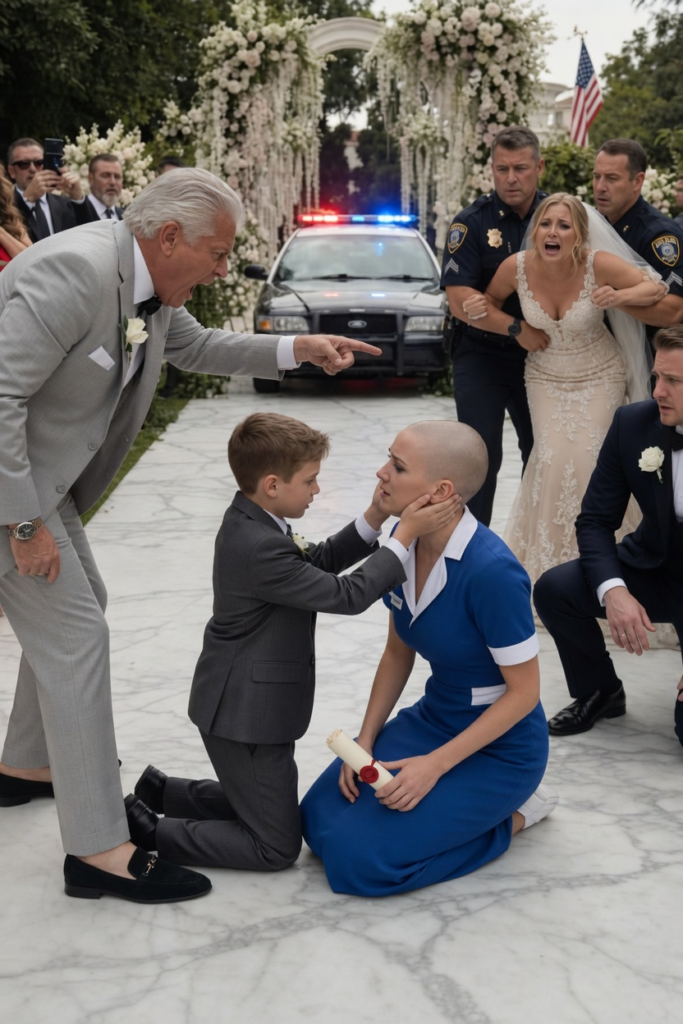
“I’m Special Investigator Dana Ruiz with the State Financial Crimes Bureau. We have a warrant for your arrest.”
The ballroom inhaled as one body.
Chloe’s bouquet dropped.
White flowers scattered across the ivory runner.
My mother stood halfway from her seat, frozen between outrage and terror.
My father looked around as if searching for someone to blame and found me.
His face changed.
He knew.
He knew before anyone said another word.
Nathaniel smiled.
It was astonishing.
Even then, he smiled.
“I’m afraid there’s been a misunderstanding,” he said smoothly. “My attorneys are in the building.”
Investigator Ruiz did not blink.
“Yes,” she said. “Two of them are currently being served.”
A ripple moved through the guests.
Cameras lifted.
Conrad Sterling’s face went gray.
“You have no idea what you’re doing,” he said.
Ruiz turned to him.
“Mr. Conrad Sterling, agents are executing search warrants at Sterling Development Group headquarters and three related properties as we speak. You are not currently under arrest, but you are advised not to leave the jurisdiction.”
The first scream came from Chloe.
Not loud.
Not theatrical.
A small, broken sound.
“Nate,” she whispered. “Tell them.”
Nathaniel looked at her then.
And for the first time, I saw his mask slip.
Not into guilt.
Into annoyance.
As if Chloe had become a chair blocking his path.
“Chloe,” he said quietly, “don’t say anything.”
That was the moment she understood he was not protecting her.
He was protecting himself.
Investigator Ruiz stepped forward.
“Nathaniel Sterling, you are under arrest for securities fraud, wire fraud, conspiracy, and falsification of financial statements related to Sterling residential investment funds.”
A guest near the front whispered, “Oh my God.”
Another said, “I invested in Parkline.”
Someone else stood abruptly and knocked over a chair.
Chloe backed away from Nathaniel.
He lowered his voice.
“Chloe. Come here.”
She shook her head.
One of the officers moved behind him.
Nathaniel’s eyes swept the room.
For one terrible second, they landed on me.
Recognition flickered.
He knew exactly who I was.
Not as Chloe’s sister.
As the person who had looked too closely.
His expression hardened.
“You,” he said.
Every head turned.
I did not move.
My father whispered something that sounded like a curse.
Nathaniel laughed once.
“Really? The bridesmaid?”
Investigator Ruiz said, “Mr. Sterling, turn around.”
But he kept looking at me.
“You have no idea what you’ve done.”
I stood.
The woman in navy behind me stood too.
“I know exactly what I’ve done,” I said.
My voice carried farther than I expected.
“I stopped paying for lies.”
Nathaniel’s smile vanished.
The officers took him by the arms.
Chloe watched as they turned the man she had been about to marry away from the altar. His cuff links flashed in the chandelier light. His perfect hair did not move. His shoes left clean prints through the fallen petals.
At the door, he looked back once.
Not at Chloe.
At me.
Then he was gone.
For five full seconds, no one spoke.
Then the ballroom erupted.
Guests shouted into phones. Reporters pushed toward the aisle. Sterling executives moved quickly toward side exits and were stopped by officers. The wedding planner pressed both hands to her headset and looked like she might faint. My mother grabbed my father’s sleeve. Chloe stood at the altar in her cathedral dress, shaking so violently her veil trembled.
And then she turned on me.
“You did this,” she screamed.
The room quieted just enough for everyone to hear.
She lifted her skirt and stumbled down the aisle toward me.
“You ruined my life!”
I stayed where I was.
“No,” I said. “I interrupted a crime scene.”
Her face twisted.
“You couldn’t stand it. You couldn’t stand that I was finally above you.”
I looked at her ruined bouquet on the floor.
“Chloe, you were standing beside a man being investigated for defrauding retirees, subcontractors, and investors. This was never above me. It was beneath all of us.”
She slapped me.
Hard.
The sound cracked through the ballroom.
My cheek burned.
Gasps rose around us.
The woman in navy moved instantly, but I lifted one hand to stop her.
I touched my cheek, then looked at my sister.
“That’s twice in two days someone in this family has put hands on me.”
Chloe’s fury flickered.
Fear entered.
Good.
“Harper,” my mother whispered, rushing toward us. “Please, not here.”
I looked at her.
“Not here?” I repeated. “You cut my hair while I was unconscious, and your concern is still the audience?”
A murmur moved through the guests.
My mother froze.
My father grabbed her arm.
“Shut up,” he hissed.
But it was too late.
Phones were already raised.
Chloe stared at me, breathing hard.
“What are you talking about?” someone whispered.
I did not explain to the room.
I did not need to.
For once, silence did the work.
I turned and walked out of the ballroom.
This time, no one stopped me.
Outside, the afternoon sun hit my face, bright and clean and almost insulting. The world had the audacity to look normal.
Behind me, the Fairmont Grand was collapsing into scandal.
In front of me, my car waited at the curb.
My phone buzzed.
Maya.
Are you safe?
I typed back.
Yes.
Then another message appeared.
You did the right thing.
I stared at those words for a long time.
The right thing.
People say that as if it feels pure.
It does not.
The right thing can feel like grief. It can feel like betrayal. It can feel like standing alone while every bridge behind you burns and telling yourself warmth is not the same as home.
I drove back to my hotel and turned off my phone.
For twenty-four hours, I let the world scream without me.
When I turned my phone back on Sunday evening, I had 183 missed calls.
Thirty-seven from my mother.
Nineteen from my father.
Fifty-four from Chloe.
The rest were relatives, reporters, unknown numbers, and two vendor attorneys thanking me for documentation that might help them recover unpaid balances.
There was also one voicemail from Chloe.
I listened to it once.
At first, she was sobbing.
Then she was furious.
Then she was begging.
Then she said something that sounded almost like the truth.
“I didn’t know it was fraud. I knew some things were weird, but I didn’t know. I just wanted one thing that was mine. I wanted one day where nobody compared us. And now everyone knows. Everyone knows he didn’t love me. Everyone knows I was stupid.”
I sat on the edge of the hotel bed, phone in hand, and felt something I did not want to feel.
Pity.
Not enough to go back.
But enough to hurt.
The next morning, I met with an attorney named Lillian Cross.
She was small, severe, and wore red glasses that made her look like she had no patience for nonsense because she had personally killed it years ago.
She reviewed my police report, my photographs, the bank transfers I had made for Chloe’s wedding, the texts from my mother pressuring me to pay vendors, and the voicemail from Chloe after the slap.
When she finished, she folded her hands.
“Your family is in trouble.”
I looked down.
“How much trouble?”
“Your mother and father may face charges related to the haircut, depending on the prosecutor. Your sister’s slap was witnessed and recorded. Civilly, you have claims for assault, intentional infliction of emotional distress, conversion if they disposed of the hair, and potentially financial recovery for the wedding payments if you can establish misrepresentation.”
I breathed out slowly.
“Will it be ugly?”
Lillian looked at me over her glasses.
“It already is.”
I nodded.
She continued.
“The question is whether you want private boundaries or public accountability.”
I thought of my mother’s scissors.
My father’s flashlight.
Chloe’s hand across my face.
The answer surprised me with how clear it was.
“Both.”
So we began.
Over the next three months, the Sterling scandal consumed the city.
Nathaniel was denied bail after prosecutors argued he had access to foreign accounts and had already attempted to move money hours before the wedding. Conrad Sterling resigned from three boards. Sterling Development Group filed emergency restructuring papers. Investors came forward by the dozens. Retirees who had trusted the Sterling name. Small contractors who had not been paid. Families who had put savings into promised housing developments that existed only in glossy brochures.
The wedding footage became national news.
Not because of Chloe.
Not because of me.
Because nothing fascinates people more than watching wealth trip over its own polished shoes.
For two weeks, reporters camped outside my apartment building. I did not speak to them.
Maya did not either.
But my documents did their work.
The fraudulent vendor accounts helped investigators trace money through shell companies faster than they otherwise could have. The wedding had not been the whole crime, but it had been a knot in the rope. Pull one strand, and the rest tightened around Nathaniel’s wrists.
Chloe disappeared from social media.
My parents did not.
At first, my mother posted a long statement about “private family pain during an already devastating public tragedy.” She said I had been “emotionally volatile.” She said the haircut was “a regrettable misunderstanding between women under stress.”
Lillian sent a letter.
The post came down within an hour.
My father tried calling my office.
Security told him not to return.
Then one afternoon, my mother came to my apartment.
I saw her through the peephole.
She looked smaller.
No makeup. Gray sweater. Hair pulled back. Hands clenched around a purse.
I almost did not open the door.
Then I remembered something Lillian had told me.
“Closure does not require access. But sometimes you need one last conversation to hear that the door is truly locked.”
I opened it with the chain still on.
My mother’s eyes filled the second she saw me.
My hair had grown slightly, softening at the edges, but it was still short. She looked at it the way a person looks at evidence.
“Harper,” she said.
“Mom.”
“Can I come in?”
“No.”
The word came easily.
She flinched.
“I deserve that.”
I said nothing.
She swallowed.
“Your father and I have been advised not to discuss the case.”
“Then don’t.”
“I just wanted to see you.”
“You saw me while you were cutting my hair.”
Her face crumpled.
“I know.”
For years, I had wanted my mother to break like that. To finally understand. To finally show remorse big enough to match the wound.
But seeing it did not heal me.
It only confirmed that she had always been capable of knowing better.
“I told myself I was helping Chloe,” she whispered. “I told myself hair wasn’t serious. I told myself you were strong and Chloe was fragile. I told myself so many things.”
I looked at her carefully.
“And did you ever tell yourself I was your daughter too?”
She covered her mouth.
That was answer enough.
“I loved you,” she said.
“No,” I replied. “You depended on me. You admired what I could do for the family. You loved the relief I gave you. But you did not love me in a way that protected me.”
She cried then.
Quietly.
I did not comfort her.
It felt cruel at first. Then it felt honest.
“Chloe is not well,” she said.
I closed my eyes.
There it was.
The old doorway.
The old hallway.
The old assignment.
Chloe is hurting, Harper. Be kind.
Chloe is upset, Harper. Make it easier.
Chloe is jealous, Harper. Dim yourself.
Chloe is broken, Harper. Fix her.
I opened my eyes.
“Then Chloe needs professional help.”
“She asks for you.”
“No.”
“She’s your sister.”
I looked at my mother through the narrow gap in the door.
“And I am myself.”
My mother stared at me as if she had never considered that those words could belong together.
I unhooked the chain only enough to hand her an envelope.
Inside was Lillian’s formal notice: repayment demand for the $60,000, preservation of evidence, no-contact requirement except through counsel, and notification that I would fully cooperate with prosecutors regarding the assault.
My mother took it with shaking hands.
“Harper, please.”
“This is the last time you come to my home.”
“Your father—”
“Can speak through an attorney.”
She looked down at the envelope.
Then back at me.
“I am sorry,” she whispered.
I believed that she was.
I also understood that sorry was not a bridge. It was a sign placed near a cliff after someone had already fallen.
“I hope you become someone who would not do this again,” I said.
Then I closed the door.
I sat on the floor afterward for a long time, my back against the wood, breathing through the ache.
It did not feel like victory.
It felt like surgery.
Necessary.
Painful.
Clean.
The criminal cases against my family did not become a spectacle. Lillian made sure of that. My mother and father entered a diversion agreement that required counseling, community service, restitution for my legal costs related to the assault, and a formal written admission of what they had done. Chloe accepted responsibility for striking me at the wedding and entered her own agreement.
The civil case settled privately.
I recovered the $60,000.
Every dollar.
Not because Chloe had it. She did not.
My parents refinanced their house. Chloe sold the jewelry Nathaniel had given her before prosecutors seized the rest. The settlement included a strict no-contact clause and a statement acknowledging that the payments I had made for the wedding were not gifts, but funds obtained through family pressure and false representations.
The apology letter arrived on a rainy Thursday.
Three pages.
My mother wrote about envy as if it had been a weather pattern instead of a choice. My father wrote two paragraphs in stiff, painful sentences. Chloe’s section was the shortest.
I read it standing by the window.
Harper,
I hated you because it was easier than admitting I hated myself. I thought if I married someone powerful enough, I would never feel small again. But I became smaller than I have ever been. You did not ruin my wedding. You revealed what it was. I do not expect forgiveness. I am sorry for what I let them do. I am sorry for what I did.
Chloe.
I folded the letter.
I did not cry.
I placed it in a drawer with the settlement papers, the police report, and one copper lock of hair Celeste had saved from the salon floor and tied with black ribbon.
Not as a relic of pain.
As a record.
Six months later, Nathaniel Sterling pleaded guilty to multiple counts of securities and wire fraud.
The hearing was crowded.
I sat in the back with Maya on one side and Lillian on the other.
Chloe was there too.
She sat across the aisle with no makeup, a plain navy dress, and hair pulled into a low bun. She looked less like a bride abandoned at the altar and more like a woman waking up after a long illness.
Our eyes met once.
She did not smile.
Neither did I.
But she nodded.
Small.
Ashamed.
Human.
I nodded back.
That was all.
It was enough.
Nathaniel stood before the judge in a gray suit instead of a tuxedo. Without the flowers, the chandeliers, and the Sterling name protecting him, he looked ordinary. Handsome still, but ordinary in the way predators often are once the stage lights go out.
When the judge asked if he understood the charges, Nathaniel said yes.
When asked if he admitted to knowingly misleading investors, falsifying records, and directing funds through shell entities, he hesitated.
Then he said yes again.
I watched his shoulders tighten.
For the first time, the room did not belong to him.
After the hearing, Chloe approached me outside the courthouse.
Maya shifted slightly, but I touched her arm.
“It’s fine.”
Chloe stopped several feet away.
Her eyes moved to my hair.
It had grown into a soft copper crop by then. Celeste had shaped it beautifully. I liked it more than I expected. Some mornings, I missed the old length like a ghost. Other mornings, I ran my fingers through the short waves and felt free.
“You look good,” Chloe said.
“Thank you.”
She swallowed.
“I’m moving.”
That surprised me.
“Where?”
“Portland. A friend from college has a small event business. Real events. Normal ones. Birthday parties. Retirements. School fundraisers. She said I could answer phones until I figure myself out.”
I nodded.
“That sounds healthy.”
She almost smiled.
“Healthy would be new.”
The silence between us was not warm, but it was no longer burning.
“I’m not asking you to visit,” she said quickly. “Or call. Or forgive me. I just wanted to tell you I’m trying to become someone who doesn’t need you to be less.”
That sentence hurt.
In a clean way.
“I hope you do,” I said.
Chloe’s eyes shone.
“Me too.”
She turned to leave, then stopped.
“Harper?”
“Yes?”
“I did know Mom was going to do something. I didn’t know she would cut that much. I didn’t know she’d do it while you slept.” Her voice shook. “But I wanted it. That’s the truth. Some part of me wanted you humbled. And I think that’s the ugliest thing about me.”
I looked at her for a long time.
“Then don’t look away from it.”
She nodded.
“I won’t.”
Then she walked down the courthouse steps and disappeared into the gray afternoon.
A year after the wedding that never happened, I opened my own forensic consulting firm.
I named it Vale Integrity Group.
Not dramatic.
Not poetic.
Just mine.
The first office was small, with exposed brick, bad plumbing, and a view of an alley where delivery trucks blocked the sun every afternoon. I loved it immediately.
On the day we opened, Celeste sent flowers.
Maya sent a card that said, Use secure links.
Lillian sent a bottle of very good scotch and a note that said, For after depositions.
My parents sent nothing.
That was their first gift of respect.
Silence.
Months passed.
Then more.
My work grew.
A nonprofit hired me to audit housing grants. Then a pension fund. Then a law firm. Then a coalition of Sterling victims who wanted someone to explain, plainly and without condescension, where their money had gone.
I stood before them in a community center one Tuesday night with short copper hair, a navy suit, and a stack of charts. Many of them were older. Some were angry. Some were embarrassed. All of them had been told by powerful men that trust was proof of sophistication.
I told them the truth.
“You were deceived by people who designed the deception carefully. Shame belongs to the deceiver.”
An elderly woman in the front row began to cry.
Afterward, she took my hands and said, “I thought I was stupid.”
I squeezed her fingers.
“No,” I said. “You were targeted.”
On the drive home, I realized I was speaking to myself too.
I had not been stupid for loving my family.
I had been targeted by the roles they needed me to play.
The fixer.
The quiet one.
The reliable one.
The one who could be cut and still expected to attend the wedding smiling.
That version of me was gone.
Not dead.
Retired.
The final hearing for restitution came eighteen months after the wedding.
Nathaniel received his sentence. Years in federal prison. Financial penalties. Asset forfeiture. Cooperation requirements. His father avoided prison but lost the company, the boards, the houses, and the social kingdom he had mistaken for morality.
The victims would not recover everything.
Fraud never returns all it takes.
But they recovered more than expected.
And buried inside the court’s findings was a paragraph crediting early documentary evidence provided by an unnamed analyst.
Unnamed.
I preferred it that way.
That evening, I returned to my office and found a package waiting outside the door.
No return address.
Inside was a hatbox.
For one sharp second, my body remembered my father’s voice.
Wear a hat, selfish brat.
I almost threw the box away unopened.
Instead, I lifted the lid.
Inside was not a hat.
It was a framed photograph from Chloe.
A picture of us when we were children, maybe seven and five. We were sitting in the backyard under a sprinkler, both soaked, both laughing. My red hair was plastered to my shoulders. Chloe was missing a front tooth. Neither of us looked jealous yet. Neither of us knew what our parents would teach us to become.
Behind the frame was a note.
I found this while packing. I wanted you to have proof there was a time before I made everything a competition. I’m still in therapy. I’m still sorry. I won’t contact you again unless you ask me to.
Chloe.
I stood there in my office until the hallway lights clicked off.
Then I placed the photograph on the bookshelf.
Not on my desk.
Not hidden in a drawer.
On the shelf.
A place for history.
Not a place of control.
Two years after the wedding, my hair reached my shoulders again.
I had kept it short for a while because I liked the woman I had become with nowhere to hide. But one morning, I woke up, looked in the mirror, and realized growing it back did not mean going backward.
So I let it grow.
Not for beauty.
Not for defiance.
For choice.
On a clear spring Saturday, I drove past the Fairmont Grand.
The hotel looked the same. Marble columns. Polished doors. Valets in black jackets. Another wedding party stood outside laughing, the bride lifting her dress away from the curb.
I pulled over across the street and watched for a moment.
There was no pain in my chest.
Only distance.
Then my phone rang.
Maya.
“Tell me you’re not working today,” she said.
“I’m not working.”
“That was not convincing.”
“I’m parked outside the Fairmont.”
A pause.
“Harper.”
“I’m fine.”
“Are you?”
I looked at the bride across the street. Her bridesmaids surrounded her, fussing over her train. One of them adjusted the bride’s veil with such tenderness that I smiled.
“Yes,” I said. “I really am.”
That evening, I hosted dinner at my apartment.
Maya came. Lillian came. Celeste came with her husband. Two colleagues from my firm came. A neighbor brought bread. We ate pasta from mismatched bowls and drank wine from glasses I had bought myself.
At one point, someone asked about the framed childhood photo on the shelf.
“My sister,” I said.
Celeste glanced at me carefully.
“Do you speak?”
“Not often.”
“But the photo stays?”
I looked at it.
“Yes.”
“Why?”
I thought about the answer.
Because forgiveness had turned out to be less like opening a door and more like putting down a weapon.
Because memory did not have to be a chain.
Because I could love the child Chloe had been without handing my life back to the woman who hurt me.
“Because it reminds me that people are not born cruel,” I said finally. “But they are responsible for what they become.”
No one argued.
Later, after everyone left, I washed the dishes alone. The city hummed outside my window. My apartment smelled like garlic, lemon, and candle wax. My hair brushed my collarbone when I leaned over the sink.
I caught my reflection in the dark glass.
For years, mirrors had been battlegrounds.
Was I too much?
Too pretty?
Too noticeable?
Too selfish?
Too cold?
Too unforgiving?
That night, the mirror asked nothing.
It only reflected me back.
Whole.
Not untouched.
Not unchanged.
Whole.
A week later, I received one final letter from my father.
I almost did not open it.
But I did.
Harper,
Your mother said I should write more, but I do not know how to make words better than actions. I was cruel to you. I was weak where I pretended to be strong. I let one daughter become a throne and the other become a tool. That was my failure as a father.
I held the flashlight.
I have written that sentence fifty times in counseling because I tried to tell myself I only watched. I did not only watch. I helped.
You do not owe me a reply.
Dad.
I read it twice.
Then I folded it and placed it with the others.
I did not reply.
Not because I wanted to punish him.
Because peace, once earned, deserved protection.
Three years after the wedding, Vale Integrity Group moved into a larger office.
At the opening reception, a young analyst named Priya asked me where to hang the company values plaque.
I looked at the wall facing the entrance.
“Right there,” I said.
The plaque was simple.
Truth does not become cruel because someone needed the lie.
That sentence had carried me from a kitchen floor covered in hair to a courtroom, from a ruined wedding to my own front door, from being useful to being free.
As the reception began, I stood near the windows with a glass of sparkling water and watched people fill the room.
Clients.
Friends.
Colleagues.
People who knew me not as Chloe’s sister, not as the family fixer, not as the girl with the ruined hair, but as Harper Vale.
A woman who found patterns.
A woman who followed money.
A woman who had learned that silence can protect abuse or prepare justice, depending on what you do next.
My phone buzzed once.
A message from an unknown number.
I almost ignored it.
Then I opened it.
It was from Chloe.
No long apology this time.
Just a photograph.
She was standing in a small community hall beside a table decorated with paper flowers. A banner behind her read: Happy Retirement, Mrs. Alvarez. She wore a simple black dress, no diamonds, no performance. She looked tired and real and peaceful.
Below it, she had written:
I planned this one honestly. Thought you should know.
I stared at the message for a long moment.
Then I typed:
Good.
I did not add more.
I did not need to.
Across the room, Maya lifted her glass at me.
Lillian was arguing with someone about contract language. Celeste was telling Priya that every woman should have one haircut that scares her into recognizing herself. People laughed. The room glowed.
I slipped my phone into my pocket and walked toward them.
For a long time, I had believed justice would feel like everyone finally staring at the people who hurt me.
But justice was quieter than that.
It was my mother learning that apologies did not erase boundaries.
It was my father writing, I held the flashlight.
It was Chloe planning one honest party in a rented hall.
It was Nathaniel Sterling standing in a courtroom without applause.
It was stolen money returned, lies documented, victims believed.
And it was me, standing in a room I built with my own name on the door, wearing my copper hair loose over my shoulders because no one alive had the right to decide how much of me the world was allowed to see.
The night before Chloe’s wedding, they had tried to make me disappear.
By the next afternoon, five hundred elite guests were not staring at my ruined hair.
They were watching the truth walk down the aisle.
And in the end, that was the most beautiful thing I had ever seen.
Part 3
Three years and four months after the wedding that never happened, Nathaniel Sterling tried to come back from the dead.
Not literally, of course.
Men like Nathaniel rarely die in the ordinary sense. They lose money, reputation, property, and freedom, but something in them keeps breathing inside sealed rooms and legal filings. Their names disappear from society pages and reappear in appeals. Their voices go quiet in courtrooms and return through attorneys. Their power changes shape, but it does not surrender unless someone forces it to.
I learned this on a Monday morning in October, when a thick envelope arrived at my office.
It was waiting on my desk when I walked in, placed neatly between a stack of audit reports and a mug of coffee Priya had left for me.
The return address was from a federal public defender’s office.
I opened it standing.
By the second page, my coffee had gone cold.
Nathaniel Sterling was filing a post-conviction motion. His claim was simple and poisonous: key evidence in his case had been improperly influenced, selectively presented, and possibly fabricated by “a financially motivated private analyst with personal animus toward the Sterling family.”
He did not name me in the first paragraph.
He did not need to.
By page four, there I was.
Harper Vale.
My work.
My documents.
My testimony.
My family history.
My ruined hair.
My sister’s failed wedding.
All of it twisted into a story Nathaniel could understand because it was the only kind of story men like him believed in: revenge.
He claimed I had hated him for marrying Chloe. He claimed I had manipulated vendor records. He claimed Chloe had been “emotionally unstable” and “coached” by me after the arrest. He claimed the wedding scandal had been a personal vendetta dressed up as justice.
I read the motion twice.
Then I called Maya.
She answered with, “I was about to call you.”
“So it’s real?”
“It’s real,” she said. “But it’s weak.”
“Weak things still bite.”
“Yes,” Maya replied. “That’s why we don’t put our fingers near their mouths.”
I sat down slowly.
“What happens now?”
“There will be a hearing. The government will respond. You may be called to testify. Chloe may be called too.”
At Chloe’s name, my chest tightened.
We had not spoken in nine months.
Not because of anger. Because distance had become the healthiest language we knew.
She had stayed in Portland. Her event business had grown. Every few months, she sent one careful message. A picture of a community fundraiser. A note about therapy. Once, a photo of a tiny apartment filled with plants and secondhand furniture.
I usually replied with one or two words.
Good.
Proud of you.
Keep going.
It was not sisterhood as we had imagined it when we were children.
But it was honest.
“Has Chloe seen this?” I asked.
“She will soon,” Maya said.
I closed the file.
“Then he isn’t trying to win.”
Maya paused.
“What do you mean?”
“He’s trying to make sure none of us are free.”
That was Nathaniel’s real talent.
He understood cages.
Some were made of money. Some of shame. Some of fear. Some of old family wounds. His motion was not just legal strategy. It was a hand reaching through prison bars to pull us all back to the aisle where he had last owned the room.
I would not let him.
Two days later, Chloe called.
For a second, neither of us spoke.
Then she said, “I got the papers.”
“I know.”
“He says I lied.”
“Yes.”
“He says you made me lie.”
“Yes.”
Her breathing shook.
“He still sounds like himself. Even in legal language.”
That sentence hurt because I knew exactly what she meant. Nathaniel’s voice was polished into every accusation. Elegant. Controlled. False in ways that made truth sound crude.
“Chloe,” I said, “are you safe?”
There was a silence.
Then she whispered, “Someone came to my work.”
I stood.
“When?”
“Yesterday. A man I didn’t know. He said he represented people who wanted this all to be over. He said if I signed a declaration saying I misunderstood certain things before the wedding, they would pay off my remaining debts.”
My hand tightened around the phone.
“What did you say?”
“I asked him to leave.”
“Did he?”
“Eventually.”
“Did you get his name?”
“No. But Harper…”
“Yes?”
“I recorded him.”
For one moment, I simply closed my eyes.
Three years earlier, Chloe would have hidden the visit, taken the money, or blamed me for making her afraid.
Now she had recorded him.
Not perfectly. Not like an investigator. Like a woman learning how not to be used.
“Send it to Maya,” I said.
“I already did.”
Something moved in my chest, quiet and unexpected.
Not forgiveness.
Not exactly pride.
Something close.
“Good,” I said.
Chloe gave a small, broken laugh.
“I learned from the best.”
The hearing was scheduled six weeks later.
During those weeks, Nathaniel’s legal team tried everything. They requested old messages. They questioned my financial recovery from the civil settlement. They implied my firm had benefited from publicity. They suggested Chloe had been jealous, unstable, humiliated, desperate to save herself.
The old story again.
Women as emotional noise.
Men as misunderstood architects.
Numbers as flexible.
Truth as negotiable.
Lillian handled my preparation.
Maya handled the government side.
Chloe flew in two days before the hearing and asked if we could meet somewhere neutral. We chose a quiet café near the courthouse.
When she walked in, I nearly did not recognize her.
Her hair was shorter. Her clothes were simple. She wore no engagement ring, no diamonds, no performance. She looked nervous but steady.
She sat across from me and placed both hands around her coffee cup.
“You look different,” I said.
“So do you.”
My hair was long again by then, falling past my shoulders in copper waves. The first time it brushed my back after growing out, I had cried in the shower. Not because the hair itself mattered more than anything else, but because choice had returned quietly, strand by strand.
Chloe looked at it, then away.
“I’m glad it grew back,” she said.
I studied her.
“Are you?”
She nodded.
“I used to think your hair was proof life favored you. Now I think it was just hair, and I was very sick with envy.”
The words were plain.
No performance.
No excuse.
That made them heavier.
“Thank you for saying that,” I replied.
She swallowed.
“I’m scared.”
“Of Nathaniel?”
“Of him. Of court. Of Mom and Dad being there.” She looked down. “Of becoming who I was the minute I feel small again.”
That was the first time Chloe said something that made me trust her more.
Not because she claimed to be healed.
Because she did not.
“Then tell the truth while you’re scared,” I said. “That’s what adults do.”
She gave me a sad smile.
“You always sound like a judge.”
“I get that from Lillian.”
The hearing began on a Thursday morning.
The courtroom was smaller than I expected. No chandeliers. No flowers. No aisle of petals. Just wood, fluorescent light, files, microphones, and a judge who looked like he had no patience for theater.
Nathaniel appeared in a dark prison-issued suit.
He had aged.
Not badly. Men like him rarely age badly. But the smoothness was gone. There were lines beside his mouth now, a hardness under his eyes. When he saw me, he smiled.
It was the same smile from the altar.
A smile that said he still believed rooms could be conquered.
I looked through him.
Chloe sat two rows ahead of me, shoulders squared. My parents sat on the opposite side of the courtroom. My mother looked fragile. My father looked diminished, his hands folded tightly in his lap.
I had not seen them in over a year.
My mother turned once, as if she wanted to speak.
I looked away.
The government presented first.
Maya was precise and merciless. She walked the judge through the original evidence. Bank transfers. Shell vendors. Altered invoices. Investor statements. Internal Sterling communications. Metadata. Independent confirmations. Nothing depended solely on me. Nothing depended solely on Chloe. Nathaniel had not been convicted because one angry woman ruined his wedding.
He had been convicted because he committed fraud.
Then came the recording Chloe had made.
The courtroom listened as the unknown man’s voice filled the room.
“Miss Vale, no one benefits from reopening old wounds. Mr. Sterling’s people are prepared to help you if you help correct the record.”
Chloe’s recorded voice answered, shaking but clear.
“What record?”
“The one your sister created.”
“My sister didn’t create the fraud.”
A pause.
Then the man said, “You should be careful where loyalty gets you.”
When the recording ended, Nathaniel’s attorney stood quickly, objecting to relevance.
The judge looked unimpressed.
“Counsel, your client filed a motion alleging witness contamination. Evidence of attempted witness influence is highly relevant.”
Nathaniel’s jaw tightened.
For the first time that day, he stopped smiling.
Chloe testified before I did.
She walked to the stand like someone crossing thin ice.
Her voice trembled at first, but it held.
She admitted she had ignored warning signs because she wanted the Sterling life. She admitted she had resented me. She admitted she had been cruel. She admitted our family had mistreated me before the wedding.
Nathaniel’s attorney tried to use that against her.
“Ms. Vale, you were humiliated when my client was arrested, correct?”
“Yes.”
“You were angry.”
“Yes.”
“You blamed him for destroying your wedding.”
Chloe looked at Nathaniel.
Then she looked back at the attorney.
“No,” she said. “I blamed him for lying. I blamed myself for wanting the lie.”
The attorney tried again.
“Isn’t it true your sister Harper influenced your testimony?”
Chloe breathed in.
“My sister influenced my life by finally refusing to lie for me. That is different.”
The courtroom went still.
I looked down at my hands.
I did not cry.
But something old in me loosened.
Then it was my turn.
I stated my name.
My profession.
My role in identifying suspicious financial records.
Nathaniel’s attorney approached with a thin smile.
“Ms. Vale, you had personal reasons to dislike the Sterling wedding, did you not?”
“Yes.”
“Your family had injured you.”
“Yes.”
“Your sister had insulted you.”
“Yes.”
“You were angry.”
I looked at him.
“Yes.”
He spread his hands slightly, as if the case had opened for him.
“So you admit you were emotionally compromised.”
“No,” I said. “I admit I was angry. Anger and accuracy are not opposites.”
A faint sound moved through the courtroom.
The attorney’s smile faded.
I continued before he could stop me.
“Every document I provided was preserved in original format. Every transfer was verified by subpoenaed bank records. Every invoice was confirmed by the vendor or contradicted by the vendor. My emotional state did not create shell companies, false statements, forged reports, or missing investor money.”
The judge wrote something down.
Nathaniel stared at me.
His attorney changed direction.
“You recovered money from your family after the wedding, correct?”
“Yes.”
“So you financially benefited from the scandal.”
“I recovered funds I had paid under family pressure for a wedding that was never completed. That was not benefit. That was restitution.”
“You built a company after this case.”
“Yes.”
“Using your reputation from it.”
I leaned slightly toward the microphone.
“I built a company because I was good at the work before Nathaniel Sterling committed crimes in public.”
That time, the judge did not hide his expression.
Nathaniel’s attorney sat down soon after.
The judge issued his ruling that afternoon.
Motion denied.
No evidentiary misconduct.
No credible fabrication.
No basis to disturb the conviction.
But he was not finished.
He referred the attempted approach to Chloe for further investigation as potential witness tampering.
Nathaniel stood very still.
The room no longer belonged to him.
Again.
After the hearing, I stepped into the courthouse hallway and took my first full breath in hours.
Chloe came out behind me.
For a moment, we stood side by side without speaking.
Then she said, “I meant what I said.”
“I know.”
“I don’t expect us to be sisters like before.”
“We were never sisters in a healthy way before.”
She nodded.
“Then maybe someday we can be something new.”
I looked at her.
Not the bride.
Not the rival.
Not the girl who wanted me smaller.
Just Chloe.
Trying.
“I’m not ready,” I said.
“I know.”
“But I’m not saying never.”
Her eyes filled.
She nodded again, quickly, like she was afraid too much emotion would break the moment.
“That’s more than I deserve.”
“Yes,” I said. “It is.”
And for the first time, she did not flinch from the truth.
My parents approached slowly.
My father looked at me as if he were asking permission from ten feet away.
I almost left.
Then I stayed.
He stopped in front of me.
“I heard what you said in there,” he told me.
I waited.
His voice roughened.
“Anger and accuracy are not opposites.”
I said nothing.
“I spent years calling your anger disrespect because it was easier than admitting it was evidence.”
My mother began to cry silently.
Dad looked down at his hands.
“I don’t ask for anything. I just wanted to say I understand that now.”
My mother whispered, “We both do.”
I looked at them for a long time.
These were not the towering figures of my childhood anymore. They were older, smaller, stripped of the authority I had once mistaken for truth.
“I hope you keep understanding it,” I said.
Then I turned and walked away.
Not because I hated them.
Because the conversation was complete.
Outside, the sky was clear.
Chloe caught up to me at the courthouse steps.
“Harper?”
I turned.
She held out a small envelope.
“What is it?”
“Final payment.”
I opened it.
A cashier’s check.
Not huge. Not dramatic.
Ten thousand dollars.
“I know the settlement is done,” Chloe said quickly. “This isn’t legal. It’s personal. I saved it from my work this year. I wanted the last money connected to that wedding to become something clean.”
I stared at the check.
“What do you want me to do with it?”
“Anything you want.”
I thought of the Sterling victims. The retirees. The contractors. The woman who thought she was stupid.
Then I looked at Chloe.
“Scholarship fund,” I said.
“For what?”
“For women studying forensic accounting, compliance, or financial investigation. Especially women rebuilding after family abuse.”
Chloe’s face changed.
“That sounds like you.”
“No,” I said. “It sounds like us choosing better.”
Six months later, the Vale Foundation awarded its first scholarship.
We held the ceremony in a modest community hall, not unlike the one in Chloe’s photograph. No marble. No chandeliers. No society reporters. Just folding chairs, coffee urns, a small stage, and twenty-three people who cared enough to come.
The first recipient was a woman named Elena Morales. Thirty-two years old. Single mother. Former bookkeeper. She had discovered payroll fraud at a company where everyone told her to stay quiet because the owner was “a generous man.”
She did not stay quiet.
When she accepted the scholarship, her hands shook.
“I thought telling the truth would end my life,” Elena said into the microphone. “It ended one version of it. Then it gave me another.”
I looked at Chloe, seated near the aisle.
She wiped her eyes.
My parents were not there.
I had not invited them.
That boundary felt peaceful now, not sharp.
After the ceremony, Chloe helped stack chairs. Maya complained about bad coffee. Lillian told Elena to call her if anyone tried to intimidate her. Priya took photos for the foundation website.
I stood near the doorway and watched the room empty slowly.
No one was staring at my hair.
No one was asking me to shrink.
No one was pretending cruelty was love.
Chloe came to stand beside me.
“We did something good,” she said softly.
I looked at the scholarship certificate in Elena’s hands.
“Yes,” I said. “We did.”
Outside, evening settled over the city. The air smelled like rain on pavement. My hair moved in the wind, long enough now to brush my shoulder blades.
Chloe glanced at it, then smiled faintly.
“It really is beautiful.”
This time, there was no poison in the words.
“Thank you,” I said.
She looked nervous.
“Can I ask something?”
“You can ask.”
“Do you think we’ll ever be close?”
I considered lying to be kind.
I did not.
“I don’t know.”
She nodded, accepting it.
“But I think,” I continued, “we can be honest. That’s a better beginning than closeness built on pretending.”
Chloe looked out at the wet street.
“I can live with that.”
“So can I.”
We walked to our cars together, not touching, not rushing, not performing forgiveness for anyone.
At my car, she stopped.
“Goodnight, Harper.”
“Goodnight, Chloe.”
She drove away first.
I stood under the streetlight until her taillights disappeared.
Then I got into my own car and looked at myself in the rearview mirror.
For once, I did not see the girl in the kitchen.
I did not see the bridesmaid with a burning cheek.
I did not see Nathaniel pointing at me from the altar.
I saw a woman who had survived being edited by other people and had written herself back in full.
The story was not clean.
No real ending is.
My parents remained at a distance. Chloe remained a possibility, not a promise. Nathaniel Sterling remained in prison, with fewer weapons than before. The stolen money was not all restored. The old wounds did not vanish.
But the pattern had ended.
That was the victory.
No more scissors in sleeping rooms.
No more daughters used as tools.
No more lies dressed as family duty.
No more silence sold as peace.
I started the engine and drove home through the rain, toward my office, my work, my chosen people, and the life that finally fit me.
They had once cut my hair so I would not outshine my sister.
In the end, I did not need to outshine anyone.
I only needed to stop standing in the dark.