He Threw His Pregnant Wife Into the Street Over a Lie… One Year Later, He Found Her Collecting Bottles With His Twin Sons
You stand beneath the lights of the most expensive ballroom in Monterrey, holding the microphone with a hand that does not tremble.
Not anymore.
All evening, people have congratulated you. Politicians, bankers, developers, old family friends, men who once called Carmen “the perfect wife” and then looked away when you destroyed her. They smiled at Valeria, kissed her cheek, admired her diamonds, and whispered about how lucky you were to find love again.
Love.
The word tastes like poison now.
Across the ballroom, Valeria smiles at you from her table. She believes this is her coronation. She believes you are about to ask her to stand, slip a ring on her finger, and make her the official queen of everything she stole.
Beside her, Mauricio Elizondo sits in the front row, polished and arrogant, swirling champagne in a crystal glass.
He thinks you invited him as a gesture of peace.
He thinks he is watching your surrender.
He has no idea he is sitting in the center of his own execution.
You look at Valeria and continue.
“A union,” you say, “that I was told began after a tragedy. After betrayal. After my former wife, Carmen Garza, supposedly stole from me, cheated on me, and humiliated my family.”
A murmur moves across the room.
Valeria’s smile stiffens.
Mauricio lowers his glass.
You let the silence stretch.
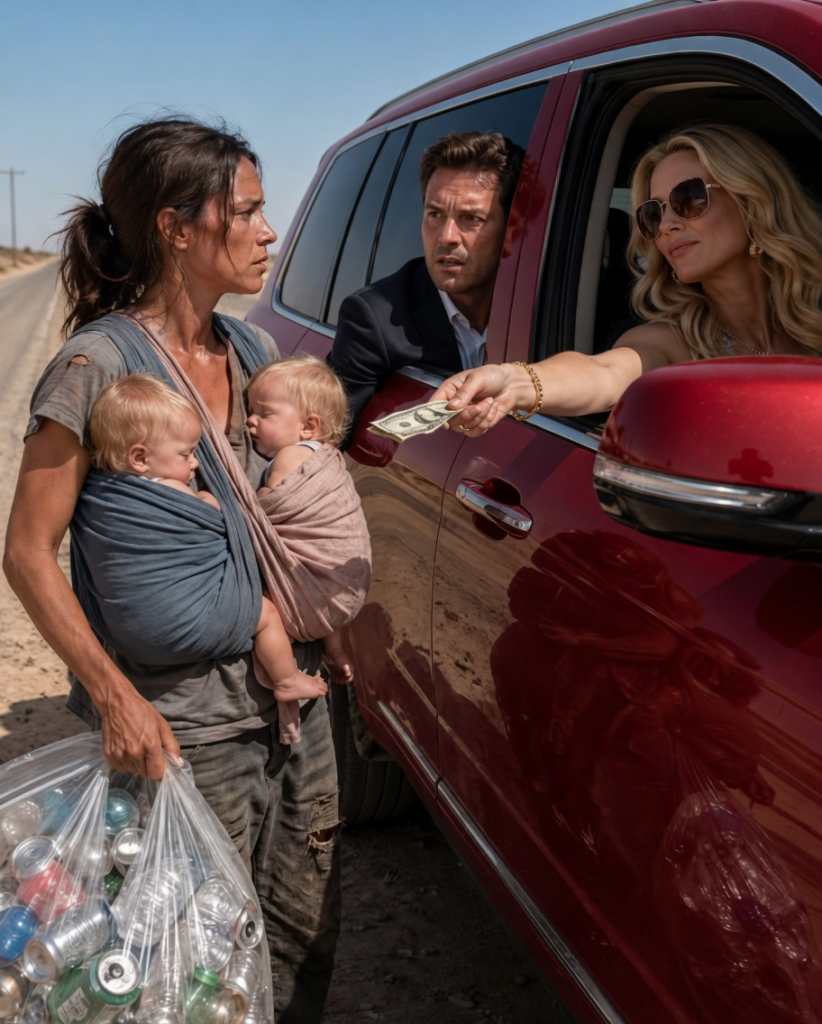
For the past two days, your investigators, attorneys, auditors, and security team have worked without sleep. You have not slept either. Every time you closed your eyes, you saw Carmen walking under the sun with two babies tied to her chest and a sack of crushed cans at her feet.
Your sons.
Your blood.
Your shame.
You lift your hand toward the giant screen behind you.
“Tonight,” you say, “I want to show you the truth.”
The lights dim.
The first image appears.
Two birth certificates.
Mateo Garza.
Leonardo Garza.
The room goes quiet in a different way now.
Not polite.
Hungry.
Confused.
Afraid.
You hear someone whisper, “Twins?”
Valeria stands halfway from her chair.
“Alejandro,” she says sharply.
You do not look at her.
“These are my sons,” you say. “Born premature in a rural clinic. Registered only under their mother’s last name because their father believed a lie and threw their pregnant mother into the street.”
Gasps ripple through the ballroom.
Your mother, seated near the front, covers her mouth with both hands. Your sister turns pale. Your uncle curses under his breath.
Valeria begins walking toward the stage.
You turn your eyes to her at last.
“Sit down.”
The words are quiet.
That is why they work.
She stops.
For the first time since you met her, Valeria looks unsure.
The screen changes.
Bank transfer records appear beside a technical report. Highlighted lines show cloned credentials, device fingerprints, and an IP trail linked to Valeria’s personal phone.
“These were the transfers Carmen was accused of making,” you say. “They were fake.”
The next slide.
Motel photographs.
Then the actor’s signed confession.
Then payment records.
“The affair was staged.”
Another slide.
The gold and emerald cross.
Then a video clip of the former head housekeeper, face blurred, voice shaking as she admits Valeria paid her to plant it among Carmen’s clothes.
“The theft was staged.”
The ballroom erupts.
People stand. Phones rise. Reporters push forward. Security holds the aisles.
Valeria screams something, but the sound disappears beneath the roar.
You do not raise your voice.
You do not need to.
You have learned the difference between rage and power.
The screen changes again.
Now Mauricio Elizondo appears.
Photographs of him with Valeria in the Polanco apartment.
Emails.
Encrypted messages.
Confidential documents.
Financial projections.
Strategic contracts stolen from your company.
“This,” you say, turning toward Mauricio, “was the real affair. And this was the real theft.”
Mauricio’s face drains of color.
His attorney, seated two tables behind him, rises so fast his chair falls backward.
Valeria runs toward the stage now.
Security intercepts her.
“You bastard!” she shrieks. “You can’t do this to me!”
You look at her as if seeing her clearly for the first time.
“No,” you say. “You did this to Carmen. I am only giving it witnesses.”
She thrashes against the guards.
“She lied to you! She was nothing before you!”
Your jaw tightens.
Nothing.
You think of Carmen’s cracked lips under the desert sun. Carmen covering the twins’ faces from dust. Carmen refusing to pick up the crumpled money Valeria threw at her feet.
“She was my wife,” you say. “And the mother of my children.”
Valeria laughs wildly.
“You don’t even know if those brats are yours.”
You expected that.
Your attorney steps onto the stage and hands you a document.
You lift it.
“DNA results. Ninety-nine point nine percent.”
The room goes dead silent.
Even Valeria stops moving.
Then your mother begins to cry.
Not softly.
A broken, public sound.
You almost look away.
But no.
Let everyone feel it.
For one year, Carmen carried your children alone because you were too proud to investigate before condemning her. For one year, your sons lived on powdered milk, donated clothes, and whatever their mother could earn from bottles and cans because you believed a woman with perfect hair and a venomous smile.
You look toward the reporters.
“All evidence has already been sent to the district attorney’s office, federal financial authorities, and my corporate legal team. Civil and criminal actions begin tonight.”
Mauricio starts walking toward the exit.
Two men in plain clothes step in front of him.
Not your men.
Authorities.
He freezes.
The ballroom explodes again.
Flashes.
Shouts.
Questions.
Valeria is crying now, but you recognize the performance. Tears have always been one of her weapons. Tonight they fall uselessly onto marble.
She points at you.
“You loved me.”
You stare at her.
“No,” you say. “I loved the lie you built.”
Then you step away from the microphone.
But before you leave the stage, you turn back.
“There is one more thing.”
The room quiets again, instantly.
You reach into your jacket and take out the engagement ring.
The diamond catches the spotlight.
For months, Valeria sent jewelers pictures of the ring she wanted. She thought tonight she would wear it. She thought every woman in Monterrey would envy her hand.
You hold the ring up.
“This was meant for Valeria.”
She lifts her chin, desperate for any remaining piece of dignity.
You close your fist around it.
“But it belongs to no woman who builds her happiness on another woman’s grave.”
You drop the ring into the champagne fountain.
The diamond vanishes beneath gold bubbles.
People gasp.
A reporter captures the exact moment Valeria’s face collapses.
By midnight, the video is everywhere.
But you are no longer in the ballroom.
You are in the back of a black SUV, driving toward the edge of the city with the investigator beside you and a security convoy behind. The gala is still burning behind you, but your mind is somewhere else.
A dirt road.
A sack of bottles.
Two sleeping babies.
Carmen.
The investigator, Ramírez, looks at you from the passenger seat.
“She may not want to see you.”
“I know.”
“She may hate you.”
“She should.”
He nods.
You look out the window at Monterrey’s lights fading into darkness.
“What if she refuses help?” he asks.
You swallow.
“Then I will make sure she has it without needing to forgive me.”
That is the first honest thing you have said all year.
The place where Carmen is staying is not a home.
It is a half-built room behind an old woman’s house near the highway, with a tin roof, a concrete floor, and one naked bulb hanging from a wire. Ramírez found it through the recycling route and the clinic records. A widow named Doña Elvira had let Carmen sleep there after finding her fainted with the twins in her arms.
Your SUV stops outside the gate.
The night is hot.
Dogs bark in the distance.
You step out, and suddenly every million you have ever earned feels obscene.
Doña Elvira opens the gate holding a broom like a weapon.
She is small, round, and furious.
“Who are you?”
Your throat tightens.
“Alejandro Garza.”
Her eyes sharpen.
Then she raises the broom and hits you across the shoulder.
Hard.
Security moves forward.
You lift a hand to stop them.
Doña Elvira hits you again.
“This is for leaving that woman in the street,” she says.
Another hit.
“This is for those babies.”
Another.
“And this is because rich men think apology is a car and flowers.”
You stand still and take it.
You deserve worse.
From inside the room, a baby begins to cry.
Then Carmen’s voice.
Tired.
Alert.
“Elvira?”
She steps into the doorway.
And the world stops again.
Carmen is thinner than you remember. Her face is sharper. Her eyes are older. She holds one baby against her shoulder while the other lies in a plastic laundry basket padded with folded blankets.
For one second, she looks at you as if you are a ghost.
Then her expression closes.
Not anger.
A door locking.
“What are you doing here?” she asks.
You open your mouth.
Nothing comes out.
All the speeches you rehearsed collapse.
I found the truth.
I am sorry.
They are my sons.
I will fix everything.
Every sentence sounds too small.
Carmen adjusts the baby on her shoulder.
“Did Valeria send you to finish the joke?”
You flinch.
“No.”
“Then leave.”
Her voice is quiet.
That hurts more than screaming.
You take one step forward.
Doña Elvira lifts the broom again.
You stop.
“Carmen,” you say. “I know.”
She stares at you.
“You know what?”
“Everything.”
The baby whimpers.
She rocks him automatically, with the exhausted rhythm of a mother who has soothed through hunger, heat, fear, and loneliness.
You feel your chest crack.
“I know Valeria framed you. I know about the fake transfers, the motel photos, the cross. I know she threatened you. I know Mateo and Leonardo are mine.”
Carmen’s face goes pale.
For a moment, the locked door inside her eyes opens just enough for pain to escape.
Then it shuts again.
“So now you know.”
You nod.
“I am sorry.”
She laughs.
Not loudly.
Not bitterly.
Worse.
Empty.
“Sorry?”
You lower your eyes.
“Yes.”
She steps outside barefoot onto the dirt.
“You threw me out while I was trying to tell you I was pregnant.”
Your eyes close.
“I know.”
“No, Alejandro. You do not know. You slept in clean sheets. I slept under bus station benches. You ate in restaurants. I vomited from hunger while carrying your children. You mourned your pride. I bled in a clinic where they almost died because my body had nothing left to give.”
Your breath shakes.
She keeps going.
“You know facts. You do not know.”
Every word is deserved.
Every word is a blade.
You stand there under the bare bulb, one of the richest men in northern Mexico, and feel smaller than the dust on your shoes.
“You’re right,” you whisper.
That surprises her.
You can see it.
The old Alejandro would have defended himself. Explained. Blamed Valeria. Claimed he was deceived. Asked for mercy because his pain was big too.
But you are done protecting yourself from the truth.
“I don’t know,” you say. “And I can never repay what I did.”
Carmen shifts the baby.
“Then why are you here?”
You look at your sons.
One is awake now, blinking up at the light. His tiny fist curls near Carmen’s collarbone. The other makes a soft sound from the basket.
Your voice breaks.
“To make sure you never have to pick up bottles again. To protect you from Valeria. To give them my name, if you allow it. To give you everything you should have had from the beginning.”
Her eyes harden.
“I don’t want your pity.”
“You won’t have it.”
“I don’t want to be bought.”
“I’m not here to buy forgiveness.”
“Then what do you want?”
The honest answer terrifies you.
You want to rewind time.
You want to kneel at her feet and wake up in your old bedroom with Carmen beside you, pregnant and safe, Valeria nothing but an ugly rumor you never believed.
You want your sons’ first breath.
Their first cry.
The first time Carmen needed you and you should have been there.
But those things are dead.
So you tell the truth.
“I want to spend the rest of my life being less unforgivable than I was.”
Carmen’s eyes fill, but no tears fall.
She has probably learned tears waste water.
“Pretty words,” she says.
“Yes.”
“You were always good at pretty words.”
You nod.
“I was.”
A long silence stretches between you.
Then Doña Elvira snorts.
“At least he admits that.”
Carmen almost smiles.
Almost.
You turn to Ramírez.
He brings forward a folder.
You do not hand it to Carmen directly. You place it on the small plastic table beside the doorway, like an offering she can reject.
“What is that?” she asks.
“Proof. Copies of everything. The evidence against Valeria and Mauricio. The DNA results. Temporary housing options in your name. A bank account set up for child support, controlled through your attorney, not me. And contact information for three lawyers. You can choose one, or choose another. I will pay, but they will work for you.”
Her eyes narrow.
“You brought lawyers?”
“I brought choices.”
She looks at the folder as if it might bite.
Good.
She should distrust anything from you.
“The boys need medical care,” you say. “A pediatric specialist is ready tomorrow morning, anywhere you choose. I can arrange transportation, or Doña Elvira can go with you.”
Carmen looks at her.
Doña Elvira crosses her arms.
“I’m going.”
You nod.
“Of course.”
The baby in Carmen’s arms begins to fuss. Without thinking, you take a half-step forward.
Carmen’s eyes flash.
You stop immediately.
“May I know which one?” you ask softly.
She looks down at the baby.
“This is Mateo.”
Your throat tightens.
Mateo.
Your son’s name enters you like a prayer and a punishment.
“And Leonardo?”
She glances toward the basket.
“Asleep.”
You look at him from where you stand. Tiny. Fragile. Alive despite everything.
“Thank you,” you whisper.
Carmen frowns.
“For what?”
“For keeping them alive when I failed all of you.”
Her face changes.
This time, a tear falls.
She wipes it angrily.
“I didn’t do it for you.”
“I know.”
She looks exhausted suddenly.
Not physically only.
Soul tired.
“Leave now,” she says.
Every part of you wants to stay.
So you leave.
That is the first decent thing you do.
By dawn, the scandal has swallowed Monterrey.
News anchors replay the gala footage every hour. Social media splits into camps, then collapses into horror as more evidence leaks. Valeria’s face becomes the symbol of betrayal. Mauricio’s company stock plunges. Grupo Garza’s board calls an emergency meeting.
You attend none of it.
Your attorneys handle the corporate war.
You sit in a hospital waiting room while Carmen and Doña Elvira take the twins inside with the pediatrician.
Not beside Carmen.
Not as her husband.
Not as a forgiven man.
Across the room.
Where she told you to sit.
You obey.
Your mother arrives halfway through the appointment.
She looks like she has aged ten years in one night. Her pearl earrings are mismatched. She never makes mistakes like that.
When she sees you, she slaps you.
The sound echoes through the waiting room.
You accept it.
Then she slaps you again.
“For Carmen,” she says.
Another.
“For my grandsons.”
Her voice breaks.
“And for raising a son stupid enough to believe diamonds over his wife.”
You close your eyes.
“I know, Mamá.”
“No,” she says. “You are only beginning to know.”
She sits two chairs away and cries into her handkerchief.
You do not comfort her.
You cannot.
A nurse comes out and calls Carmen’s name.
You stand on instinct.
Carmen turns and looks at you.
You sit back down.
Her expression softens by one invisible degree.
The doctor’s report is painful but not hopeless.
The twins are underweight, with anemia risk and respiratory vulnerability from premature birth, but treatable. They need nutrition, follow-up, vaccines, safe housing, and rest.
Safe housing.
The phrase sits in your chest like a stone.
Carmen listens to every instruction carefully. She asks about formula, fevers, sleep, breathing, weight gain. She does not ask you anything.
When payment comes, you step toward the desk.
Carmen’s hand rises.
“No.”
You stop.
She takes out a folded envelope from the folder you left her. A temporary legal authorization from her new attorney, allowing medical expenses to be paid from the child support account without direct contact with you.
You feel something like pride.
Not in yourself.
In her.
She found the safest way to accept what her sons needed without accepting you.
Good.
After the appointment, your mother approaches Carmen.
“Mi hija,” she whispers.
Carmen’s face tightens.
“I was your daughter when your son threw me out.”
Your mother begins to cry again.
“I believed him.”
“Yes.”
“I am ashamed.”
“You should be.”
The words are hard.
But Carmen’s voice is not cruel.
Your mother nods, accepting the blow.
“Can I see them?”
Carmen looks at the twins, then at the woman who once helped choose her wedding dress.
“Not today.”
Your mother’s face crumples.
“Okay.”
Carmen walks past both of you.
Doña Elvira follows, carrying the diaper bag like a general carrying a flag.
You watch them leave in the car arranged by the attorney.
For once, no one waits for you.
For once, the door closes in your face.
For once, you understand a fraction of what Carmen felt.
Valeria is arrested three days later.
Mauricio follows within the week.
The charges are messy: fraud, extortion, corporate espionage, falsified evidence, conspiracy, financial crimes. Her lawyers claim she is being framed. Mauricio claims their relationship was personal and unrelated to business. Both of them blame each other before the ink dries.
You watch none of the interviews.
You give statements only through counsel.
Every time someone asks if you feel vindicated, you want to break something.
Vindicated?
Carmen was homeless.
Your sons were hungry.
Your company may recover. Your reputation may recover. Your fortune may recover.
Some things should not recover too quickly.
You resign temporarily as public CEO and appoint a crisis board. Not because you are noble. Because you finally understand that a man who could be fooled so completely by his own ego should not pretend nothing happened.
Your board hates it.
Your lawyers advise against the wording.
You issue the statement anyway.
I failed my family. I failed to investigate before condemning an innocent woman. I will cooperate fully with all legal processes and prioritize the safety, health, and future of my children and their mother.
The public loves it.
You hate that.
Repentance should not be good branding.
Carmen moves into a small furnished house in a quiet neighborhood chosen by her attorney, not by you. The lease is in her name. Security is discreet. Medical care is scheduled. A nutritionist visits. The twins begin gaining weight.
You receive updates through lawyers.
Two ounces gained.
Vaccines completed.
Mateo sleeping better.
Leonardo still coughing at night.
You read each update like scripture.
You are allowed one supervised visit after three weeks.
Carmen’s lawyer sets the rules.
One hour.
Public family center.
No touching the children unless Carmen permits.
No discussion of reconciliation.
No gifts beyond approved supplies.
You arrive thirty minutes early.
You bring nothing flashy.
No diamond toys.
No designer blankets.
Just two boxes of diapers, formula approved by the doctor, and a small bag of cotton onesies.
Your hands shake in the parking lot.
Ramírez, now assigned to security rather than investigation, looks at you.
“You look like you’re meeting a firing squad.”
“I’d rather.”
He almost smiles.
Inside, Carmen is already there.
She sits in a chair with Mateo in her lap and Leonardo asleep in a stroller. She wears a simple blue dress. Her hair is clean, tied back. She looks stronger.
Still tired.
Still guarded.
But not defeated.
You stop a few feet away.
“Hello, Carmen.”
“Hello.”
Your eyes drop to Mateo.
He is awake.
Your son looks at you with serious gray eyes.
Your eyes.
You nearly fall apart.
Carmen watches you carefully.
“This is Mateo,” she says.
“I remember.”
She hesitates.
Then she turns him slightly.
“You can sit.”
You sit across from them.
Not too close.
Mateo stares at you.
You smile, and it feels like your face might crack.
“Hi, Mateo.”
He blinks.
That is all.
It is enough to destroy you.
Leonardo wakes after ten minutes and begins to cry. Carmen reaches for him, trying to balance both babies at once. For one second, your body moves before permission.
Then you stop.
Carmen notices.
A long moment passes.
Then she says, “You can hand me the bottle.”
You do.
Your fingers brush hers.
She pulls away immediately.
You deserve that too.
The hour is both too long and too short.
You learn Mateo hates being burped.
Leonardo grips Carmen’s finger when he sleeps.
They both like the same soft humming song, one Carmen says she learned from an old woman at the clinic.
Your sons have a history without you.
Small, fragile, precious.
And you missed all of it.
At the end of the visit, you ask, “May I hold one of them?”
Carmen’s face closes.
“No.”
You nod.
“Okay.”
You expected it.
It still hurts.
As she leaves, she turns back.
“Keep showing up,” she says.
Then she walks out.
You sit alone in the family center for twenty minutes after she leaves.
Because your knees will not work.
Months pass.
You show up.
Not as a husband.
Not as a hero.
As an appointment.
Tuesdays and Saturdays.
One hour becomes two.
Public center becomes Carmen’s lawyer’s office playroom.
Then a park, with security nearby.
The first time Mateo lets you hold him, he pulls your tie into his mouth and drools on imported silk.
You cry.
Carmen pretends not to see.
Leonardo is harder. He cries whenever you hold him for the first three visits. You hand him back each time without making Carmen comfort you for it.
Eventually, he falls asleep on your chest.
You do not move for forty-seven minutes.
Your arm goes numb.
You would have let it fall off.
Carmen watches from the bench.
Something unreadable moves across her face.
One day, she says, “You’re different with them than I expected.”
You look down at Leonardo.
“How?”
“Patient.”
The word feels like more grace than you deserve.
“I am trying not to mistake love for possession anymore,” you say.
She looks away.
The trial against Valeria becomes brutal.
Her defense attempts to paint Carmen as unstable, desperate, vengeful. That lasts exactly one morning.
Then the prosecution plays the threat message.
If you try to find him, or demand one peso using the bastards in your belly, the three of you will be found bagged in an empty lot.
Carmen is in the courtroom that day.
You asked her not to come.
She came anyway.
When the message is read aloud, the room goes cold.
Valeria sits at the defense table, face pale beneath perfect makeup.
Carmen does not look away.
That is the moment you understand she no longer needs anyone to rescue her from Valeria.
She only needs the world to see what she survived.
The housekeeper testifies.
The actor testifies.
The digital forensics expert testifies.
Mauricio’s assistant testifies after making a deal.
Each statement closes another door around Valeria.
When Carmen takes the stand, the entire room seems to hold its breath.
She speaks clearly.
She describes the night you threw her out. The guards. The suitcase with half her clothes. The way she tried to tell you she was pregnant and you turned your back.
You sit behind the prosecution, hands clasped so tightly your knuckles ache.
She does not exaggerate.
That makes it worse.
Truth needs no decoration.
Valeria’s lawyer asks, “Why didn’t you contact Mr. Garza later if the children were his?”
Carmen looks at Valeria.
“Because your client told me my babies would be murdered if I did.”
The lawyer shifts.
“But you had no proof at that time.”
Carmen turns back.
“I had two lives inside me. I chose caution over pride.”
No one breathes.
The questioning ends soon after.
Valeria is convicted on several charges. Mauricio on others. Appeals will come, money will fight, but the empire they built from lies is broken.
When the sentence is read, Valeria turns toward you.
Her face is twisted, mascara streaked.
“You ruined me,” she mouths.
You shake your head once.
No.
Carmen did not ruin her.
You did not ruin her.
Valeria reached for another woman’s life and cut her own hands open.
Outside court, reporters swarm.
This time, Carmen speaks.
Not you.
She stands with her lawyer beside her and the twins safe at home with Doña Elvira.
“I was called a thief, an adulteress, and worse,” she says into the microphones. “I was thrown away while pregnant. I survived because strangers showed me more mercy than the people who once called me family.”
Your mother, standing behind you, begins to cry quietly.
Carmen continues.
“I do not want pity. I want every woman listening to understand this: when someone with power destroys your name, stay alive long enough for the truth to find a voice.”
That clip becomes bigger than the gala.
This time, you are glad.
A year after you found Carmen on the roadside, your sons celebrate their first real birthday.
Not the date of their birth. Carmen says that day is too painful, too full of fear.
This is the anniversary of the day they moved into their safe little house.
A rebirth day.
There are balloons, cake, too many toys from your mother, and a backyard full of people Carmen chose carefully.
Doña Elvira sits like royalty in the shade.
Ramírez is there because the twins adore his mustache.
Your mother is allowed to attend now, but she follows Carmen’s rules with religious devotion. She brings food, asks before holding the boys, and never once calls them “my babies” without adding “if Carmen allows.”
You are allowed to arrive early and help set up.
That feels like a medal.
Carmen hands you a roll of tape and points to the banner.
“Crooked,” she says.
You look at it.
“It’s fine.”
“It’s crooked.”
You adjust it.
“Better?”
“Still crooked.”
You smile.
For one second, it feels almost like before.
Then both of you feel the danger of that thought and look away.
Healing is not a straight road.
Sometimes it circles old happiness and warns you not to confuse memory with repair.
During the party, Mateo takes three wobbly steps from Carmen toward you.
The yard erupts.
You freeze, terrified that moving will break the miracle.
Mateo falls into your knees.
You pick him up only after looking at Carmen.
She nods.
You lift him, laughing and crying at once.
Leonardo, offended by the attention, throws cake on the floor.
Everyone cheers louder.
That night, after guests leave, you help gather plates.
Carmen finds you in the kitchen washing plastic cups.
“You don’t have to do that,” she says.
“I know.”
She leans against the doorway.
“Your mother told me you sold the San Pedro house.”
You nod.
“I did.”
“Why?”
You rinse a cup slowly.
“Because every room in it remembers the night I failed you.”
She looks down.
“I hated that house.”
“I know.”
“You loved it.”
“I loved what I thought it meant.”
“What did it mean?”
You turn off the water.
“That I had won.”
Carmen’s eyes lift to yours.
“And now?”
You look toward the backyard where your sons are sleeping in portable cribs under Doña Elvira’s watchful eye.
“Now I think winning without wisdom is just a decorated trap.”
She studies you.
“You say things like a man trying very hard to be quoted.”
You laugh before you can stop yourself.
Then she laughs too.
Not much.
But enough.
The sound nearly breaks you.
Two years pass.
You and Carmen do not remarry.
People ask.
Reporters speculate.
Your mother prays.
You do not pressure her.
You have learned that love cannot be demanded from someone you once abandoned. Trust is not a debt she owes because you finally became decent. Fatherhood gives you responsibility, not rights over her heart.
Instead, you build a life around consistency.
School payments.
Medical support.
Security when needed.
Birthday mornings.
Doctor visits.
Custody agreements that expand slowly because Carmen sees you doing what you said you would do.
You learn how to pack diaper bags.
Then lunchboxes.
You learn Mateo likes bananas but hates banana yogurt, which makes no sense but is law.
You learn Leonardo gets quiet before he gets sick.
You learn not to call Carmen in panic.
You learn to ask: What do they need?
Not: How do I feel?
Carmen builds something too.
With the settlement, restitution, and your legally structured support, she starts a foundation for women falsely accused, abandoned, or financially trapped by powerful partners. She names it Rebozo.
You cry when you hear the name.
She does not ask why.
The foundation begins small.
Legal consultations.
Emergency housing.
Medical referrals.
Counseling.
Then it grows.
Because Carmen’s story has become a warning and a beacon.
Women come from Monterrey, Saltillo, Reynosa, Guadalajara.
Some arrive with bruises.
Some with lawsuits.
Some with nothing but children and a folder of messages.
Carmen meets each one with the same steady eyes she gave you on the roadside.
No pity.
No panic.
Just, “Sit. Start from the beginning.”
One afternoon, you arrive to pick up the boys and see Carmen in the courtyard speaking to a young woman with a baby. The woman is crying. Carmen is holding her hand.
For a moment, you cannot move.
The woman you left in the dust is now pulling others out of it.
That is grace.
Not for you.
For the world.
When Carmen sees you, she finishes the conversation and walks over.
“You’re early.”
“Traffic was light.”
“In Monterrey? Don’t lie.”
“I wanted to see the new office.”
She gives you a suspicious look.
“You donated the computers anonymously.”
You blink.
“How did you—”
“Please. You still use the same purchasing director.”
You look embarrassed.
“I didn’t want credit.”
“Good. You’re not getting any.”
You smile.
“Fair.”
She studies you for a moment.
Then she says, “Thank you.”
The words are simple.
They stay with you for days.
The twins turn four on a bright spring morning.
They are loud, wild, beautiful boys with Carmen’s stubbornness and your mother’s dramatic eyebrows. Mateo is fearless. Leonardo is observant. Together they are chaos in matching sneakers.
You host the party at a park, not a ballroom.
Carmen’s choice.
There are piñatas, sandwiches, fruit cups, and a cake shaped like a truck because both boys are obsessed with vehicles. Doña Elvira complains that the icing is too sweet while eating two slices.
Your mother chases the twins with napkins.
Ramírez stands near the grill, pretending he is not emotionally attached to two preschoolers who call him “Bigote.”
Carmen stands beside you under a tree.
Not close enough to touch.
Close enough to feel like peace.
Mateo runs up with a toy car.
“Papá, race!”
Papá.
The word still hits you every time.
You crouch and race him along the grass.
He wins because he cheats.
Leonardo announces this with great seriousness.
Carmen laughs.
You look up at her.
Sunlight moves through her hair. She looks older than the woman you married, younger than the woman you found on the roadside, and entirely herself.
You stand.
The boys run back toward the piñata.
For a while, you and Carmen watch them.
Then she says, “I don’t hate you anymore.”
The world seems to pause.
You turn slowly.
She keeps looking at the children.
“I thought I would forever,” she says. “And sometimes I wanted to. Hate was easier than grief.”
You say nothing.
“I don’t know if I can love you again.”
Your throat tightens.
“I know.”
“But I don’t hate you.”
Your eyes burn.
“That is more than I deserve.”
“Yes,” she says.
You almost laugh.
She looks at you then.
“I’m not saying this to comfort you.”
“I know.”
“I’m saying it because I’m tired of carrying you like a wound.”
You nod.
That may be the most honest gift she has ever given you.
Not forgiveness as romance.
Not reconciliation as reward.
Release.
For herself.
The party continues.
No music swells.
No dramatic kiss follows.
Real endings are rarely that simple.
But something shifts.
A weight leaves the air between you.
Months later, Carmen invites you to dinner.
At her house.
Not for the boys.
For a conversation.
You arrive with flowers, then leave them in the car because you panic that flowers are too much. Then you retrieve them because arriving empty-handed feels worse. At the door, Carmen sees your face and sighs.
“Just give me the flowers, Alejandro.”
You do.
She puts them in water.
Dinner is simple: chicken, rice, salad, tortillas. The boys eat too fast, argue about a dinosaur, spill juice, and are sent to wash their hands twice.
After they sleep, you and Carmen sit in the small courtyard.
No lawyers.
No supervised clock.
No cameras.
Just two people and all the ghosts between them.
She speaks first.
“I’ve been thinking about the boys.”
You nod.
“What about them?”
“They ask why we don’t live together.”
Your chest tightens.
“What do you tell them?”
“That adults make mistakes, and safety matters.”
You close your eyes briefly.
“That’s fair.”
“They love you.”
“I love them.”
“I know.”
She looks at you.
“I need them to see a father who respects boundaries. Not one who buys his way back in.”
You nod.
“I understand.”
“Do you?”
“Yes.”
She studies you for a long time.
Then she says, “I’m willing to try more family time. Dinners. Outings. Maybe vacations someday. Not marriage. Not promises. Just time.”
Your heart pounds.
You want to say yes too quickly.
Instead, you breathe.
“I would be grateful for that.”
She smiles faintly.
“Grateful looks better on you than powerful.”
You laugh softly.
“It feels heavier.”
“It should.”
The first family dinner becomes two.
Then weekend breakfasts.
Then trips to the zoo.
Then one summer beach trip where Mateo gets sand in everyone’s shoes and Leonardo decides the ocean is suspicious.
You and Carmen do not become what you were.
That marriage died the night you did not believe her.
But something else grows.
Not from innocence.
From truth.
It is slower.
Less glamorous.
Stronger in different places.
One evening, at the beach, the boys fall asleep early after a day of sun and waves. You and Carmen sit on the balcony listening to the water.
She holds a mug of tea.
You hold nothing because your hands are nervous.
She notices.
“You look like you’re about to confess to another crime.”
You smile sadly.
“No. Just thinking.”
“Dangerous.”
You nod.
“I used to think love meant certainty. That if I loved someone, I would know. I would protect them. I would never be fooled.”
Carmen looks at the sea.
“And then?”
“Then I learned ego can sound like certainty.”
She says nothing.
“I didn’t protect you because I was protecting my pride.”
The waves move in the dark.
Carmen’s voice is quiet.
“I know.”
“I will be sorry for that until I die.”
“I know that too.”
You turn to her.
“Is that enough?”
She looks at you for a long time.
“No.”
Your chest tightens.
Then she continues.
“But enough isn’t always the point. Some things can’t be balanced. They can only be carried differently.”
You absorb that.
Carried differently.
Not erased.
Not repaid.
Not magically forgiven.
Carried.
Together, sometimes.
Apart, sometimes.
Honestly, finally.
Years later, people still tell the story wrong.
They say you exposed Valeria at a gala and won Carmen back.
They say the poor wife became rich again.
They say the villain went to prison, the husband repented, and the family was restored.
People love clean endings because they do not have to sit with the mess.
The truth is harder.
You did expose Valeria.
Carmen did survive.
Your sons did become healthy, loud, impossible little boys who filled every room with life.
But Carmen was not a prize returned to her rightful owner.
She was a woman who rebuilt herself from dust, hunger, fear, and betrayal. If she allowed you near her again, it was not because your apology healed the wound. It was because your actions, repeated over years, stopped reopening it.
And you?
You never became the hero.
You became accountable.
That is less glamorous.
It is also the only thing that saved you.
On the twins’ seventh birthday, Carmen hosts a gathering at the Rebozo foundation courtyard. Women and children fill the space. There is food, music, laughter, and a wall painted with bright colors where the boys have proudly added handprints.
Mateo runs toward you with frosting on his shirt.
Leonardo follows carrying a book he insists you must read immediately.
Carmen watches from across the courtyard, speaking to Doña Elvira and your mother.
Your mother has changed too.
She volunteers twice a week now, mostly folding donated clothes and crying with strangers.
Valeria’s name is rarely spoken anymore.
Mauricio’s empire never fully recovered.
Grupo Garza did.
But different.
You created an internal ethics office, not because it looks good, but because you learned too late that unchecked power makes lies easier to believe.
At sunset, Carmen joins you near the mural.
The boys are playing nearby.
She looks at their handprints.
“They’re happy,” she says.
“Yes.”
“They know they’re loved.”
“Yes.”
She turns to you.
“That matters more than what happened before.”
You swallow.
“I hope so.”
She reaches out and takes your hand.
Not dramatically.
Not like a movie.
Just her fingers resting over yours for one quiet moment.
You do not move.
You barely breathe.
Then she lets go.
“Don’t look so shocked,” she says.
“I’m trying not to.”
“You’re failing.”
You laugh.
She smiles.
It is not the smile from your first marriage.
It is older.
Wiser.
Earned.
You would not trade it.
Later, after the party ends and the boys fall asleep in the back seat of Carmen’s car, she stands beside you under the streetlight.
“You can come for breakfast Sunday,” she says.
“With the boys?”
“With us.”
The word lands softly.
Us.
Not a promise.
Not a return.
A doorway.
You nod.
“I’ll bring bread.”
“Bring the good one. Not the dry expensive one you like.”
You smile.
“Yes, Carmen.”
She gets into the car.
Before she drives away, Mateo rolls down the window and shouts, “Papá! Don’t be late!”
Leonardo adds, “And bring chocolate bread!”
You laugh.
“I will.”
The car pulls away.
You stand there until the taillights disappear.
Years ago, you watched Carmen become smaller in your rearview mirror as she walked down a highway carrying your sons and a sack of bottles. That image will never leave you. It should not.
Tonight, you watch her drive away safe, strong, and free.
Not because you rescued her.
Because she survived you.
You look up at the dark sky over Monterrey.
The city glitters like it did the night of the gala, but you are no longer impressed by lights. You have seen how darkness hides behind chandeliers. You have seen how truth can walk barefoot beside a highway and still be more powerful than every diamond in a ballroom.
You get into your car and sit for a moment before starting the engine.
On the passenger seat is a drawing Mateo gave you.
Four stick figures.
Mamá.
Papá.
Mateo.
Leo.
Above them, in uneven letters, he wrote:
Family day.
Your eyes fill.
You place the drawing carefully in a folder, not because it is evidence, but because it is proof.
Not that everything was fixed.
Not that the past disappeared.
Proof that something living can still grow from ground someone tried to poison.
Sunday morning, you arrive early.
Not too early.
Carmen hates that.
You bring chocolate bread, fresh fruit, and the humility to knock instead of walking in.
The door opens.
Carmen stands there with flour on her cheek and a suspicious look.
“You remembered.”
“I was warned.”
Behind her, the boys shout your name.
The house smells like coffee, pancakes, and noise.
Carmen steps aside.
You enter slowly.
Not as the man who owns the room.
Not as the husband returning to his place.
As someone invited.
That difference is everything.
And when the door closes behind you, you understand the final truth.
You did not get your old life back.
You got something more difficult.
A chance to become worthy of the new one.