THE BASEMENT THAT SHOULD NEVER HAVE BEEN LOCKED: A GRANDPARENT’S VISIT THAT SHOOK AN ENTIRE TEXAS COMMUNITY
The house on the edge of Austin, Texas, looked like any ordinary suburban home, yet beneath its calm exterior something deeply unsettling was beginning to unravel in ways no one could have imagined.
Inside that silence lived a story that would soon ignite outrage, fear, and heated debates across social media platforms, as neighbors and strangers tried to understand how something so hidden could remain unnoticed.
For three weeks, a grandfather had not seen his grandson, and each passing day transformed concern into suspicion, and suspicion into a desperate urgency that he could no longer ignore or rationalize away.
He told himself at first that children grow distant, that schedules change, and that modern families sometimes drift apart without warning, but his instincts refused to accept such a comfortable explanation.
The house itself seemed to resist his approach as he arrived unannounced, its driveway scattered with dry leaves that scraped across concrete like whispers of something long forgotten or deliberately ignored.
A dusty pickup truck sat still under a thick layer of grime, as if time itself had stopped caring about what happened around it, while the air carried a strange sour undertone.
That smell did not belong to any ordinary household routine, nor did it resemble the comforting scent of laundry or cooking that once defined visits to this same home.
Instead, it felt like a warning that something had been hidden away, something that had been allowed to decay in silence while life continued pretending nothing was wrong.
He stood at the front steps, remembering how his grandson used to run toward him with laughter, filling the porch with energy that once made every visit feel alive and meaningful.
Those memories clashed violently with the present stillness, creating a psychological tension that made every second at the door feel heavier than the last, as if the house itself was watching him.
When he knocked, there was no immediate response, only a hollow silence that seemed to stretch unnaturally long, as though the building was deciding whether to reveal its secrets or keep them buried.
He waited again, listening to the faint hum of appliances inside, each sound amplified by the absence of human voices that should have filled the space with normal domestic life.
Eventually, he used a spare key he had been given months earlier, a gesture once meant to symbolize trust and family connection, now transformed into something far more uncertain and disturbing.
The door opened with a soft click that felt too easy, too unguarded for a home that seemed so reluctant to welcome him inside its atmosphere of quiet tension.
He stepped into the hallway and immediately sensed that something was wrong in a way that could not be explained by simple neglect or temporary absence.
The living room appeared untouched in structure but drained of warmth, as if someone had carefully removed all signs of daily living without disturbing the physical arrangement of furniture.
Dust softened the edges of familiar objects, muting photographs that once captured laughter and milestones, now reduced to faded reminders of a family that seemed suspended in time.
He called out his grandson’s name, expecting at least an echo of recognition, but only silence answered him, pressing against his ears like a heavy and uncomfortable pressure.
Each room he passed told the same story, not of chaos, but of absence, as though life had quietly stepped out without informing anyone of its departure.
The kitchen counter held unopened envelopes and expired milk, small details that together formed a pattern too deliberate to be dismissed as mere oversight or busy schedules.
It was not a messy home, nor an abandoned one in the traditional sense, but something more unsettling, a place where presence had been selectively erased.
That realization made his chest tighten as he moved deeper into the hallway, where the air grew colder and the silence felt more concentrated and intentional.
Then he heard it, a faint scraping sound beneath the floor, irregular yet persistent, as if something or someone was trying to communicate from a hidden space below.
He stopped immediately, every instinct in his body focusing on that sound, which seemed to come from somewhere beneath the structure of the house itself.
The sound repeated again, slower this time, followed by a pause that suggested exhaustion or hesitation from whatever was producing it in the darkness below.
He followed it carefully, step by step, until he reached a door at the end of the hallway that looked newer than the rest of the house’s interior structure.
The lock on that door was not decorative or casual, but heavy, industrial, and installed with visible urgency that suggested it had been added under unusual circumstances.
Fresh wood surrounded the latch, and uneven screws hinted that whoever installed it had not prioritized aesthetics, but rather containment and restriction above all else.
A wave of unease passed through him as he placed his hand against the surface, feeling a faint vibration that confirmed something was indeed moving on the other side.
He hesitated for only a moment before calling out again, his voice lower now, shaped by fear he was struggling to suppress in order to remain functional.
From behind the door came a voice, weak and broken, yet unmistakably familiar, calling out a name that shattered every remaining assumption he had tried to hold together.
His grandson was alive, but frightened, and that realization transformed everything he thought he knew about the situation into something far more urgent and alarming.
He immediately reached for his phone, dialing emergency services with hands that struggled to remain steady while explaining the situation in fragments of clarity and disbelief.
The dispatcher’s questions felt distant as adrenaline narrowed his focus to the door, the lock, and the faint sounds coming from within the space below.
Every second waiting for help felt stretched beyond normal time, as if the house itself was amplifying delay into something unbearable and emotionally suffocating.
He searched for tools inside the house, moving with a calmness that surprised even himself, as panic threatened to rise but was forced down by determination.
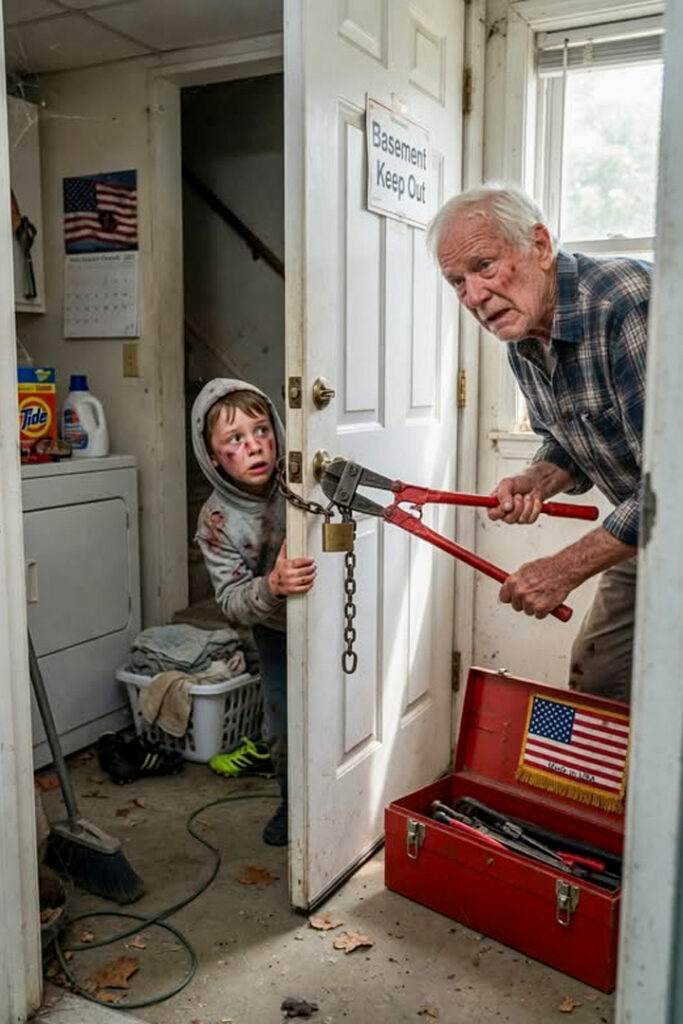
He returned to the locked door with a set of bolt cutters, their weight grounding him in a reality that felt increasingly unreal and emotionally overwhelming.
He told the voice behind the door to move back, trying to maintain clarity even as his hands trembled under the pressure of what was about to happen.
The metal lock resisted at first, groaning under force, as the house seemed to hold its breath in anticipation of a truth it had long concealed.
Then, with a sharp break, the lock gave way, echoing through the hallway like a signal that something irreversible had finally begun to unfold.
For a brief moment, there was only silence, deeper than before, as if even the air refused to move in response to what had just occurred.
He opened the door slowly, expecting confusion, fear, or relief, but nothing could have prepared him for the emotional weight of what lay beyond the threshold.
The basement revealed a space that should have never been hidden in such a manner, and what he saw there would later divide opinions across entire communities.
What followed was not just a personal family crisis, but a public storm of speculation, outrage, and debate that spread rapidly across social platforms and local news channels.
Neighbors began to question what they had missed, whether signs had been ignored, and how a situation of this magnitude could remain concealed for so long.
Some demanded accountability from those involved, while others urged caution, insisting that conclusions should not be drawn without full investigation and verified facts.
Online discussions erupted within hours, turning the story into a viral topic that fueled emotional reactions, conflicting interpretations, and intense public scrutiny.
Hashtags began circulating, each one attempting to frame the narrative in ways that reflected outrage, sympathy, or suspicion depending on the perspective of those sharing it.
The grandfather, once an ordinary retiree, now found himself at the center of a conversation far larger than his personal experience, unable to escape the attention.
Authorities moved quickly to secure the scene, gathering information and beginning the complex process of reconstructing events that had led to such a disturbing discovery.
Questions multiplied faster than answers, and every new detail seemed to generate even more uncertainty about what had truly been happening inside that house.
The community reacted with shock, as residents struggled to reconcile the image of a normal neighborhood with the reality that had suddenly been exposed.
In the days that followed, discussions continued to intensify, shifting between outrage, grief, confusion, and demands for systemic reflection on overlooked warning signs.
For many, the story became a symbol of how easily silence can conceal suffering, and how trust within families can sometimes mask deeper and darker realities.
Yet even as the public debated, the emotional weight of the discovery remained deeply personal for those directly involved, especially the grandfather who had opened that locked door.
He was left grappling not only with what he had seen, but with the realization that instinct had brought him there just in time.
And as the story continued to spread, it became clear that its impact would not fade quickly, but instead linger in public memory as a case that demanded answers, reflection, and accountability.
Police officers descended the basement stairs with flashlights raised, but even trained professionals paused when the smell and silence wrapped around them like something alive and deeply unnatural.
One officer covered his mouth immediately, while another turned away for a second, visibly shaken by the scene waiting below the weak yellow basement light.
The room was not filthy in the way abandoned places usually become filthy, because someone had clearly been entering regularly and controlling exactly what remained inside.
A thin mattress rested against one wall beside empty food containers, stained blankets, and plastic water bottles scattered across damp concrete floors that smelled of mold and isolation.
Dylan sat curled in the far corner, his face pale and hollow, shielding his eyes from the sudden brightness as if daylight itself had become unfamiliar to him.
The sight destroyed something inside his grandfather instantly, because this was not simply fear or neglect anymore, but evidence of prolonged suffering hidden beneath an ordinary family home.
One paramedic later admitted anonymously that the child’s expression haunted him more than the basement itself, because Dylan looked relieved and terrified at exactly the same time.
That contradiction became one of the most discussed details online after local reports leaked information from emergency responders involved in the rescue operation that afternoon.
People across the country reacted emotionally, many demanding immediate arrests while others argued that the public still lacked enough information to fully understand what had happened.
Some users accused authorities of responding too slowly, while others blamed neighbors for not reporting strange activity sooner despite obvious warning signs surrounding the house.
The debate intensified when investigators confirmed that the basement lock had been installed only weeks earlier, suggesting deliberate planning rather than a spontaneous emotional breakdown inside the household.
Questions exploded everywhere online.
Why had the school not intervened sooner after repeated absences?
Why had extended family members accepted excuses for so long?
Why had no social worker visited the property despite complaints from nearby residents?
The story transformed from one family tragedy into a national conversation about hidden abuse, emotional isolation, and how easily modern communities ignore uncomfortable suspicions until disaster becomes unavoidable.
Television commentators argued fiercely about parental accountability, while psychologists appearing on podcasts discussed manipulation tactics often used to isolate vulnerable children from outside contact.
Meanwhile, Dylan’s grandfather became an unexpected symbol online for trusting intuition instead of remaining politely silent when something felt deeply wrong within his own family.
Thousands praised his decision to visit unannounced, claiming that instinct and persistence may have saved the child’s life before the situation became even more catastrophic.
Others questioned whether warning signs had existed long before those three weeks, asking painful questions about how grief can sometimes blind families to dangerous transformations happening around them.
As investigators continued searching the property, another disturbing detail emerged that sent fresh waves of outrage through social media discussions late that evening.
Neighbors revealed that vehicles had frequently stopped outside the house after midnight, often remaining only a few minutes before disappearing quietly back into darkness without explanation.
That revelation triggered widespread speculation online, with theories spreading rapidly across forums, livestreams, and reaction channels that dissected every publicly available detail surrounding the investigation.
Authorities refused to confirm rumors circulating online, but their silence only fueled more discussion, causing hashtags connected to the case to trend nationally within twenty-four hours.
Outside the house, reporters crowded sidewalks while neighbors watched nervously through curtains, suddenly realizing the terrifying story had unfolded directly beside their everyday routines.
The grandfather avoided cameras completely.
Friends later said he blamed himself endlessly for not visiting sooner, replaying every ignored instinct and every reassuring lie that had delayed his decision to drive there that day.
At the hospital, Dylan reportedly refused to let go of his grandfather’s sleeve for hours, panicking whenever medical staff attempted to separate them, even briefly, for examinations or treatment.
That heartbreaking detail spread rapidly online after a nurse anonymously described the scene, triggering emotional reactions from millions of strangers following the developing case across multiple platforms.
Many readers admitted they cried imagining the child’s fear during those weeks hidden beneath the same roof where ordinary family life once existed above him every single day.
And perhaps that was the most horrifying part for so many people.
Not the basement itself.
Not the lock.
Not even the smell.
But the unbearable realization that unimaginable suffering can exist quietly beneath ordinary lives while the outside world continues driving past without ever truly noticing anything wrong.