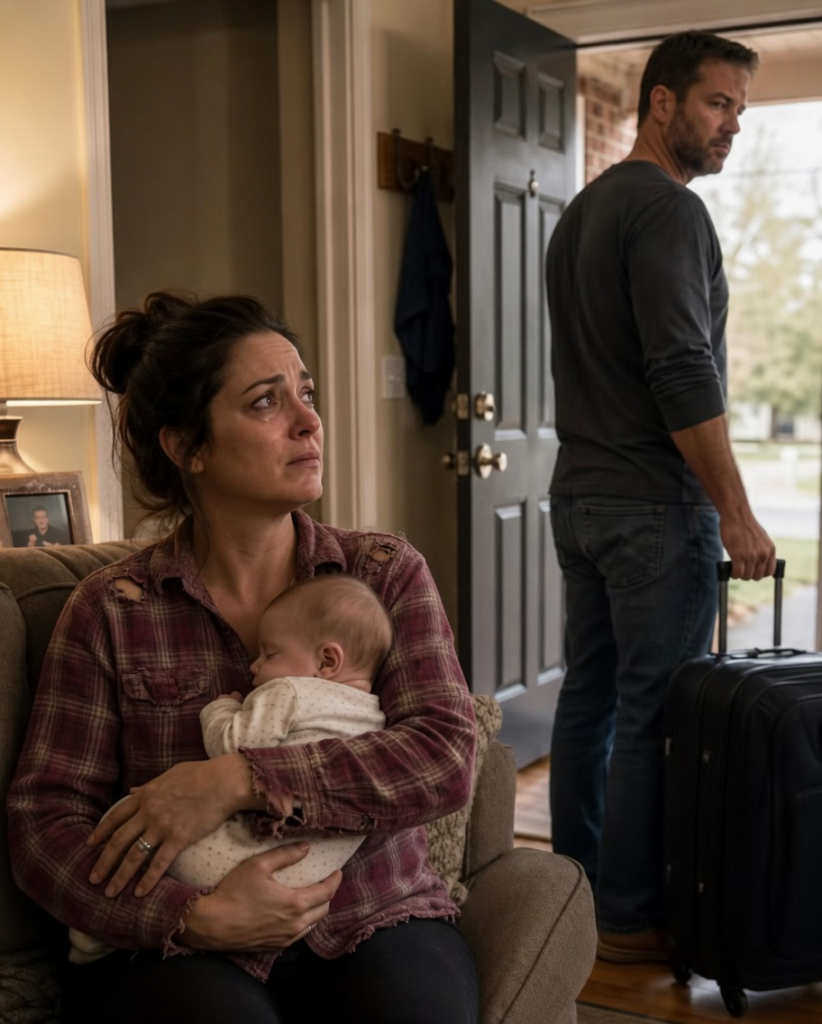
“I’ll send money.”
That was the last sentence Andrés gave you before walking out of the life you had built together.
Not “I’m sorry.” Not “Tell my son I love him.” Not even “I’ll come back to see him.” Just money, as if a wire transfer could replace a father’s hand on a feverish forehead, a bedtime story, or the weight of a baby falling asleep against his chest.
You stayed sitting on the sofa long after the door closed.
Mateo slept in your arms, his tiny mouth open, one fist pressed against your nightgown. The apartment was silent except for his breathing and the refrigerator humming in the kitchen. You looked down at your son and realized that your marriage had ended, but your real life had just begun.
At first, you thought Andrés would come back.
Not to you, maybe, but to Mateo. You thought guilt would wake him at night. You thought one photo, one fever, one birthday candle would remind him that a man could leave a wife, but not a child.
You were wrong.
He sent money for three months.
Then less.
Then late.
Then nothing.
When you called, he said he was “reorganizing his finances.” When you messaged, he left you on read. When Mateo turned one, Andrés sent a stuffed bear with the store tag still attached and no card.
By then, the girl had moved into his new apartment.
Her name was Valeria.
You hated that you knew it.
She posted photos online like she had won a prize: Andrés holding her waist at restaurants, Andrés kissing her forehead on beaches, Andrés smiling in a way he hadn’t smiled at you in years. Under one photo, she wrote, “Real love doesn’t care about age.”
You stared at that sentence until your eyes burned.
Real love.
You wanted to comment that real love did not leave a newborn behind. Real love did not call fatherhood “this life” like it was a prison sentence. Real love did not use youth as an excuse for cruelty.
But you didn’t write anything.
You had a baby to feed.
So you worked.
You had once been a literature teacher before your pregnancy became complicated. After Andrés left, you took every job you could find. You tutored children after school, corrected essays at night, translated documents for small businesses, and baked banana bread to sell to neighbors on weekends.
You learned how to stretch one chicken breast into three meals.
You learned which pharmacy had the cheapest fever medicine.
You learned to cry silently in the bathroom with the faucet running so Mateo wouldn’t hear you.
But children notice more than adults think.
When Mateo was three, he found you sitting on the kitchen floor one night, holding an overdue bill in your hand. He walked over in his little dinosaur pajamas and placed his toy car in your lap.
“For you, Mommy,” he said.
You looked at that little red car and broke.
Not loudly.
Just enough for him to climb into your arms and pat your cheek like he was the one comforting you.
That was the night you made yourself a promise.
Your son would never grow up believing abandonment was stronger than love.
You could not give him a perfect family.
But you could give him truth, effort, and a home where nobody made him feel like a burden.
Years passed like that.
Hard years.
Beautiful years.
Mateo grew into a quiet boy with serious eyes and a habit of asking questions that made adults uncomfortable. He wanted to know why the moon followed the car. Why old people walked slower. Why some fathers picked their kids up from school and others didn’t.
You never lied to him.
You softened the truth, but you did not decorate it.
“Your father chose to live somewhere else,” you told him when he was old enough to ask directly. “That choice was his. It was not because of you.”
Mateo listened carefully.
Then he asked, “Did he see me?”
Your throat tightened.
“When you were born, yes.”
“Did he hold me?”
You remembered Andrés standing beside the hospital bed, hands in his pockets, looking at his son like he was afraid touch would create responsibility.
“No,” you whispered.
Mateo nodded once.
He didn’t cry.
That worried you more than tears would have.
After that, he stopped asking about Andrés for a while.
But he started keeping things.
Report cards. Certificates. Drawings. Little awards from school. Anything that proved he had done well, he placed in a blue folder under his bed. One evening, when he was seven, you found him arranging the papers carefully.
“What are you doing?” you asked.
He looked up, embarrassed.
“Nothing.”
You sat beside him.
“Mateo.”
He hesitated.
Then he said, “If he ever comes, I want him to know I wasn’t a bad kid.”
Your heart cracked so cleanly you almost heard it.
You pulled him into your arms.
“My love, he didn’t leave because you were bad.”
“I know,” he said.
But his voice told you he didn’t.
That is the cruelty of an absent parent.
They leave the room, but their shadow raises the child.
You fought that shadow every day.
You showed up for school plays, even when you had to bring translation work in your purse. You clapped the loudest at spelling bees. You learned enough math to help with homework, even though numbers had always made you nervous.
When Mateo got sick, you sat awake all night counting his breaths.
When he won his first science fair, you took him for pizza even though you only had enough money for one medium pie.
When he cried because another boy said, “At least my dad wanted me,” you didn’t tell him to be strong. You held him while he cried, then whispered, “You were wanted by me with my whole life.”
That sentence became your family prayer.
You were wanted by me with my whole life.
Meanwhile, Andrés changed too.
Not for the better.
His relationship with Valeria became public, then messy, then ridiculous. They posted luxury trips, then vague quotes about betrayal, then photos where they seemed to be competing for attention more than loving each other.
He started a business selling imported furniture and failed within two years.
Then he entered real estate.
Then cryptocurrency.
Then private consulting.
Every few years, he reinvented himself as a successful man.
But success that needs constant announcement is usually bleeding somewhere underneath.
You only knew these things because people told you.
Your cousin sent screenshots. A former neighbor whispered updates at the market. Once, Mateo’s teacher mentioned she had seen Andrés at a charity event with a much younger woman and then turned red when she realized who she was talking to.
You learned to smile politely.
“That’s his life,” you would say.
And you meant it.
Mostly.
The hardest moment came when Mateo turned ten.
He had a school ceremony for academic excellence. You wore your best dress, the navy one you had altered twice because you couldn’t afford a new one. Mateo wore a white shirt and stood onstage holding a certificate almost bigger than his chest.
After the ceremony, he looked around the crowd.
Not obviously.
Just a little.
But you knew.
Every child with an absent parent becomes an expert at searching doorways.
“Are you okay?” you asked afterward.
He smiled too quickly.
“Yes.”
You took him for ice cream.
He ate silently for a few minutes, then said, “Do you think he knows I’m smart?”
You set down your spoon.
“I don’t know.”
“Would he care?”
That question was a knife.
You could have lied.
You wanted to lie.
Instead, you said, “He should.”
Mateo looked at you.
“But does he?”
You reached across the table and held his hand.
“Some people don’t know how to value what is precious. That doesn’t make the precious thing worth less.”
He looked down at his melting ice cream.
Then he whispered, “I don’t want to be like him.”
You squeezed his hand.
“You won’t be.”
From that day on, Mateo became relentless.
He studied like hunger lived inside him. He read books from the public library until the librarian knew him by name. He taught himself English from videos and old grammar books. He entered competitions, won scholarships, and turned every “no” into fuel.
But he was not cold.
That was what amazed you.
He became strong without becoming cruel.
He helped classmates who struggled. He carried groceries for the elderly woman downstairs. He once gave his winter jacket to a boy at school and came home pretending he had “forgotten” it somewhere.
You knew better.
“Mateo,” you said, holding up his bare arms.
He shrugged.
“He needed it more.”
“You need one too.”
“I have sweaters.”
You stared at him.
He smiled, and in that smile you saw all the nights you had chosen kindness when bitterness would have been easier.
Maybe love really had won something.
When Mateo was thirteen, Andrés called.
After thirteen years.
You were washing dishes when the unknown number appeared. You almost ignored it, but something made you answer.
“Hello?”
There was a pause.
Then a voice you had spent years forgetting said, “Lucía?”
Your hand tightened around the phone.
Andrés sounded older, but not humble.
Never humble.
“What do you want?” you asked.
He sighed, as if you were already being difficult.
“I heard Mateo is doing well.”
You looked toward the living room, where Mateo was studying with headphones on.
“He is.”
“I’d like to see him.”
The glass in your hand slipped into the sink and cracked.
You stared at it.
Thirteen years of silence, and now he wanted access like he had misplaced a key.
“Why?”
“He’s my son.”
You almost laughed.
“No. He is your child. Being a father requires presence.”
Andrés grew irritated.
“Don’t start with that. I sent money.”
“For three months.”
“I was young.”
“You were forty-three.”
Silence.
Then he said the thing that told you everything.
“Listen, I’m trying to clean up my image. People ask why I never mention my son. It looks bad.”
There it was.
Not regret.
Not love.
Public relations.
You leaned against the counter and closed your eyes.
“Do not call again unless Mateo asks for you.”
Andrés lowered his voice.
“You can’t keep my son from me.”
You opened your eyes.
“I didn’t. You left him from yourself.”
Then you hung up.
That night, you told Mateo.
He listened without expression.
When you finished, he asked, “Did he ask what I like?”
You swallowed.
“No.”
“Did he ask if I’m happy?”
“No.”
“Did he say sorry?”
You couldn’t answer.
Mateo nodded.
“Then I don’t need to see him.”
You waited.
“Are you sure?”
He looked at you with eyes too old for thirteen.
“I wanted a father. Not an audience.”
You had never been prouder of him.
Still, Andrés did not disappear completely after that.
He sent birthday messages that sounded copied from the internet. He liked photos of Mateo that relatives posted. He tried to follow your son online, but Mateo declined the request.
Then, suddenly, Andrés began mentioning “my brilliant son” in public.
He posted vague statements about fatherhood.
He told old acquaintances that divorce had “complicated things” but that he had always loved Mateo from a distance.
From a distance.
As if neglect were a noble hilltop.
You wanted to scream.
Instead, you saved screenshots.
Not because you wanted revenge.
Because life had taught you that men like Andrés rewrite history the moment no one guards the truth.
When Mateo was fifteen, the letter arrived.
It came from one of the most prestigious academic programs in the country, a selective preparatory academy connected to an international university track. Mateo had applied without telling you, using scholarship essays he wrote after you fell asleep.
You found him standing frozen by the mailbox, envelope in his hand.
“What is it?” you asked.
He opened his mouth, but no sound came out.
You took the letter gently.
Accepted.
Full scholarship.
Ceremony of admission scheduled for next month.
You read the words once.
Then again.
Then your knees nearly gave out.
Mateo caught you.
“Mom?”
You started laughing and crying at the same time.
“My son,” you whispered. “My son.”
He hugged you so tightly you could feel him shaking.
For one perfect moment, there was no Andrés, no abandonment, no bills, no years of fear.
There was only the boy you had carried at forty-one becoming something even bigger than hope.
The ceremony was held in a grand auditorium with polished wood floors and banners hanging from the ceiling. Families arrived dressed beautifully, holding flowers, cameras, and pride. You wore the cream blouse Mateo loved because he said it made you look “like a president who reads poetry.”
You laughed when he said that.
But you wore it.
Mateo looked handsome in his dark suit. Taller than you now. Serious, nervous, trying not to show it. You adjusted his tie before entering the auditorium.
“You’re choking me,” he said.
“I’m fixing you.”
“I’m already fixed.”
“No child is fully fixed before a ceremony.”
He smiled.
That smile made every sacrifice worth it.
Then you saw Andrés.
He stood near the entrance, wearing a tailored suit and the same expensive cologne he had worn the day Mateo was born. His hair was grayer now, his face fuller, but his posture still carried that old arrogance.
Beside him stood Valeria.
No longer eighteen.
Now thirty-three, polished and tense, holding the hand of a little girl around six years old. Andrés’ daughter, you guessed. The child looked bored and sweet and innocent of all adult sins.
Your stomach tightened.
Mateo saw him too.
His face did not change.
That scared you.
Andrés approached with a smile too wide to be honest.
“Lucía,” he said, as if you were old friends meeting at a reunion.
You nodded once.
“Andrés.”
His eyes shifted to Mateo.
For one second, something like surprise crossed his face.
Maybe he had expected the baby he abandoned to remain small forever. Maybe seeing Mateo tall, composed, and brilliant made the years he missed stand up between them like witnesses.
“Son,” Andrés said, opening his arms slightly.
Mateo did not move.
“Hello, Andrés.”
Not Dad.
Not Father.
Andrés’ smile stiffened.
Valeria looked uncomfortable.
The little girl stared at Mateo with open curiosity.
“I wouldn’t miss this,” Andrés said.
Mateo tilted his head.
“But you did.”
The words were soft.
No anger.
That made them sharper.
Andrés cleared his throat.
“I know I wasn’t always around.”
Mateo looked at him.
“You were never around.”
People nearby began glancing over.
You touched Mateo’s arm gently.
Not to silence him.
Just to remind him he was not alone.
Andrés lowered his voice.
“Today isn’t the time for bitterness.”
Mateo’s eyes hardened.
“You’re right. Today is about work.”
Andrés smiled again, trying to recover.
“Exactly. And I’m proud of you.”
Mateo held his gaze.
“You don’t know me well enough to be proud of me.”
That was the first crack.
Andrés’ face flushed.
Valeria looked down.
The little girl squeezed her mother’s hand.
You almost felt sorry for her. Almost.
An usher called families into the auditorium, and the moment ended before it could explode. Andrés walked in behind you, clearly determined to behave like a father in public now that there were witnesses.
You took your seat near the front because Mateo had reserved it for you.
One seat.
Only one.
Andrés noticed.
He leaned down and whispered, “Where should I sit?”
Mateo looked at the rows behind you.
“Where guests sit.”
Andrés blinked.
“But I’m your father.”
Mateo’s expression remained calm.
“My mother is my parent.”
The second crack.
Andrés walked away stiffly.
You sat down with your heart pounding so hard you could barely hear the music beginning. Mateo went backstage with the other admitted students, leaving you alone in the front row with fifteen years sitting beside you like a ghost.
You remembered the hospital.
The late arrival.
The word “bonito.”
The maleta by the door.
“I’ll send money.”
You remembered the nights Mateo had fever and you had no one to call. The school forms where you wrote your name twice because father information was optional. The birthdays where Mateo pretended not to watch the door.
And now Andrés had come to clap.
How generous.
The ceremony began.
One by one, students walked across the stage as their names were announced. Each received a folder, a pin, and applause from families who had carried them there in visible and invisible ways.
Then the director stepped to the microphone.
“This year, one applicant stood out not only for academic excellence, but for a personal essay that moved the entire admissions committee.”
Your breath stopped.
Mateo had not told you this.
The director smiled.
“We have asked him to read a short excerpt today. Please welcome Mateo Herrera.”
Herrera.
Your last name.
Not Andrés’ surname.
A murmur moved through the room.
You heard it.
Andrés heard it too.
Mateo walked onto the stage.
Tall. Calm. Your son.
He unfolded a paper with steady hands, but you knew him. You saw the tiny movement in his jaw that meant he was nervous.
He looked out at the audience.
Then his eyes found you.
Not Andrés.
You.
And he began.
“When I was asked to write about the person who most shaped my life, people expected me to choose a famous author, a teacher, or maybe a historical figure. I chose my mother.”
Your hand flew to your mouth.
Mateo continued.
“She had me at forty-one, when people told her she was too old to begin. Then, when I was three months old, my father decided he was too young to stay.”
The auditorium went silent.
You felt Andrés shift somewhere behind you.
Mateo’s voice did not shake.
“My mother never taught me to hate him. That was important. She told me the truth, but she never made my heart carry her anger. She worked when she was tired, smiled when she was scared, and gave me a home where absence was not allowed to become shame.”
You could no longer hold back tears.
He looked down at the paper, then back up.
“For years, I wondered if I was missing half of myself because one parent left. But eventually, I understood something. A person who leaves does not take half of you with them. They only reveal which half was never theirs to claim.”
Somewhere behind you, someone whispered.
Mateo paused.
Then came the three seconds that destroyed Andrés.
Your son looked directly toward the back rows, where Andrés sat pretending to belong, and said:
“My father gave me his absence. My mother gave me everything else.”
Three seconds.
One sentence.
That was all it took.
The room erupted.
Not in scandal.
In applause.
It started with one person, then ten, then the entire auditorium rising to its feet. Teachers clapped. Students clapped. Mothers cried openly. Fathers wiped their eyes.
You could not stand at first.
Your body felt too full of grief and pride and release.
Then Mateo looked at you again.
So you stood.
And when you did, the applause grew louder.
Not for wealth.
Not for perfection.
For endurance.
For the invisible years.
For every woman who had been left holding a child and a broken promise, then still built a life with her bare hands.
Mateo stepped away from the podium.
The director hugged him.
You looked back once.
Only once.
Andrés sat frozen in his chair, face pale, hands motionless on his knees. Valeria sat beside him, staring at him like she had finally heard the story without his editing. The little girl looked confused.
For once, Andrés had no performance ready.
The ceremony continued, but everyone knew the emotional center of the day had already happened.
Afterward, families gathered in the courtyard for photos. Students held flowers and certificates. Parents cried and fussed and adjusted collars.
Mateo found you near a stone fountain.
For a moment, neither of you spoke.
Then you said, “You didn’t warn me.”
He smiled gently.
“If I had, you would’ve told me to make it softer.”
“I would have.”
“I know.”
You touched his cheek.
“I’m proud of you.”
He leaned into your hand for half a second, the way he had when he was little.
“I know, Mom.”
Then Andrés appeared.
His pride had been wounded, and wounded pride often tries to disguise itself as authority.
“We need to talk,” he said.
Mateo turned.
“No, we don’t.”
Andrés lowered his voice.
“You humiliated me in front of everyone.”
Mateo looked genuinely thoughtful.
Then he said, “I told the truth in front of everyone. If that humiliated you, maybe the problem started before today.”
Valeria stepped forward.
“Andrés,” she said quietly, “stop.”
He turned on her.
“Not now.”
That was the tone.
You recognized it.
The tone he used when women became inconvenient.
Valeria recognized it too, maybe for the first time.
Her face changed.
Mateo noticed the little girl hiding behind Valeria’s skirt.
He lowered his voice.
“Don’t do this in front of her.”
Andrés looked at his daughter, then back at Mateo.
For a second, shame almost reached him.
Almost.
Then pride slammed the door.
“I tried to reconnect,” Andrés said. “Your mother poisoned you against me.”
Mateo’s face went still.
You saw the child in him then.
The seven-year-old with the blue folder.
The ten-year-old asking if his father knew he was smart.
The thirteen-year-old saying he wanted a father, not an audience.
“No,” Mateo said. “She protected me from waiting for you forever.”
Andrés had no answer.
Because there was none.
Valeria took the little girl’s hand.
“We’re leaving,” she said.
Andrés stared at her.
“What?”
She did not look at him.
“We are leaving.”
There was something final in her voice.
You watched her walk away with the child, and for the first time, you did not see the eighteen-year-old who had taken your husband.
You saw a woman who had grown old enough to recognize the man beside her.
Maybe she had once believed his version of the story. Maybe he had told her you were cold, bitter, impossible. Maybe he had painted himself as trapped, misunderstood, reborn through love.
Men like Andrés always need a villain in the life they abandoned.
That day, the villain disappeared.
Only the facts remained.
Andrés looked smaller after they left.
Not physically.
Spiritually.
He looked like a man standing in the ruins of every story he had told about himself.
Mateo turned to you.
“Can we go eat?”
You blinked.
“Now?”
“I’m starving.”
You laughed.
Not politely.
Fully.
The kind of laugh that rises from a place grief used to live.
“Yes,” you said. “We can go eat.”
You went to the same pizza place where you had taken him after his first science fair. It had new tables now, brighter lights, and higher prices, but the smell was the same.
Mateo ordered too much food.
You let him.
For once, you did not calculate the bill first.
As he ate, he looked younger again. Fifteen, not a boy exactly, not a man yet, still yours in the ways that mattered and already his own in the ways that mattered more.
“Do you regret it?” you asked.
“The speech?”
“Yes.”
He wiped his hands on a napkin.
“No.”
“Not even a little?”
He thought about it.
“I didn’t say it to hurt him. I said it because I spent years feeling like his leaving made me less. Today I wanted to say out loud that it didn’t.”
You nodded, tears threatening again.
He smiled.
“Please don’t cry into the pizza.”
“I’ll try.”
“You always say that before crying.”
“I gave birth at forty-one. I earned the right to cry dramatically.”
He laughed.
And that laugh became the real ceremony for you.
Not the stage.
Not the applause.
This.
Your son eating pizza across from you, free from the shame another man left behind.
That evening, when you returned home, Mateo placed his admission folder on the kitchen table.
Not in the blue folder under his bed.
On the table.
In the open.
“I don’t need to save proof anymore,” he said.
You looked at him.
“No?”
He shook his head.
“If someone wants to know me, they can show up.”
You felt something in your chest loosen after fifteen years.
That night, after Mateo went to sleep, you sat alone in the living room.
The apartment was quiet.
Not lonely.
Quiet.
Your phone buzzed.
A message from an unknown number.
Lucía, I know I failed. I want to talk. Please.
Andrés.
You stared at the message.
Once, that sentence would have torn you open. You would have imagined apologies, explanations, closure. You would have wondered if some part of the man you married still existed under the selfishness.
But now you only felt tired.
Not angry.
Not tempted.
Just tired of men arriving late and calling it effort.
You typed one sentence.
Talk to your conscience first.
Then you blocked the number.
A few weeks later, Valeria contacted you.
You almost didn’t respond.
But her message was careful, respectful, and clearly difficult to write.
I owe you an apology. I believed many things Andrés told me. I was young, but that does not erase the pain I helped cause. I am leaving him. I hope your son knows his words helped me protect my daughter from growing up with the same emptiness.
You read it twice.
Then you sat with the strange weight of it.
For years, you had imagined Valeria as the girl who stole your husband. But the truth was uglier and more complicated. Andrés had not been stolen. He had walked willingly. And the girl had eventually become another woman carrying the cost of believing him.
You replied:
Protect your daughter. That is what matters now.
She answered:
I will.
You never became friends.
Life is not that neat.
But you stopped hating her.
That surprised you most.
Healing did not make you soft.
It made you selective.
You no longer carried people who chose not to carry their own shame.
Mateo entered the academy that fall.
The first day, you woke early to make breakfast even though he insisted he could eat cereal. You ironed his shirt. He complained. You took photos. He complained again, but smiled in every one.
At the gate, he hugged you longer than usual.
“You okay?” he asked.
You laughed.
“You are asking me?”
“Yes.”
You looked at the school behind him, then at the boy in front of you.
“I’m okay.”
He studied your face.
“You promise?”
“I promise.”
He nodded.
Then he walked through the gate.
Not away from you.
Forward.
There is a difference.
Years continued to move.
Mateo became the kind of student teachers remembered. Not because he was perfect, but because he listened deeply, questioned bravely, and treated people with a gentleness that made you secretly proud every time someone mentioned it.
Andrés tried twice more to contact him.
Mateo ignored both attempts.
On his eighteenth birthday, a letter arrived from Andrés with a long apology and a photo of him holding Mateo as a baby.
Except he had never held Mateo as a baby.
The photo was fake.
Poorly edited from an old hospital picture.
Mateo looked at it for a long time.
Then he laughed.
Not because it was funny.
Because it was pathetic.
“He still wants proof without doing the work,” he said.
You watched him tear the letter in half.
Then quarters.
Then smaller pieces.
He threw them away and washed his hands.
That was the moment you knew your son was truly free.
Not because he hated his father.
Because he no longer needed him to become anything.
At graduation, years later, Mateo gave another speech.
This time, you knew in advance.
He had learned mercy, and you had learned not to edit his truth.
He stood at the podium taller, older, his voice deeper now. You sat in the front row again, wearing the same cream blouse because he asked you to. This time, you did not cry before he began.
You made it almost thirty seconds.
He spoke about beginnings that look late to other people. About women who are told their time has passed. About children born into broken homes who still grow whole.
Then he looked at you.
“My mother was told she became a mother too late,” he said. “But she arrived exactly on time for my life.”
That was when you cried.
Completely.
Without shame.
Because fifteen years earlier, Andrés had looked at your newborn son and called him “nice.”
Three months later, he had walked out searching for youth, freedom, and a life without responsibility.
But here was the child he abandoned, standing beneath bright lights, carrying your name, your sacrifices, your stubborn love, and his own brilliant future.
Andrés had wanted to start over.
You had stayed and built something that did not need him.
After the graduation, Mateo found you in the crowd and placed his diploma in your hands.
“This is yours too,” he said.
You shook your head.
“No, my love. It’s yours.”
He smiled.
“Then hold it for me for a minute.”
So you did.
You held the diploma the way you had once held him in the hospital.
Carefully.
Amazed.
Aware that miracles do not always arrive gently.
Sometimes they arrive after years of loneliness, unpaid bills, and broken promises.
Sometimes they arrive in the arms of a forty-one-year-old woman everyone said was too late.
And sometimes, fifteen years later, they stand on a stage and destroy a selfish man’s pride with one sentence.
Not because they seek revenge.
But because truth, when finally spoken by someone who survived it, does not need to shout.
It only needs three seconds.