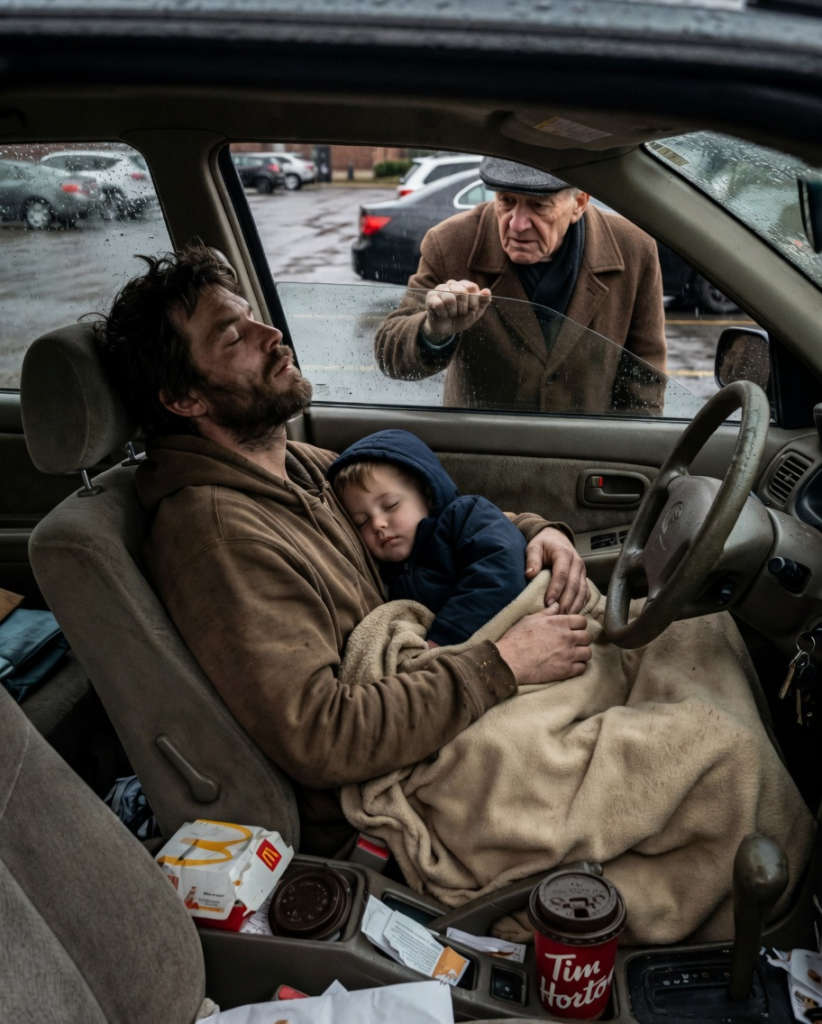
The wind sliced across the vast asphalt of the long-term parking lot at Toronto Pearson International Airport, carrying the damp, biting chill of a Canadian March.
I tightened my scarf and gripped my carry-on. I had just flown in from Vancouver on a red-eye, running on stale coffee and the excitement of a surprise.
It was my son Michael’s thirty-second birthday. I pictured his reaction—the shock, the laughter, the chaos of my twin grandsons, Nathan and Oliver. It was supposed to be a good day.
But as I moved through the endless rows searching for the rental section, a flash of silver caught my eye. A Honda Civic sat far out in the cheapest corner of the lot.
It wasn’t the car—it was the windows. Fogged thick from the inside, the kind of condensation that builds when people stay too long in a cold, enclosed space. I slowed.
Something deep in my gut, sharpened by years of fatherhood, twisted hard. I recognized the license plate.
I stepped closer, breath catching. Through the haze, I saw movement. I leaned in, blocking the grey glare.
My heart didn’t just stop—it dropped.
Michael sat in the driver’s seat, slumped awkwardly. But the back seat shattered me. Nathan and Oliver—my five-year-old grandsons—curled together under a single wool blanket, surrounded by clothes, fast-food wrappers, and stuffed animals.
I froze. The cold vanished, replaced by a burning mix of confusion and dread. I knocked.
Michael jolted awake, eyes wild—pure panic, like a cornered animal. Then he saw me. Recognition replaced panic… with something worse.
Shame.
Deep, crushing shame.
He opened the door slowly. Stale air spilled out—unwashed bodies, exhaustion, despair.
“Dad?” His voice scraped out. “What… what are you doing here?”
“What am I doing here?” My voice cracked. “Michael, what is this? Where is the house? Where is Jennifer? Why are you living in a Honda Civic with my grandsons in March?”
He stared at his boots. “It’s complicated.”
“Complicated?” I stepped closer. “You’re sleeping in a parking lot. That’s not ‘complicated.’ That’s a disaster.”
In the back, Nathan stirred, rubbing his eyes.
“Grandpa?”
That small voice broke something inside me. Not just heartbreak—a call to act.
“Hey, buddy,” I forced a smile, squeezing his foot. “Why don’t you and Oliver come get breakfast with Grandpa? Your dad and I need to talk.”
Michael looked up, eyes red, hollow. He looked thin. Drained.
“Okay,” he whispered.
As we walked toward the terminal, the boys holding my hands, I glanced back at the car. It wasn’t a car anymore. It was a grave for my son’s life.
And I swore—I’d pull him out, no matter what it took.
An hour later, we sat in a corner booth at Tim Hortons. The boys devoured pancakes. Michael sat across from me, hunched over a black coffee.
“Tell me everything,” I said. “No skipping details.”
He exhaled shakily. “Jennifer left three months ago. But she didn’t just leave. She took everything—the house, the accounts, the business money.”
“The house was joint. The business was shared.”
“She had me sign papers,” he said quietly. “Six months ago. Said it was for taxes. To protect assets. She put the house in her name. I trusted her.”
He swallowed. “Then I came home one day. Locks changed. A restraining order waiting. Her lawyer said I was mentally unstable. Dangerous.”
“That’s insane,” I snapped. “You’ve never hurt anyone.”
“I know. But they had ‘evidence.’ Fake messages. Witnesses. Her parents backed everything. The judge believed it.”
“And the money?” I asked. “The $150K I invested?”
His face broke. “She controlled the accounts. The day before filing, she moved everything to her father’s account. Called it a business loan.”
“And custody?”
“I lost,” he said flatly. “Supervised visits twice a week. Need stable housing to get more. But I can’t afford anything. She told my clients I was unstable. I lost my work.”
He gestured helplessly. “I do day labor. Shower at the gym. The boys think it’s a ‘camping trip.’ I pick them up… but we sit in the car or go to the park.”
“Where are visits held?”
“Her parents’ house. Her mother watches. Writes everything down.”
A cold, controlled fury built inside me.
“This ends now,” I said. “Pack up. You’re coming with me. We get you cleaned up, fed, and a lawyer.”
“Dad… you don’t get it,” he said. “Her family is powerful. Her father—Douglas Whitmore—big developer. Their lawyers are sharks.”
I grabbed his wrist. “Maybe you can’t fight them alone. But we can.”
That night, after the boys fell asleep in real beds, I opened my laptop.
I made two calls.
“Paul,” I said to my attorney, “I need the most ruthless family lawyer in Ontario. Money isn’t the issue.”
After hearing everything, he paused. “This isn’t just divorce. It’s fraud. You need Rebecca Hart.”
“Get her,” I said.
They thought Michael was alone.
They were wrong.
Rebecca Hart was sharp, precise, relentless.
After hearing everything, she said, “This is financial coercion and parental alienation. They stripped him of money, credibility, and access to force submission.”
“Can we prove it?” Michael asked.
“With evidence,” she said. “Therapy records?”
“I saw a therapist,” he admitted.
“Good. That helps you. Not them.”
Then we hired a forensic accountant.
Three weeks later, the truth was undeniable.
“The $150,000,” the accountant said, “was transferred to Douglas Whitmore. No invoices. No services. Just theft.”
He flipped pages. “Over time, nearly $280,000 was siphoned out.”
Michael went pale. “She was stealing the whole time.”
Rebecca smiled thinly. “This isn’t divorce anymore. This is criminal.”
Then came the recordings.
Michael recorded every supervised visit.
What we got changed everything.
Court day.
Jennifer sat confident beside her lawyer. Michael trembled beside me.
Rebecca presented everything—job, housing, therapy.
Then came the recordings.
Children laughing. Calling for their father. No fear.
Then Patricia’s voice: “I’m writing that down as aggression.”
Silence filled the courtroom.
Then the financial evidence.
“Where is the loan agreement?” Rebecca asked Jennifer.
“It was verbal.”
“For $150,000?”
Jennifer faltered.
Then came the final blow.
“The threatening texts?” Rebecca said. “They’re fake. Edited. Never sent.”
“Objection!” the lawyer shouted.
“Overruled,” the judge said. “Answer.”
Jennifer broke.
“I… I was afraid.”
“By framing him?” Rebecca pressed.
Jennifer collapsed into tears.
The judge spoke.
“I have rarely seen such calculated destruction of a parent.”
She raised the gavel.
“Sole custody is awarded to Michael Reeves. Effective immediately.”
Gasps.
“And $280,000 must be repaid. This case is referred for criminal investigation.”
Gavel slammed.
Michael nearly fell. I caught him.
“It’s over,” I said.
Outside, the boys ran to him.
“Daddy!”
He dropped to his knees, holding them, sobbing.
Douglas stormed off. Jennifer followed, broken—but not looking at her children.
Months later, justice kept moving.
Douglas was charged.
Jennifer took a plea deal.
Michael rebuilt.
I stayed.
One evening, we sat watching the sunset.
“I never thanked you,” Michael said.
“You don’t need to.”
“Yes, I do. You saved me.”
“I know my son,” I said. “You’re not what they said.”
He nodded. “Thank you.”
Inside, the boys shouted.
“Grandpa! Come play!”
I stood. “Duty calls.”
I joined them, steadying their wobbling tower.
“Grandpa, don’t let it fall,” Oliver said.
“I won’t,” I promised.
Not just the tower.
Everything.
Because that’s what fathers do.
We don’t just build.
We hold it together when everything tries to break it.