I converted the narration from “you” to “I” based on the text you provided.
I did not leave Lake Tahoe like a woman who had been destroyed.
I left like a woman who had finally understood the entire war map.
The mountain road curved through the dark pines, my headlights cutting clean lines through the night. My hands stayed steady on the steering wheel. Behind me, Nathan was probably still on that balcony, still laughing, still touching Claire’s pregnant belly, still thinking he had already erased me.
He had no idea I heard everything.
He had no idea the folder on the passenger seat was not proof of my defeat.
It was my weapon.
My first call was to Rebecca Hayes, my attorney—the woman who once warned me that love and legal documents should never be trusted in the same blind spot.
She answered on the second ring. “Evelyn?”
I did not waste time.
“Nathan forged my signature on the Clearwater bank annexes.”
Silence.
Then her voice turned sharp. “Are you certain?”
“I heard him say it.”
“Did anyone else hear?”
“No.”
“Then we need proof before morning.”
I glanced at the folder beside me.
“I have copies of the original plans, financing drafts, investor letters, and the unsigned annex version.”
“Good,” Rebecca said. “Do not go home. Do not confront him. Do not warn anyone. Send me everything.”
I almost laughed.
Do not warn anyone.
That was exactly what Nathan deserved. No warning. No final conversation. No chance to twist my pain into hysteria and my evidence into confusion.
My second call was to Marcus Lane, a forensic auditor with the emotional warmth of a locked steel vault. That was why I trusted him. He once uncovered a multimillion-dollar billing scheme because someone used the wrong decimal format in a spreadsheet. If Nathan touched the numbers, Marcus would find his fingerprints.
He answered groggily.
“This better be fraud.”
“It is.”
He woke up instantly.
By the time I reached the highway, Marcus had opened a secure upload folder, Rebecca had arranged an emergency review, and my third call connected to New York.
Richard Cole answered from Manhattan.
He was the lead partner at Eastbridge Capital, the investment group preparing to fund the Clearwater development. Calm. Polite. Ruthless when necessary. He had always respected me more than my husband did, and Nathan hated him for it.
“Evelyn,” Richard said, surprised. “Is everything all right?”
“No,” I said. “And if you want your investment protected, listen carefully.”
I told him only what I could prove.
Not the mistress.
Not the pregnancy.
Not the ring.
I told him about forged signatures, altered banking documents, unauthorized guarantees, and the possibility that Nathan was trying to close the deal under fraudulent authority.
Richard did not interrupt once.
When I finished, he asked, “Are you safe?”
The question almost broke me.
Not “What happens to the deal?”
Not “Can we still close?”
Are you safe?
I swallowed the emotion before it reached my voice. “Yes.”
“Good,” he said. “Then we freeze tomorrow’s signing until every document is verified.”
“No,” I said.
He paused. “No?”
I stared at the dark road ahead.
“If we freeze it now, he’ll know. He’ll destroy evidence, pressure staff, and play victim before we have enough.”
Richard was quiet.
Then he asked, “What are you proposing?”
I tightened my grip on the wheel.
“Let him walk onto the stage.”
The next morning, I did not sleep.
I worked from a private suite in a Denver business hotel under Rebecca’s name. Marcus arrived at 6:15 a.m. in a gray hoodie, carrying two laptops and looking as if nothing in the world had ever impressed him.
He spread the documents across the table.
“Show me the annexes.”
I did.
Within minutes, he found the first flaw.
“This signature was pasted.”
My stomach turned cold.
He zoomed in and pointed at the screen. “See the pixel halo? This was lifted from a scan. Your real signature from the April architectural approval was copied and placed onto the bank guarantee.”
Rebecca closed her eyes for one second.
I whispered, “So he really did it.”
Marcus looked up. “He did it badly.”
That should not have comforted me.
It did.
For years, Nathan had made me feel too careful, too suspicious, too difficult. He mocked my habit of saving every document version, backing up emails, and reading every clause line by line.
Now that discipline was the only thing standing between me and ruin.
Marcus kept digging.
By 8:00 a.m., he found altered timestamps.
By 9:20, he found a private email thread between Nathan and a bank liaison, routed through an assistant account that should never have touched financing files.
By 10:05, he found the worst part.
A hidden clause placed personal liability on me if the development failed or loan conditions were breached.
I stared at the screen.
“He tried to make me the guarantee.”
Rebecca’s face was stone. “He tried to make you the fall guy.”
Marcus scrolled through the metadata. “And he used your name to do it.”
My name.
Evelyn Carter.
The name I built before I married him. The name I softened after the wedding because the Whitmore family liked tradition. The name Nathan slowly pushed behind his until investors called Clearwater “Nathan’s vision,” even though I secured the land, fought for permits, negotiated with local officials, worked with architects, and saved the financing twice.
He did not only betray my marriage.
He tried to steal my work and leave my name on the debt.
At noon, Nathan called.
I stared at the screen.
Rebecca shook her head.
I let it ring.
Then he texted.
Where are you?
We need to talk before tonight.
Don’t be dramatic.
That last message almost made me smile.
Dramatic.
A man could forge bank documents, impregnate his assistant, plan to replace his wife, and still call the woman holding evidence dramatic.
I screenshotted everything.
At 1:30 p.m., Richard joined an encrypted video call with two Eastbridge attorneys and a compliance officer. Marcus presented the findings. Rebecca presented the legal risk.
I sat quietly until Richard asked, “Evelyn, what do you want to happen tonight?”
The question was simple.
Nobody had asked me that in years.
Nathan asked what I could fix.
Margaret asked what I could tolerate.
Investors asked what I could deliver.
But what did I want?
I looked at the forged signatures. I thought of Nathan’s hand on Claire’s belly. I thought of Margaret holding the family ring as if my marriage was already dead.
“I want the signing moved to public review,” I said.
Rebecca’s eyes sharpened.
“Let the dinner happen. Let Nathan gather everyone. Let him think he is about to announce control. Then we stop him in front of the people he intended to deceive.”
Richard leaned back.
“That will be ugly.”
I met his eyes through the screen.
“It already is.”
The investor dinner was held at the Whitmore family’s private club in Denver.
Of course it was.
Nathan performed best in rooms built to protect men like him. Dark wood. Old money. Quiet waiters. Expensive whiskey. Portraits of founders who made fortunes from other people’s silence.
I arrived late on purpose.
Not too late.
Just late enough for everyone to notice.
I wore a simple black dress, severe and clean, my hair pulled back, no jewelry except my father’s old gold watch. He gave it to me when I closed my first property deal at twenty-six.
He told me then, “Never let a man put his name on your work.”
I had forgotten.
Tonight, I remembered.
Music was already playing when I stepped into the main salon.
There were nearly eighty people inside: investors, bankers, architects, Whitmore relatives, old family friends, and employees trained to smile around secrets.
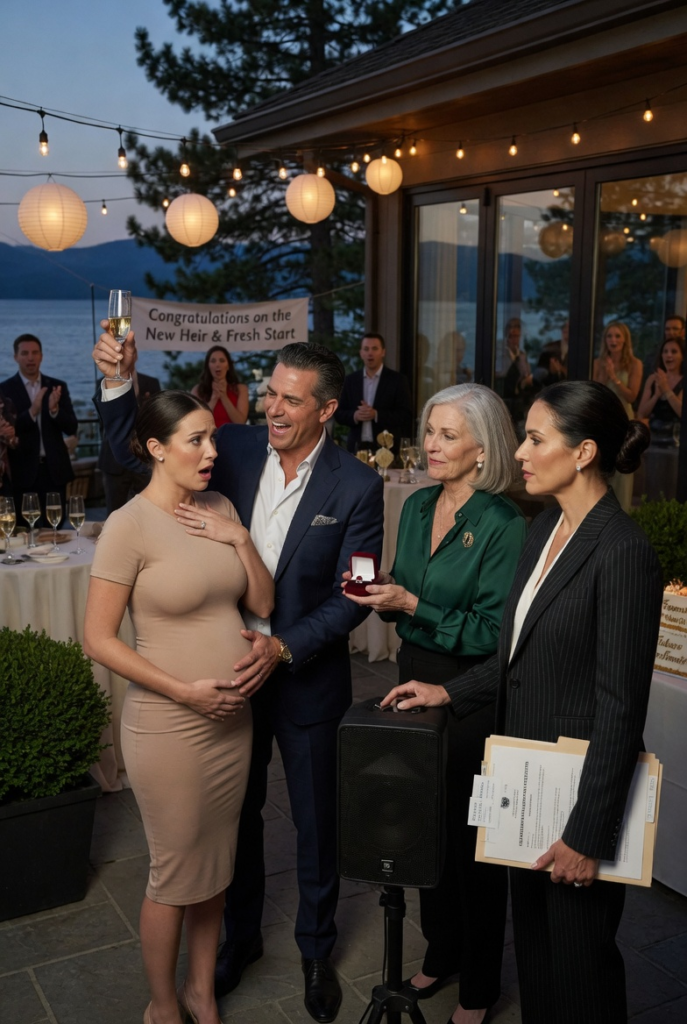
At the center of the room, Nathan was dancing with Claire.
She was wearing the antique ring.
My ring.
The one Margaret believed belonged to “the wife of the heir.”
Claire’s cream dress clung to her small pregnant belly. Nathan held her with theatrical tenderness. Margaret watched from the side, smiling like a queen witnessing a coronation.
People whispered.
Nobody intervened.
Of course they did not.
Money teaches rooms to tolerate cruelty.
Then Nathan saw me.
His smile froze.
Claire followed his gaze and turned pale.
Margaret’s hand tightened around her champagne glass.
I did not walk toward them first.
I walked toward the sound system.
The young technician looked confused.
I held out one hand.
“Turn it off.”
He hesitated.
I did not raise my voice.
“I said turn it off.”
Something in my face convinced him.
The music died mid-song.
The silence was immediate.
Nathan released Claire so quickly she stumbled. I took the microphone from the stand and turned toward the room.
Every face was on me.
Good.
I looked directly at Nathan.
“Tonight, I did not come here to cry,” I said. “I came to recover my name.”
A murmur moved through the room.
Nathan’s face darkened. “Evelyn, not here.”
I smiled.
There it was.
Not “I’m sorry.”
Not “Let me explain.”
Not “Are you okay?”
Just not here.
Because men like Nathan are never ashamed of betrayal.
They are ashamed of witnesses.
I lifted the folder in my hand.
“This room was invited to celebrate the closing of the Clearwater development,” I said. “A project many of you were told belonged to Nathan Whitmore.”
Margaret stepped forward. “Evelyn, you are embarrassing yourself.”
I turned slowly toward her.
“No, Margaret. I spent years embarrassing myself by staying quiet.”
The room went still.
I looked back at the guests.
“For four years, I led this project. I negotiated land access. I secured environmental reviews. I worked with architects, banks, local representatives, and international investors.”
Nathan laughed coldly. “You helped.”
I nodded once.
“Yes. The way a foundation helps a house stand.”
That landed.
Near the back, Richard Cole stood with two attorneys. Marcus held a tablet. Rebecca waited near the entrance, calm as a blade.
Nathan noticed them.
For the first time, fear crossed his face.
I continued.
“Tonight, I learned that my signature was placed on bank annexes without my knowledge. Documents that would expose me personally to financial liability while transferring operational control away from me.”
Gasps rippled across the salon.
A banker near the bar suddenly looked sick.
Nathan raised his voice. “That is a lie.”
I turned to Marcus.
He tapped the tablet.
The screen behind the musicians lit up.
My signature appeared, enlarged.
Then the authentic signature.
Then the forensic overlay.Marcus’s voice came through the speakers.
“The signature on the bank annex was digitally lifted from a prior document and inserted. Metadata shows the annex was modified after Ms. Carter received the earlier draft.”
Ms. Carter.
Not Mrs. Whitmore.
I felt my name enter the room like a door opening.
Nathan pointed at the screen. “This is illegal. You can’t show private documents.”
Rebecca stepped forward.
“These documents relate to an attempted fraudulent closing involving multiple investors present in this room. They are relevant to immediate compliance review.”
Nathan’s mouth closed.
Claire touched the ring on her finger as if it had begun to burn.
Margaret snapped, “This is a family matter.”
I looked at her.
“No. You made it a business crime when you toasted to trapping me with forged guarantees.”
Her face drained of color.
The whispering grew louder.
Richard walked forward.
He did not need drama.
Real power rarely does.
“Eastbridge Capital will not proceed with any closing under the documents currently presented,” he said. “We are initiating a compliance review and reserving all rights.”
Nathan turned on him. “Richard, don’t let her manipulate you.”
Richard looked almost bored.
“Mr. Whitmore, the issue is not emotion. It is document integrity.”
That sentence killed the last illusion of control.
Nathan knew how to fight feelings. He could call me jealous, unstable, cold, dramatic.
But document integrity was not a wife crying in a kitchen.
It was a locked door only evidence could open.
And I had the key.
Claire suddenly spoke.
“I didn’t know about the signatures.”
Everyone turned.
Her voice trembled. One hand rested on her belly. “Nathan told me Evelyn had already agreed to step away.”
Margaret hissed, “Claire.”
But Claire was staring at Nathan now.
Not with love.
With fear.
I felt no pity.
Not yet.
Claire was not innocent. She wore my ring, stood on my terrace, accepted my humiliation, and smiled at a future built over my body.
But it was possible to be guilty and still not know the full shape of the crime.
Nathan stepped toward her. “Don’t start.”
She stepped back.
That small movement told the room everything.
I looked at him.
“You were so sure I would beg,” I said. “You forgot I know how to read contracts.”
Margaret lifted her chin.
“You are still married to my son.”
I faced her fully.
“Yes,” I said. “That is being corrected.”
Another wave of murmurs.
Nathan’s face twisted. “You think divorce gives you the project?”
“No,” I said. “Ownership documents do.”
Rebecca opened another file.
The screen changed.
Carter Strategic Development: 54%.
Whitmore Group: 22%.
Eastbridge Capital: pending investment.
Protected local partnership: minority participation.
The room absorbed it.
For years, Nathan had let everyone believe Clearwater belonged to him because the Whitmore name was louder. I allowed it because I thought love meant not making my husband feel small.
That was my mistake.
Never again.
“I built the controlling structure through Carter Strategic Development before the marriage asset amendments,” I said. “Nathan had limited operational authority, not ownership control.”
Nathan looked like he might be sick.
Because he knew it was true.
He never cared enough to read the structure. He saw my labor as naturally available to him.
Like dinner.
Like loyalty.
Like my name.
I continued, “The attempted annex changes could only transfer control if investors relied on forged authorization and if my personal guarantee was accepted.”
Richard added, “It will not be.”
The room shifted.
I could feel the Whitmore gravity weakening.
People who came to congratulate Nathan now avoided his eyes. Bankers whispered into phones. Investors stepped away from him without looking like they were moving.
Margaret saw it too.
She panicked.
“Evelyn,” she said, suddenly softer, “let’s not destroy the family over business.”
There it was.
Family.
The word they brought out only after the crime was exposed.
I walked toward her slowly.
“Family?” I asked. “Was it family when you gave my ring to his pregnant mistress?”
Claire flinched.
Margaret’s mouth opened.
I did not stop.
“Was it family when you told her my name would disappear from the project I built? Was it family when you celebrated forged signatures that could have destroyed me financially?”
Her face hardened.
“You were never right for him.”
For the first time all night, my smile was real.
“No,” I said. “I was too much for him.”
Nathan lost control.
“You think you’re powerful because some New York investor backs you?” he snapped. “Without the Whitmore name, you are nothing.”
I turned toward the room.
“Then let’s remove it and see what remains.”
I took the top document from Rebecca.
“As of tonight, I am filing to remove Whitmore Group from operational management pending investigation. Eastbridge Capital has agreed to continue discussions only with Carter Strategic Development after compliance review. The Clearwater project will not carry the Whitmore name.”
The room erupted into whispers.
Not shouting.
Worse.
The kind of whispers that ruin reputations in private clubs, boardrooms, and banks.
Nathan lunged for the folder.
Security moved immediately.
Two guards stopped him before he reached me.
“Let go of me!” he shouted. “She is my wife!”
I looked at him with clean, steady calm.
“I was your wife,” I said. “I was never your property.”
Claire started crying. She pulled the ring from her finger with shaking hands and placed it on a nearby table like evidence at a crime scene.
Margaret stared at it, horrified, as though the jewel itself had betrayed her.
Nathan saw Claire remove it.
That wounded him more than my speech.
Because losing me was part of his plan.
Losing admiration was not.
The investor dinner ended without dinner.
People left in clusters, whispering, pretending not to record while recording everything.
By midnight, videos were spreading through business circles.
Me in black with the microphone.
Nathan being restrained.
The screen showing forged signatures.
My voice saying: I came to recover my name.
By morning, the story had escaped the club.
Businesswoman Exposes Husband’s Alleged Forgery at Investor Event.
Whitmore Group Facing Review After Clearwater Development Dispute.
Pregnant Assistant Pulled Into Corporate Scandal.
I did not read the comments.
I did not need strangers to tell me what happened.
At 8:00 a.m., Rebecca called.
“The bank suspended all annex processing. They are cooperating.”
At 8:30, Richard called.
“Eastbridge will proceed only after governance is cleaned up. But Evelyn?”
“Yes?”
“We still want the project.”
I closed my eyes.
The project survived.
Not the marriage.
Not the Whitmore fantasy.
But my work.
My four years.
My name.
At 9:15, Marcus sent another report.
He had found payments routed to a consulting company tied to Margaret’s cousin. Inflated invoices. Duplicate design fees. Vendor deposits that never reached vendors.
Nathan was not only trying to take control.
He was bleeding the project before he even stole it.
At 10:00, I filed for divorce.
The papers felt lighter than expected.
Maybe because the marriage had ended on that balcony before I ever signed anything. Maybe because grief had already become motion. Maybe because I had spent years carrying Nathan’s insecurity like a second job, and now I was resigning.
He called thirty-two times that day.
I did not answer.
His messages changed by the hour.
First rage.
You ruined me.
Then accusation.
You planned this because you were jealous.
Then bargaining.
We can fix this privately.
Then memory.
Remember Lake Tahoe before everything got complicated?
That one made me pause.
I did remember.
I remembered a younger Nathan bringing me coffee at midnight while I reviewed early land surveys. I remembered him saying he loved my ambition. I remembered believing him.
But love that later resents your strength was never love.
It was admiration waiting to become control.
I forwarded every message to Rebecca.
That became my new habit.
No emotional replies.
Only records.
Three days later, Claire asked to meet.
Rebecca said no.
I said yes, but only at the lawyer’s office, with a witness, no private conversation, no emotional ambush. I was done meeting people in places where they could rewrite the truth.
Claire arrived without makeup.
Without the ring, without Nathan beside her, without balcony lights turning betrayal into glamour, she looked young.
Not innocent.
Just young.
She sat across from me and could not hold my eyes.
“I didn’t know he forged your signature,” she said.
I said nothing.
She swallowed. “I knew he was married. I knew you built most of the project. I knew he wanted me to replace you.”
The honesty was ugly.
But it was honesty.
“I told myself you were cold,” she continued. “That you cared more about business than him. That he was lonely.”
I looked at her calmly.
“Did that make it easier to wear my ring?”
She began to cry.
I waited.
I was no longer a woman who rushed to make other people comfortable with the truth.
“No,” she whispered. “It made me feel chosen.”
There it was.
Not love.
Selection.
Nathan made her feel like winning, and she did not care that the prize belonged to a woman who once helped her get a job when she had nothing.
She placed a folder on the table.
“I brought emails.”Rebecca sat straighter.
Claire pushed it forward. “Nathan asked me to forward documents from your office account when you were traveling. Margaret told me which files to find. I didn’t understand all of it then. I understand enough now.”
I did not touch the folder.
“Why bring this?”
Claire looked down at her belly.
“Because he said if things went bad, he would say I manipulated him.”
I almost laughed.
Of course.
Nathan’s love always came with an exit strategy.
“I don’t expect forgiveness,” she said.
“Good,” I replied.
She flinched, but nodded.
I continued, “If the evidence is real, tell the truth under oath. Not for me. For your child. Don’t build that baby’s life on lies before it even begins.”
Her face collapsed.
For the first time, I felt something close to pity.
Not enough to absolve her.
Enough to hope she became better than the role she accepted.
The evidence changed everything.
Emails showed Margaret discussing how to “manage Evelyn after the closing.” Nathan referred to me as “a liability with useful credit.” There were instructions to pressure me into signing additional documents after the investor dinner, once the forged annexes were already circulating.
Useful credit.
I read the phrase once.
Then again.
It should have broken my heart.
Instead, it cleaned it.
No woman can mourn a man forever after seeing herself reduced to a financial tool in his own words.
Whitmore Group began collapsing within weeks.
The bank froze related credit lines.
Eastbridge paused funding but signed an exclusive continuation agreement with Carter Strategic Development. Two architects who once seemed loyal to Nathan asked to stay under my leadership. One senior banker called privately to say he had “concerns” about Nathan for months.
I did not thank him.
Concerns that stay quiet until a woman bleeds are not courage.
Margaret tried to save the family name.
She called old friends, visited club members, cried in private offices, and told people I was vindictive, unstable, ungrateful.
For a few days, some believed her.
Then Marcus’s report reached the right desks.
Numbers are harder to charm than social circles.
The consulting company tied to her cousin became the center of a separate inquiry. Payments that once looked like business expenses now looked like extraction. Margaret stopped calling me unstable when her own attorney advised silence.
Nathan did not follow that advice.
He appeared outside my apartment one night at 11:40 p.m.
Security called before letting him near the elevator. On the lobby camera, he looked worse than I expected. Wrinkled shirt. Damp hair. Red eyes from anger, whiskey, or both.
“Tell him to leave,” I said.
Security did.
He refused.
Then he looked into the camera as if he could see me.
“Evelyn,” he said. “You owe me a conversation.”
I almost answered.
Almost.
Then I remembered every conversation where he turned my pain into inconvenience. Every night he made me explain why betrayal hurt. Every apology just deep enough to reset the cycle.
I did not speak.
Security escorted him out.
He shouted once in the rain.
“You were nothing before me!”
I watched from my apartment, wrapped in a robe, holding a cup of tea.
That sentence used to be my fear.
Now it was almost funny.
Before him, I was Evelyn Carter.
With him, I became Mrs. Whitmore when it served him and “too much” when it did not.
After him, I was becoming myself again.
The divorce turned vicious.
Nathan fought for shares he did not own. He claimed emotional distress. He claimed I ruined his reputation.
Rebecca answered with forged signatures, altered documents, misused funds, and testimony from Claire, Marcus, and two former assistants who suddenly remembered being asked to backdate files.
His legal team changed tone.
Then strategy.
Then lawyers.
Margaret refused mediation at first, saying she would not sit in a room with “that woman.” When she finally appeared, she wore pearls, black silk, and the face of someone attending a funeral for power.
I wore white.
Not bridal white.
War white.
Clean. Simple. Untouchable.
Nathan sat across from me and avoided my eyes.
Margaret did not.
“You destroyed my son,” she said.
I looked at her for a long moment.
“No,” I said. “I stopped letting him use me as scaffolding.”
She sneered. “You always wanted to stand above him.”
“I wanted to stand beside him,” I replied. “He kept trying to kneel me.”
Even Rebecca glanced at me then.
Nathan’s jaw tightened.
Good.
Let him hear it.
The settlement took months, but the outcome was clear long before the final signatures.
I retained control of Carter Strategic Development.
Whitmore Group exited Clearwater under investigation and penalty.
Nathan lost all operational authority connected to the project.
Margaret’s side agreements were exposed and unwound.
The divorce was granted.
I kept my name.
Not Whitmore.
Carter.
The first time I saw the revised project banner, I stared at it for almost a full minute.
Carter Clearwater Reserve.
My name sat above the blue lake rendering, above the eco-luxury villas, above the protected forest zones, above the community employment plan I fought to include when Nathan said it was “bad for margins.”
My name did not look arrogant.
It looked accurate.
The groundbreaking ceremony happened one year after the night in Lake Tahoe.
I stood on a platform near the water, the air bright and clean, the lake shining behind me. Local partners sat in the front row. Eastbridge representatives stood beside the architects. Workers, engineers, community leaders, and press gathered beneath a white canopy.
There was no Whitmore crest anywhere.
No Margaret.
No Nathan.
Claire was not there either, though Rebecca told me she had the baby and moved to Oregon to live near her sister. She gave a full sworn statement and vanished from the Whitmore circle before it could swallow her too.
I wished the child peace.
I owed the mother nothing more.
Richard introduced me as the founder and principal developer.
Founder.
Principal.
Developer.
Each word returned something to the foundation of my life.
I stepped to the microphone.
For a second, the sunlight was so bright that the crowd blurred. I heard the water behind me, the soft movement of trees, the distant hum of construction equipment waiting to begin.
I thought of that balcony.
Nathan’s hand on Claire’s belly.
Margaret’s ring.
The laughter.
The sentence: She’s going to beg.
I smiled.
Not because I was cruel.
Because they were wrong.
“When this project began,” I said, “it was a stack of impossible permits, difficult land questions, and a vision many people said was too ambitious.”
A few people laughed softly.
“I was told many times that I was too intense, too careful, too demanding, too attached to details.”
I looked at Marcus, who gave the smallest nod.
“Today, I want to thank the details. The details protected this project. The details protected our partners. And in the end, the details protected the truth.”
Applause rose.
I waited.
“This development will not be built on silence,” I continued. “Not the silence of workers. Not the silence of local communities. Not the silence of women whose names are removed from the work they create.”
My voice strengthened.
“Carter Clearwater Reserve carries my name because I built it. But it will succeed because no one person gets to own the labor of many.”
This time, the applause was louder.
I did not cry.
There would be time for private grief later, time to mourn the years I made myself smaller so Nathan could feel tall.
But this moment was not grief.
It was restoration.
After the ceremony, reporters asked about the scandal.
I gave them one sentence.
“The project moved forward because the truth was stronger than the people trying to hide it.”
That became the quote.
By evening, it was everywhere.
This time, I watched.
I watched myself standing straight, speaking clearly, my name printed behind me. I looked nothing like the woman who once stood in the dark listening to her husband celebrate her erasure.
That woman did not die.
She became evidence.
Months later, I received a letter from Nathan.
Not an email.
A letter.
His handwriting was still sharp, impatient, tilted slightly right. I almost threw it away unopened. Then I decided the woman I was now could read a letter without being dragged back into the fire.
He wrote that he lost more than he expected.
He wrote that Margaret moved into a smaller house after selling several family assets.
He wrote that the Whitmore name no longer opened doors the same way.
Finally, he wrote that he underestimated me.
I stopped there.
Not because it hurt.
Because it was not an apology.
It was a confession of bad strategy.
He was not sorry he betrayed me.
He was sorry I was harder to bury than he calculated.
I folded the letter and placed it in a file marked Closed.
Then I went to dinner with Rebecca, Marcus, and two friends who knew me before the Whitmore years. I laughed more than expected. I ordered dessert. I did not check my phone under the table.
That is how healing often arrives.
Not as a grand speech.
As a meal you enjoy without fear.
Two years later, Carter Clearwater Reserve opened its first phase.
The property was stunning.
Low villas tucked into green hills, pathways designed around protected trees, water systems built to reduce waste, local artisans represented in every detail. Guests called it luxurious, but I knew the true luxury was that it had been built without surrendering the soul of the place.
On opening night, I walked alone along the lantern-lit path near the water.
The lake reflected the stars.
My father’s watch rested on my wrist.
A message arrived from Richard.
Congratulations, Evelyn. Your name looks good on the door.
I looked back toward the entrance.
CARTER CLEARWATER RESERVE glowed in warm light above the stone wall.
My name.
Not borrowed.
Not hidden.
Not attached to a man who needed my brilliance but resented its shine.
Mine.
For years, Nathan danced in rooms where people applauded him for my work. He believed a pregnant mistress, an old ring, and a forged signature could erase me. He believed I would cry quietly, sign whatever he placed in front of me, and spend the rest of my life fighting for scraps of a name he never respected.
He was wrong.
I did cry.
Later.
Privately.
Honestly.
But I did not drown.
I recovered the project.
I recovered my future.
Most importantly, I recovered Evelyn Carter.
The woman who did not come back to beg.
The woman who turned off the music.
The woman who took the microphone.
The woman who finally said her own name loudly enough for every liar in the room to hear.