You see the first name on the list, and the whole bank seems to tilt beneath your feet.
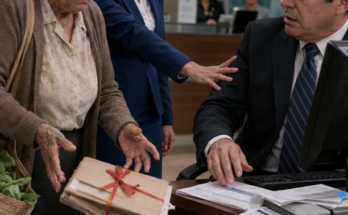
For six years, you have walked into that same Wellspring National Bank branch in Bakersfield, California, holding the same folder tied with a red ribbon, asking the same question everyone had learned to laugh at.
“I’m here to ask about my husband’s account.”
And for six years, they treated you like a joke.
But now the joke is lying on the marble floor at your feet, scattered in printed pages, stamped documents, secret transfers, and a list of names that should never have existed.
Your folder slips from your hands.
The red ribbon comes loose.
The paper your husband gave you on his deathbed slides across the floor like a final warning.
Because the first name on that list is not the bank manager.
It is not the rude teller.
It is not some stranger in a suit.
It is your oldest son.
Miguel Ramirez.
For a moment, you cannot breathe.
You hear the young woman in the blue suit say something, but her voice sounds far away, like she is calling you from the bottom of a well.
“Mrs. Ramirez? Teresa? Are you all right?”
You are not all right.
You are seventy years old, your knees ache from decades of standing at a produce stand, your hands are cracked from washing nopales and cilantro in cold water before sunrise, and suddenly the whole world has become too heavy to hold.
Your son’s name stares up at you.
Miguel.
The boy you fed when there was nothing in the house but beans and tortillas.
The boy whose school shoes you patched with black marker because you could not afford new ones.
The boy who kissed your forehead at his father’s funeral and told you, “Don’t worry, Ma. I’ll take care of you.”
Your lips tremble.
“No,” you whisper. “No, that cannot be right.”
Across the desk, Mr. Oliver — the bank manager who mocked you for years — is white as paper.
He tries to reach for the printed list, but the woman in the blue suit slams her palm on it before he can touch it.
“Don’t,” she says.
Her voice is calm, but it cuts through the branch like a blade.
The older man beside her, Mr. Whitaker, adjusts his glasses and opens another folder from his black briefcase.
You barely know them.
Yesterday, they were strangers.
Today, they are the only reason anyone is finally listening.
The woman’s name is Julia Carter, a federal investigator with the State Banking Compliance Division. Mr. Whitaker is an attorney, older, careful, with silver hair and eyes that miss nothing.
They came to your tiny house after you received the yellow envelope.
They asked questions about your husband.
They asked about the account number.
They asked whether anyone in your family knew you came to the bank every Monday.
And you told them the truth.
Everybody knew.
Your sons knew.
Your daughter knew.
The bank knew.
The whole neighborhood knew.
For six years, people called you stubborn, confused, lonely, crazy with grief.
But Don Aurelio — your Aurelio — had told you on his deathbed, with a voice thinner than thread, “Tere, don’t let them bury what is yours.”
You never understood what he meant.
Now you do.
Julia Carter picks up the list and reads it silently.
Her jaw tightens.
Mr. Whitaker looks at you with pity, but not the cheap pity Mr. Oliver always gave you.
This is the kind of pity that comes with anger.
The kind that says someone has done something unforgivable.
“Mrs. Ramirez,” Julia says gently, “we need you to sit down.”
You shake your head.
“No. Tell me what this is.”
Mr. Oliver finally speaks.
“This is a misunderstanding.”
His voice cracks on the last word.
Julia turns to him.
“You said that already.”
“I need to call corporate.”
“You will call no one until my team finishes securing the records.”
Mr. Oliver reaches toward the phone anyway.
That is when Julia nods to the security guard at the door — not the bank’s guard, but the quiet man who came in with her and never smiled.
He steps forward.
Mr. Oliver freezes.
For the first time in six years, the man who laughed at you is afraid.
You look down again at the list.
Miguel’s name sits at the top.
Below his name are two others you recognize.
Karla Bennett, senior teller.
Richard Oliver, branch manager.
And then one name that makes your blood turn colder than any winter morning in the fields.
Linda Ramirez.
Your daughter-in-law.
Miguel’s wife.
The woman who brought you secondhand groceries every Christmas and acted like she was saving your life.
The woman who told your grandchildren, “Grandma gets confused sometimes.”
The woman who once laughed at your old shoes and said, “You know, Teresa, some people just don’t know when to stop chasing dreams.”
You grip the edge of the chair.
Your body wants to sit, but pride holds you up.
“What did they do?” you ask.
No one answers fast enough.
“What did they do to my husband’s money?”
Mr. Whitaker takes the top sheet from Julia and places it on the desk facing you.
He points to a paragraph with his pen.
“Your husband was part owner in a construction liability settlement from 1998. He worked on a downtown hospital expansion in Los Angeles. There was an accident, and later a lawsuit. Most of the workers settled for small amounts because they didn’t know the full terms.”
Your mind goes back decades.
Aurelio coming home with dust in his hair.
A bandage around his ribs.
A cough that never fully went away.
A construction company that disappeared.
A lawyer who called once, then never again.
“He told me there was nothing,” you say.
“He may have believed that at first,” Mr. Whitaker says. “But years later, additional compensation was placed into a trust for several injured workers and their surviving spouses. Your husband’s share was deposited under a trust account. You were named the sole beneficiary.”
You blink at him.
“Trust?”
Julia leans closer.
“It means the money was legally protected for you.”
You stare at the screen.
The number is still there.
$3,842,611.73.
You cannot even understand it.
Three million dollars.
More money than you have seen in all the cash boxes, produce bags, rent envelopes, and unpaid bills of your entire life.
Your throat tightens.
“Aurelio knew?”
Mr. Whitaker nods.
“He found out shortly before he died.”
The hospital room returns to you.
The smell of bleach.
The buzzing light.
His cold fingers folding the paper into your hand.
His eyes begging you to believe him.
You close your eyes.
For six years, you thought he left you a mystery.
Now you know he left you a battle.
Julia turns one page.
“Someone submitted documents claiming you were mentally unfit to manage the trust. Then several people signed internal requests to freeze, redirect, and delay the release of the account.”
“I never signed anything.”
“We know.”
Your hands begin to shake.
“They said I was crazy?”
Julia’s face softens.
“They said you were confused, dependent, and unable to understand financial matters.”
A bitter laugh escapes your mouth.
You think of every dawn you woke at 3:40 a.m.
Every crate of tomatoes you lifted.
Every receipt you counted.
Every rent payment you made with exact cash.
Every time you fed your children from coins and prayers.
“They said I cannot understand money?”
No one answers.
Because everyone in that bank can see you understand perfectly.
You understand betrayal.
You understand humiliation.
You understand that while you were selling vegetables in 105-degree heat, people you loved were standing between you and the life your husband tried to leave you.
Karla Bennett is no longer laughing.
She stands frozen behind her teller window, one hand over her mouth.
Her eyes keep darting toward the exit.
Julia notices.
“Karla Bennett,” she calls.
Karla flinches.
“Yes?”
“Step away from your computer.”
“I didn’t do anything.”
“Step away.”
Karla moves slowly, like her legs belong to someone else.
The customers in line have gone silent.
Some of them recognize you.
They have seen you here before.
Some laughed with the employees.
Some looked away because it was easier.
Now they stare at you with a shame that comes too late.
Mr. Oliver clears his throat.
“Mrs. Ramirez, perhaps we can discuss this privately.”
You look at him.
For six years, he spoke to you like you were a stain on the floor.
Now he says your name like it might save him.
“Privately?” you repeat.
He loosens his tie.
“Yes. This is sensitive.”
You take one small step toward him.
Your shoes are old.
The left heel is worn crooked.
You bought them at a thrift store for six dollars.
Those shoes carried you through rain, bus stops, grocery lines, hospital hallways, cemetery dirt, and every Monday morning humiliation this bank gave you.
You look him straight in the eyes.
“You never humiliated me privately.”
His mouth shuts.
The entire branch hears it.
And for the first time, nobody laughs.
Julia’s phone buzzes.
She answers, listens, then looks at the guard.
“Lock the records room.”
Mr. Oliver jerks upright.
“You cannot do that.”
“We already did.”
His face loses the last bit of color.
You turn to Julia.
“What happens now?”
Before she can answer, the front doors open.
And your son walks in.
Miguel is wearing a pressed gray shirt, dark jeans, and the expensive watch Linda bought him after he “finally got promoted.”
He sees you first.
Then Julia.
Then Mr. Whitaker.
Then the papers on the desk.
His steps slow.
“Ma?” he says.
You do not answer.
You cannot.
Because now you understand why he came so fast.
Someone warned him.
Maybe Karla.
Maybe Oliver.
Maybe Linda.
Maybe all of them.
Miguel looks at the paper in your hand.
His eyes flicker just for a second.
But a mother knows.
You saw that same look when he was nine and stole quarters from your coffee can.
You saw it when he was seventeen and lied about crashing his father’s pickup.
You saw it when he was thirty-eight and told you he could not help with your roof because “money was tight,” while Linda posted photos from Las Vegas.
Guilt has a face.
And your son is wearing it.
“What is going on?” he asks.
Julia steps between you and him.
“Miguel Ramirez?”
“Yes.”
“I’m Julia Carter with State Banking Compliance. We need to ask you some questions.”
Miguel forces a laugh.
“Questions about what?”
Your voice comes out before Julia’s.
“About your father.”
He looks at you.
Something breaks in his expression.
Not enough.
But something.
“Ma, I can explain.”
The words hit you harder than any denial.
Because innocent people do not start with that.
Your knees finally give, and you sit down.
Mr. Whitaker pulls a chair closer.
You do not thank him because your mouth has gone dry.
Miguel takes one step toward you.
“Ma, listen to me.”
Julia lifts a hand.
“Stay where you are.”
He stops.
The bank is silent enough to hear the printer humming.
You look at him and see two boys at once.
The little one who ran barefoot through your kitchen.
The grown one who let you live with mold in your ceiling while millions sat behind a locked screen.
“Did you know?” you ask.
Miguel opens his mouth.
Nothing comes.
You nod slowly.
That is answer enough.
He runs a hand through his hair.
“Ma, it wasn’t like that.”
“Then tell me what it was like.”
He looks around at the customers, the tellers, the guards.
His pride fights with his fear.
Fear wins.
“Dad told me before he died,” Miguel says. “He said there might be money. He asked me to help you.”
Your fingers curl into your palm.
“Help me?”
“I tried.”
You almost laugh.
“You tried?”
“He didn’t understand the process. There were forms. Legal things. Linda knew someone at the bank. We thought if we controlled it first, we could protect it.”
“Protect it from who?”
Miguel looks down.
You already know.
“From me,” you say.
He whispers, “Ma…”
“No. Say it.”
He cannot.
So Julia says it for him.
“Documents were filed claiming Mrs. Ramirez was not competent to receive the trust distribution. The filings requested temporary administrative control by a family representative.”
You stare at your son.
“A family representative.”
Miguel wipes sweat from his forehead.
“It was supposed to be temporary.”
“Six years is temporary?”
“We had debts.”
There it is.
The rotten heart of it.
Not confusion.
Not protection.
Debt.
Linda’s salon.
The failed trucking business.
The house with granite counters.
The private school they said was “too expensive to visit Grandma because gas costs money.”
You remember asking Miguel for $300 to fix the leak over your bed.
He sighed like you had asked him for a kidney.
“Ma, I have my own family now.”
Your own family.
As if you were no longer part of it.
“How much did you take?” you ask.
Miguel says nothing.
Julia turns another page.
“Over six years, there were multiple attempted withdrawals. Most were blocked by trust restrictions, but smaller administrative fees and legal disbursements were approved.”
“How much?”
Mr. Whitaker answers quietly.
“Approximately $186,000.”
Your breath catches.
One hundred eighty-six thousand dollars.
You think of the plastic buckets under your leaking roof.
Your swollen feet.
Your expired blood pressure medicine cut in half to make it last longer.
You think of your husband’s grave, where you brought grocery-store carnations because roses cost too much.
Miguel begins to cry.
But the tears only make you colder.
“I was going to pay it back.”
You look at him.
“With what?”
He flinches.
That is when Linda storms in.
She is dressed like she is going to a business lunch: cream blazer, gold earrings, hair sprayed perfectly in place.
She pushes through the branch doors, phone in hand, eyes sharp and furious.
The moment she sees the investigators, she stops.
Then she sees you.
And somehow she still has the nerve to look annoyed.
“Teresa,” she says. “What did you do?”
You almost smile.
Six years of being called confused, stubborn, embarrassing, dramatic.
And now everyone wants to know what you did.
You stand again.
Slowly.
Painfully.
But you stand.
“I asked about my husband’s account.”
Linda’s mouth tightens.
“Do you have any idea how complicated this is?”
Julia steps toward her.
“Linda Ramirez?”
Linda looks her up and down.
“And you are?”
Julia shows her badge.
Linda’s expression changes.
Not much.
But enough.
“We need you to remain here,” Julia says.
“I need to call my lawyer.”
“You may.”
Linda looks at Miguel.
“What did you say?”
Miguel does not answer.
Linda’s face hardens.
“You idiot.”
The word cracks through the bank.
Not “Are you okay?”
Not “What happened?”
Not “I’m sorry.”
Just that.
You look at your son, and for the first time, you see that Linda did not create his weakness.
She fed it.
She dressed it up.
She taught it to speak with confidence.
But the weakness was his.
Linda turns to you.
“You don’t understand what that money would do to this family.”
You stare at her.
“This family?”
“Yes. Miguel is your son. Your grandchildren deserve a future.”
“And I deserved the one my husband left me.”
Linda scoffs.
“You sell vegetables from a folding table. What are you going to do with millions?”
The words land in the exact place Mr. Oliver’s insults used to land.
But this time, something inside you refuses to bend.
You pick up the paper with your name on it.
Your husband’s name.
Beneficiary.
Unique.
Legal.
Real.
“I am going to stop asking permission to be treated like a person.”
The silence after that is not empty.
It is full.
Full of everything everyone should have said for you years ago.
Mr. Whitaker closes his briefcase.
“Mrs. Ramirez, we need to proceed carefully. The trust assets will be secured. The unauthorized parties will be investigated. There may be criminal charges.”
Miguel’s face collapses.
“Criminal?”
Linda snaps, “For what? This is a family matter.”
Julia turns to her.
“No. This is financial exploitation of an elderly beneficiary, falsification of internal banking records, attempted misappropriation of trust assets, and possibly conspiracy.”
The word conspiracy changes the air.
Mr. Oliver grips the desk.
Karla begins crying behind the teller counter.
Miguel looks at you like you are supposed to save him.
That is the most painful part.
After everything, he still believes your love should protect him from consequences.
“Ma,” he whispers. “Please.”
You look at him.
You see his first birthday cake, the one you made in a dented pan.
You see him asleep on Aurelio’s chest after a long shift.
You see the boy he was before wanting more became bigger than gratitude.
Then you see yourself.
All those Mondays.
All that laughter.
All those nights talking to Aurelio’s photograph, saying, “I’m sorry. I couldn’t find it.”
You press a hand to your chest.
“I begged you to believe me,” you say.
Miguel cries harder.
“I know.”
“I asked you to come with me.”
“I know.”
“You told me to stop embarrassing the family.”
He covers his face.
“I know, Ma.”
Your voice shakes, but it does not break.
“You embarrassed the family.”
Linda makes a sharp sound.
“Teresa, think carefully.”
You turn to her.
“I have been thinking carefully for six years.”
Julia signals the guards.
Two more investigators enter from the back hallway, carrying sealed evidence bags.
Mr. Oliver’s office door is open now.
Files are being boxed.
Computers are being logged.
The bank that once treated you like a poor old woman with a fantasy now looks like a crime scene.
And you are standing at the center of it with your old shoes and your red ribbon on the floor.
Mr. Whitaker helps you gather your papers.
When he reaches for Aurelio’s note, you stop him.
“That one,” you say softly, “I’ll carry.”
He nods.
You fold it the way your husband folded it.
Four corners.
Careful.
Like a prayer.
Julia approaches you.
“Mrs. Ramirez, we can take you somewhere private now. There will be paperwork, statements, and legal protection for the trust. But you are safe.”
Safe.
It is such a strange word.
You have lived most of your life surviving, not being safe.
Safe was for people with insurance.
Safe was for people with locked gates and savings accounts.
Safe was for women who did not count pennies at the pharmacy.
But now, as you walk toward the doors of the bank, every employee watches you.
No one laughs.
Karla lowers her eyes.
You stop in front of her window.
She is crying so hard her mascara has smudged.
“I’m sorry,” she whispers.
You look at her for a long moment.
For six years, she called you “the ghost account lady.”
For six years, she made your humiliation part of her workday entertainment.
You could scream.
You could curse.
You could slap the glass.
Instead, you say, “I hope one day, when you are old, someone listens to you the first time.”
Karla breaks down completely.
You walk out.
Outside, the California sun is bright and cruel.
The same sun that baked your shoulders at the farmers market.
The same sun that faded your dresses on the clothesline.
The same sun that watched you come here every Monday and leave smaller than when you arrived.
But today, when it touches your face, you do not feel smaller.
You feel seen.
Miguel follows you out before the investigators stop him.
“Ma, please,” he calls.
You turn.
Linda is behind him, pale with rage.
Mr. Oliver is still inside, talking fast to someone who is not listening.
Miguel stands on the sidewalk like a child locked out of home.
“I’m still your son,” he says.
You nod.
“Yes.”
His eyes fill with hope.
“And you are still the man who stole from your father’s widow.”
The hope dies.
You do not say it with hatred.
That would be easier for him.
You say it with truth.
He wipes his face.
“I was desperate.”
“So was I.”
He looks at your shoes.
For once, he really sees them.
The cracked leather.
The uneven heel.
The dust from the bus stop.
“Ma…”
“You knew I was hungry sometimes.”
His face twists.
“You never told me.”
“I should not have had to.”
That sentence ends something.
Not your love.
A mother’s love does not die cleanly.
It lingers.
It aches.
It reaches for the child even after the child becomes the knife.
But trust?
Trust can die in one sentence.
And yours does.
Julia places a hand near your elbow, not touching unless you allow it.
You allow it.
You get into Mr. Whitaker’s car.
Not because you are weak.
Because this time, someone is taking you where you need to go.
Over the next three weeks, your life becomes papers, signatures, interviews, and things you never thought you would hear attached to your name.
Asset recovery.
Elder financial abuse.
Bank liability.
Trust distribution.
Criminal referral.
Civil damages.
The words are large, cold, official.
But underneath them all is one simple truth.
Your husband did not lie.
Aurelio remembered you.
He protected you as best he could.
And the people who thought poverty made you powerless were wrong.
The story spreads faster than you expect.
At first, it is just the customers who were in the bank.
Then it becomes a local news story.
Then a bigger one.
“Elderly Produce Vendor Finds Hidden $3.8 Million Trust After Six Years of Being Denied by Bank.”
You hate the word elderly.
You hate that reporters keep asking for photos of your old house.
You hate that people who ignored you now call you “inspiring.”
But you agree to one interview.
Just one.
You wear your clean blue dress, the one with tiny white flowers.
You sit in your kitchen under the patched ceiling.
The camera crew expects tears.
They expect anger.
They expect a poor woman shocked by money.
Instead, you hold Aurelio’s note in your lap and say, “When poor people speak, people think they can decide whether our truth matters. My husband gave me a number. I believed him. That is all.”
The reporter asks, “What will you do with the money?”
You smile faintly.
“Fix my roof first.”
The clip goes viral.
People laugh, but this time, not at you.
They love that answer.
They love your calm.
They love your stubbornness.
They do not understand that stubbornness was all you had when no one else stood beside you.
Two months later, Wellspring National Bank settles part of the civil claim.
The amount is confidential, but everyone in town knows it is big.
The branch manager is fired first.
Then charged.
Karla loses her job and later agrees to testify.
Linda tries to blame Miguel.
Miguel tries to blame Linda.
But signatures do not care about excuses.
Emails do not care about tears.
Bank logs do not care who says, “I never meant for it to go that far.”
It went that far.
And now it comes back.
You do not attend every hearing.
Mr. Whitaker says you do not have to.
But you attend the first one.
Miguel walks in wearing a navy suit you recognize.
You paid for it years ago when he had his first office interview.
He sees you sitting in the second row.
His face crumples.
For one second, he is your boy again.
Then the judge calls the case, and he is just a defendant.
Linda will not look at you.
She stares straight ahead, lips pressed tight, still acting like dignity is something she can wear.
When the judge reads the charges, your hands shake in your lap.
You do not feel victory.
That surprises you.
For years, you dreamed of proving everyone wrong.
You imagined walking into that bank and watching their faces change.
But justice does not feel like dancing.
It feels like standing at a grave and finally knowing who pushed you toward it.
After the hearing, Miguel asks through his lawyer if he can speak to you.
Mr. Whitaker says you do not have to.
Julia says the same.
But you agree.
Not for him.
For yourself.
You meet in a courthouse conference room with lawyers present.
Miguel sits across from you, thinner now, older in a way that has nothing to do with age.
He cannot stop looking at your hands.
“I’m sorry,” he says.
You wait.
You have learned that people often say “I’m sorry” when what they mean is “Please make this stop.”
Miguel swallows.
“I was angry after Dad died. He always trusted you more. Even when I was grown, he talked to you like you were the strong one. I hated that.”
You listen.
Outside the small room, footsteps pass in the hallway.
“When he told me about the account, I thought… I thought he should have told me too. I thought I deserved something. I worked hard. I had bills. Linda kept saying you wouldn’t know how to handle it.”
He wipes his eyes.
“At first, I told myself I was just delaying it. Then we used a little. Then more. Then it became too late to confess.”
You look at your son.
“Your father trusted me because I stayed.”
Miguel bows his head.
“I know.”
“No,” you say. “You don’t.”
His eyes lift.
“I stayed when he was poor. I stayed when he was sick. I stayed when the cough got worse and the hospital bills came. I stayed when he felt ashamed because he could not work. I stayed when all he had left to give me was a folded paper.”
Your voice begins to tremble.
“You thought the money was the inheritance. It wasn’t. His trust was.”
Miguel cries silently.
You stand.
“I forgive the child I raised,” you say. “I do not excuse the man who betrayed me.”
He covers his face.
You leave before your heart changes shape again.
Forgiveness, you learn, is not a door you open for someone else.
Sometimes it is a door you close gently so you can sleep.
By spring, your roof is fixed.
Not patched.
Fixed.
Real shingles.
Real gutters.
No buckets.
The first night it rains, you sit on your bed and listen.
Nothing drips.
Nothing leaks.
Nothing needs to be moved away from the wall.
You cry harder that night than you did in court.
Not because of the money.
Because peace has a sound.
And for you, it sounds like rain staying outside.
You do not buy a mansion.
Everyone expects you to.
Reporters ask about it.
Neighbors whisper about it.
Linda’s cousins say you are selfish because “family should help family.”
You block their numbers.
You buy your little house from the landlord who raised rent every year and still never fixed the plumbing.
Then you buy the empty lot beside it.
Not for cars.
Not for status.
For a garden.
Aurelio always wanted one.
You plant tomatoes, peppers, cilantro, and roses.
Red roses.
Not grocery-store carnations.
Real roses, growing from your own dirt.
You place one on Aurelio’s grave every Sunday.
The first time you bring him roses, you sit beside the stone and unfold his note.
The paper is soft now, almost breaking at the creases.
“Tere… don’t let them bury what is yours.”
You touch his name on the headstone.
“They didn’t,” you whisper.
Then you tell him everything.
You tell him about the bank.
About Miguel.
About the investigators.
About the roof.
About the garden.
About the number on the screen that made everyone stop laughing.
The wind moves through the cemetery grass.
For a moment, you can almost hear his voice.
Not loud.
Aurelio was never loud.
Just steady.
Like always.
Months pass.
Your life changes, but not in the way people imagine.
You still wake early.
You still make coffee in the old pot because the new machine has too many buttons.
You still fold plastic grocery bags under the sink.
You still know the price of onions, milk, and bus fare.
But now, when you go to the pharmacy, you do not cut pills in half.
When winter comes, your house is warm.
When your knees hurt, you see a doctor who listens.
When someone at a counter talks down to you, you look them in the eye until they remember their manners.
The farmers market gives you a booth for free after the news story.
You accept for one season.
Then you start paying again.
“I can afford it,” you tell them.
People come just to meet you.
Some buy tomatoes they do not need.
Some ask for selfies.
Some tell you about mothers, grandmothers, aunts, widows, people who were ignored until it was too late.
One woman stands at your booth holding a bank folder against her chest.
She is maybe fifty-five, with tired eyes.
“My brother says my mother didn’t leave me anything,” she says. “But I found a paper.”
You look at the folder.
Then at her.
“Do not go alone,” you say.
The next week, you hire Mr. Whitaker’s firm to help create a small foundation.
Nothing fancy.
No gala.
No champagne.
You name it The Aurelio Trust Project.
Its purpose is simple: free legal help for elderly workers, widows, and low-income families trying to claim pensions, settlements, insurance, or bank accounts that institutions “cannot find.”
Julia comes to the opening.
So does Mr. Whitaker.
The sign is small but clear.
You stand in front of it wearing your blue dress and old shoes.
People ask why you still wear them.
You look down and smile.
“Because they know the way.”
One year after the day everything changed, you walk back into the same bank building.
It is no longer Wellspring National Bank.
After the scandal, the branch closed for months.
Now it has reopened under a new name, with new staff, new paint, and a new manager who looks nervous when you enter.
You are not alone.
Beside you is the woman from the farmers market with the bank folder.
Behind her are three others.
A retired janitor.
A widow from Fresno.
An old farmworker whose hands look like your Aurelio’s hands.
The new manager comes out quickly.
“Mrs. Ramirez,” he says. “How can we help you today?”
The sentence lands strangely.
How can we help you?
Not “Again?”
Not “This account doesn’t exist.”
Not “Accept reality.”
You place a folder on the desk.
“This woman has a question about her mother’s account.”
The manager nods.
“Of course.”
You watch him sit.
Watch him open the file.
Watch him actually read.
It should not feel revolutionary.
But it does.
The woman beside you begins to cry quietly.
You put a hand over hers.
“Stay standing,” you whisper. “They can hear you better that way.”
As the manager works, you glance toward the corner where Mr. Oliver’s office used to be.
The glass has been replaced.
The desk is different.
But you can still see him there in your memory, smiling with fake pity.
“If your husband had money, you wouldn’t be selling vegetables.”
You almost laugh.
Not because it was funny.
Because he never understood.
You were never poor because you lacked value.
You were poor because too many people profit when honest people are kept tired, ashamed, and quiet.
But you are not quiet anymore.
A week later, a letter arrives from Miguel.
You recognize his handwriting before you open it.
For a long time, you just sit at the kitchen table and stare at the envelope.
Then you make coffee.
Then you open it.
He writes that he has accepted a plea agreement.
He writes that Linda has left him.
He writes that he does not expect anything from you.
He writes that he thinks about his father every night.
At the bottom, he writes one sentence three times.
“I should have believed you.”
You fold the letter.
You do not cry.
Not because you feel nothing.
Because grief has changed into something quieter now.
You place the letter in a drawer.
Not with Aurelio’s note.
That one stays in your Bible, between the pages where the paper will be safe.
Miguel’s letter goes in the kitchen drawer with batteries, tape, receipts, and spare keys.
That feels right.
Some things are sacred.
Some things are just evidence.
On the second anniversary of the bank scandal, the foundation helps its hundredth person recover money that had been delayed, hidden, forgotten, or denied.
A check for $42,000 goes to a retired hotel maid whose employer never told her about a pension account.
A veteran’s widow receives insurance benefits she was told had “expired.”
A farmworker’s daughter finds unpaid settlement funds from an injury case older than she is.
Each time, you think of Aurelio.
Each time, you think of the red ribbon.
Each time, you think of every person who stood in line and laughed.
But the best day comes quietly.
No cameras.
No reporters.
No courtroom.
Just a little girl at your farmers market booth, maybe eight years old, holding two dollars in her hand.
Her grandmother stands behind her, embarrassed.
“We don’t need much,” the grandmother says. “Just two tomatoes.”
You fill a bag with tomatoes, peppers, cilantro, and a bundle of green onions.
The woman shakes her head.
“No, no, I can’t pay for all that.”
You tie the bag.
“You already did.”
The little girl looks confused.
“With what?”
You lean down.
“With a promise.”
“What promise?”
“That when someone older tells you something important, you listen.”
The girl nods seriously.
“I promise.”
You hand her the bag.
Her grandmother’s eyes fill with tears.
You pretend not to see because dignity is a fragile thing, and poor people deserve to keep theirs.
That evening, you sit in your garden as the sky turns orange over Bakersfield.
The roses are blooming.
The tomatoes are heavy on the vine.
Your house is warm behind you.
Your knees hurt, but less than before.
On the small table beside your chair sits a cup of coffee, Aurelio’s photo, and the old red ribbon from your folder.
You pick up the ribbon and run it through your fingers.
For six years, people thought it tied together a foolish woman’s fantasy.
They were wrong.
It tied together proof.
Love.
Memory.
Stubbornness.
And the last gift of a man who knew his wife would keep walking into that bank until the truth had nowhere left to hide.
You look at Aurelio’s photograph.
His smile is faded, but you know it by heart.
“They know now,” you say.
The evening wind moves softly through the roses.
And this time, you do not ask whether he hears you.
You already know.
Because the account was real.
The promise was real.
The betrayal was real.
But so was justice.
And after six years of being laughed out of the bank, you finally understand something they never wanted you to know.
You were never the poor old woman chasing a ghost.
You were the rightful owner walking toward the truth.
One Monday at a time.