Chapter 1: The Anatomy of a Tuesday
By the time I reached my thirty-second year, my name—Whitney Walsh—had become entirely synonymous with a single, exhausting function: convenience. I was the load-bearing wall of my family’s architecture. If a cousin needed a ride to the airport at dawn, my phone rang. If a disorganized aunt needed someone to bake three dozen cupcakes for a charity drive, I received the text. I managed. I scheduled. I absorbed the ambient chaos of my bloodline and translated it into smooth, operational silence.
I am a pediatric nurse at Ridgeview Community Hospital. My entire professional existence revolves around charting vitals, calculating dosages, and keeping fragile humans tethered to the earth when the monitors start screaming. My husband, Marcus, is a physical therapist—a man whose hands are steady enough to reset a dislocated joint and gentle enough to braid our five-year-old daughter’s hair. We have two children. Sophie is our youngest, a girl with enormous, perceptive brown eyes. Oliver, our seven-year-old, is an old soul wrapped in a boy’s frame.
Because I was the family’s designated caretaker, I learned very early that asking for anything in return was the quickest route to feeling utterly invisible. When Oliver scored the winning goal in his first pee-wee soccer tournament, my mother, Diane Walsh, discovered the news three weeks later through a peripheral Facebook post. I had stopped expecting them to show up. I had built a fortress of lowered expectations to survive my own family.
But last Tuesday was supposed to be a transactional anomaly. A mere four hours.
My gallbladder had been a ticking time bomb for six agonizing months, transforming my twelve-hour night shifts into marathons of nausea and blinding abdominal pain. The laparoscopic removal was scheduled for a Tuesday morning, right in the middle of a vital continuing education conference Marcus had booked in Denver. He offered to cancel his flight. I waved him off.
“Mom and Dad will watch the kids,” I had assured him, packing his suitcase. “It’s fine.”
It’s fine. That phrase had been the tragic operating system of my entire life.
I had telephoned my mother the prior Thursday to arrange the logistics. Diane never agreed to favors like a normal grandmother; she accepted them as if she were a reigning monarch granting clemency to a peasant. “Of course, sweetheart,” she had cooed into the receiver. “Bring them to the house at six-thirty. We’ll make blueberry pancakes. Don’t worry your little head about a thing.”
On the morning of the surgery, I meticulously packed an overnight bag for the kids. A change of clothes, extra toothbrushes, Oliver’s current chapter book, and Sophie’s frayed stuffed rabbit. Being a nurse, I am biologically incapable of not labeling things. I compiled their feeding schedules, allergy warnings, emergency contact numbers, and health insurance photocopies into a stiff manila folder. I left it sitting squarely on my kitchen counter to grab on the way out. I couldn’t have known it then, but that bland cardboard folder was about to become the most lethal object in my possession.
At 6:45 AM, I pulled my Honda into the driveway of the sage green colonial on Birch Lane where I had grown up. My father, Ray Walsh, opened the heavy oak door wearing a terrycloth bathrobe. Ray was a retired postal carrier who had never once raised his voice in my presence—and had never once stood up for me, either. He possessed a spineless neutrality that bordered on an art form.
Inside, the kitchen smelled of warming butter. Diane hugged me, careful to avoid my right side, and plucked the manila folder from my grip. “We’ve got this handled,” she promised, waving a spatula.
I knelt on the hardwood floor. Sophie was clinging to the fabric of my sweatpants with a desperate, white-knuckled grip. I gently peeled her small fingers away, kissing the crown of her head. “Mommy will be back right after lunchtime, baby.” Just then, my mother’s phone vibrated violently against the granite island. Diane glanced at the illuminated screen, and I watched a micro-expression of intense calculation wash over her face before she swiftly placed the device face-down.
“Who was that?” I asked casually, adjusting the strap of my bag.
“Oh, just Amber,” Diane said breezily. “Something about her stylist.”
Amber. My younger sister. The golden child. The woman who required an audience for a sneeze. I didn’t think twice about the text. I was too focused on the impending scalpel.
Two hours later, I was counting the water stains on the ceiling of the pre-op bay. The anesthesiologist, a young man with a soothing baritone, injected the milky propofol into my IV line. A heavy, chemical warmth flooded my veins. My final conscious thought before the darkness swallowed me was a comforting, naive certainty: My babies are safe.
I would soon wake up to discover exactly what my mother’s promises were worth.
Chapter 2: The Math of a Lifetime
Consciousness returned in jagged, disorienting fragments. First came the rhythmic, electronic chirp of a heart monitor. Then, the brutal, sterile glare of the overhead fluorescents burning through my eyelids. Finally, the pain arrived—a deep, visceral throbbing beneath my ribs, as if a cinderblock had been unceremoniously dropped onto my liver.
The digital clock mounted on the beige wall read 2:47 PM.
I turned my heavy head toward the rolling bedside table. My phone sat where the nurse had left it. My fingers felt numb and thick as sausages as I fumbled for the device. I tapped the dark screen.
Fourteen missed calls. All fourteen were from Margaret Doyle.
Mrs. Doyle was my sixty-seven-year-old neighbor. She was a retired elementary school teacher who lived in the gray ranch house next to ours, a woman who cultivated prize-winning hydrangeas and minded her own business. Margaret Doyle did not call a hospital recovery room fourteen times unless the world was actively burning down.
My sluggish brain registered the text messages stacked beneath the missed calls.
11:15 AM: I’m getting worried. The kids are fine, but please call me. I don’t know what is going on. 12:18 PM: Whitney, honey, your kids are at my house. Your parents left. Call me when you can. 12:34 PM: Whitney, please call me. Oliver is upset.
The sterile recovery bay suddenly tilted on a violent axis. The nausea clawing at my throat had absolutely nothing to do with the residual anesthesia. My trembling thumb stabbed the call button next to her name.
Margaret answered before the first ring could finish its electronic trill. “Oh, thank God,” she breathed. Her voice was taut, vibrating with the suppressed panic of a seasoned educator trying not to alarm a parent.
“Mrs. Doyle,” I rasped, tasting copper and dry cotton. “What happened?”
“Listen to me carefully, Whitney. Your parents left your house around eleven-thirty. I was pruning the front hedges and saw your father’s car speed off. I assumed they were grabbing groceries. But ten minutes later, I looked over and saw Oliver and Sophie sitting alone on your parents’ front porch. Sophie was crying hysterically.”
A white-hot lance of agony shot through my fresh incisions as my abdominal muscles violently contracted. “My kids were on the porch?”
“I marched right over,” Margaret continued, her tone hardening with grandmotherly outrage. “Oliver had his arm wrapped tightly around his sister. He told me his grandpa promised they would be back in an hour.” I stared blankly at the beige wall. Three hours. My five-year-old and seven-year-old had been abandoned on a concrete porch in the blistering May heat for over three hours.
“They are perfectly safe now,” Margaret rushed to assure me. “They are sitting at my kitchen table. Oliver made Sophie a peanut butter sandwich.”
A seven-year-old boy, making lunch for his little sister, because the adults entrusted with their very survival had vanished. “I’ll come get them,” I choked out, tears of sheer, unadulterated fury finally spilling hot tracks down my cheeks.
I disconnected the line. I pulled up Diane Walsh’s contact and pressed the green icon.
My mother answered on the third ring. Her voice was light, breezy, dripping with the terrifying, practiced nonchalance she employed whenever she was altering reality. “Hi, sweetheart! How are you feeling?”
“Where are my children?” I demanded, my voice dropping to a low, guttural register.
There was a pause on the line. It was a microscopic beat of silence, but I had studied the linguistics of my mother’s manipulation for three decades. It was the sound of a predator recalibrating its camouflage.
“Oh,” Diane murmured. “I assume Mrs. Doyle called you.”
“Where. Are. My. Children.”
“Whitney, lower your voice,” my mother scolded, instantly pivoting to defense. “Your father took Amber to her salon appointment. She had a last-minute cancellation with Ricardo, and you know how impossible it is to get into his chair. The kids were fast asleep when we left! Your father checked the guest room before we backed out of the driveway.”
“They were not napping,” I hissed, gripping the plastic bedrail. “They were sitting on the concrete porch. Sophie was sobbing.”
Another calculated pause. “Well, Margaret is right next door. She’s a perfectly capable woman.” “Why did you leave them?” I whispered, my chest caving in under the weight of the betrayal.
And then, Diane Walsh delivered the seven words that would sever our bloodline forever.
“Your sister needed us more, Whitney. She had a hair appointment.”
I didn’t scream. I didn’t hurl insults. I lay back against the thin hospital pillow and allowed the absolute clarity of those words to wash over me. I hung up the phone without uttering another syllable.
As the IV dripped steadily into my vein, the mathematics of my entire life finally balanced out. When I was ten, I won a blue ribbon at the science fair; my parents skipped it because Amber had a ballet recital. When I graduated nursing school cum laude, they arrived forty minutes late because Amber had a migraine. When I married Marcus, it was a $412 backyard barbecue that Diane abandoned early to drive Amber to a gallery opening. Meanwhile, they took out a thirty-thousand-dollar second mortgage to fund Amber’s extravagant engagement party to a man she had known for a year.
I hadn’t just been neglected; I had been systematically trained to believe my oxygen was less important than my sister’s perfume.
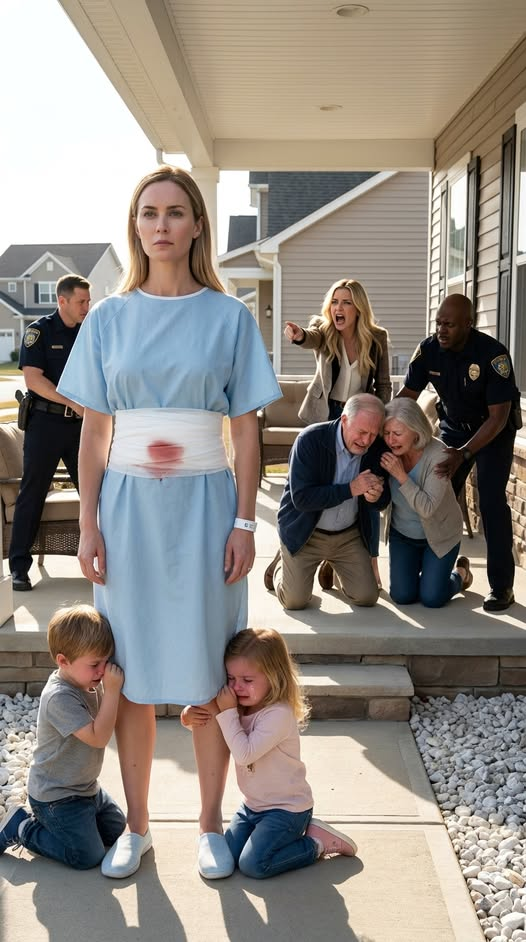
The hospital discharged me at five o’clock. I drove myself home, a direct violation of medical protocol, because I had no one else to call. When I pulled into my driveway, Margaret Doyle was walking my children across the manicured lawn. Sophie slammed into my legs, burying her tear-stained face into my thighs. Oliver walked up slowly, his small shoulders tight with a stress no seven-year-old should carry.
“Mom,” Oliver asked quietly, looking at my pale face. “Are you okay? I held her hand the whole time.”
I dropped to my knees on the asphalt, ignoring the screaming pain in my abdomen, and pulled them both into my chest. “You did so good, my brave boy,” I wept into his hair.
Sophie pulled back, her big brown eyes looking up at me in utter confusion. “Mommy? Grandma said Auntie Amber needed her more.”
That night, after scrubbing the day away in a hot shower and putting the kids to bed, I sat alone at my kitchen table. I opened my laptop and absentmindedly scrolled through Instagram.
I navigated to Amber’s profile. There, posted at 10:48 AM—exactly when the surgeon was slicing into my flesh—was a selfie of Amber in a salon chair, wrapped in a black cape. The caption read: Emergency Glam Sesh! Mom came through last minute!
Beneath it was a comment from Diane: Anything for my girl.
I kept scrolling. At 1:30 PM, Amber posted a photo of two iced lattes resting on a marble cafe table, sunlight streaming over the foam. Post-salon brunch with my bestie, aka Mom.
At 1:30 PM, I was waking up to fourteen missed calls. At 1:30 PM, my son was spreading peanut butter on white bread in a neighbor’s kitchen because his grandparents had abandoned him.
I took screenshots of both posts. I connected my laptop to the wireless printer. As the pages slid warmly into the tray, I reached out and pulled the manila folder toward me. The trap they had built for me was about to become their permanent exile.
Chapter 3: The Quiet Eradication
Revenge, I realized sitting in the blue glow of my laptop screen, doesn’t need to be loud. It doesn’t require screaming matches on front lawns or dramatic, tear-soaked letters. True, lasting vengeance is entirely administrative.
I grabbed a blue ballpoint pen and flipped open the heavy cover of the manila folder. On the blank inner margin, I wrote down a numbered list.
1. Locks. 2. School Pickup Authorization. 3. Last Will & Testament. 4. Power of Attorney. 5. Medical Directives. 6. Life Insurance Beneficiaries.
Six items. Six bureaucratic walls I was going to construct between my toxic lineage and the children they had endangered.
The eradication began on Wednesday morning. At 8:15 AM, I contacted Ridgeview Lock and Key. A quiet, burly man named Dale arrived in a white utility van an hour later. He didn’t ask questions as I handed him cash from my emergency envelope. He simply dismantled the hardware on my front and back doors, replacing the old, compromised tumblers with heavy, brass deadbolts. He reprogrammed the garage keypad.
While Dale was drilling into the doorframe, my phone vibrated on the counter. Mom. I watched her name flash across the glass for six agonizing rings. A voicemail icon popped up shortly after. I didn’t listen to it. I didn’t need to hear the cheerful, manufactured tone she was undoubtedly using to test the waters.
Dale handed me three pristine, jagged brass keys. I gave one to Margaret Doyle, who accepted it with a solemn, silent nod. I slid one onto my own keychain. I placed the third in a padded envelope to mail to Marcus at his Denver hotel. There would be no spare key hidden under the ceramic frog for Diane anymore. Item one: Done.
Thursday morning, day two of the exile. I drove to Ridgeview Elementary.
The administrative office smelled of laminating plastic and floor wax. Mrs. Holt, the school secretary who had manned the front desk for fifteen years, peered at me over the rim of her reading glasses.
“Mrs. Walsh, what can we do for you today?” she asked warmly.
“I need to immediately update Oliver and Sophie’s emergency contact and authorized pickup lists,” I stated, my voice devoid of emotion.
Mrs. Holt pulled the manila file from a rolling cabinet. She slid the single sheet of paper across the laminate counter. I stared at the two names printed neatly on the left column: Diane Walsh (Grandmother). Ray Walsh (Grandfather). I pressed my pen to the paper and drew a thick, aggressive line straight through their names. It was a physical severing. Beneath the crossed-out text, I wrote in Margaret Doyle’s name, and added Marcus’s sister, Clare Walsh, who lived in Charlotte.
Mrs. Holt watched my hand move. She had been at this desk long enough to understand the silent tragedies of suburban families. She didn’t press for details. She simply took the paper back, her eyes lingering on the heavy strike-through lines.
“I’ll have this updated in the system before the lunch bell,” she promised quietly.
As I walked out of the school, the cool morning air hit my face. As of 9:43 AM, my parents legally ceased to exist in the eyes of my children’s educators. Item two: Done.
Friday afternoon brought me to the second floor of a converted Victorian house on Main Street. Sandra Klein was a silver-haired family attorney who kept a bowl of butterscotch candies on her mahogany desk. She had drafted our original will when Oliver was born.
I sat in the plush leather chair opposite her, wincing slightly as my stitches pulled, and laid my thick manila folder on the wood.
“I need to amend our estate documents,” I told her, opening the folder to reveal my handwritten list. “I need Diane and Ray Walsh removed from the Last Will and Testament as guardianship nominees. I need them stripped from the Power of Attorney, and entirely excised from the medical directives.”
Sandra stopped typing. She lowered her glasses to the bridge of her nose. “Both of them, Whitney? In every capacity?”
“Every single one,” I confirmed, my gaze unwavering. “Replace them all with Clare Walsh.”
The clicking of Sandra’s keyboard was the only sound in the office. Thirty minutes later, her paralegal carried in a stack of freshly printed documents and a heavy brass notary stamp. I signed my name six times in blue ink. The satisfying thump of the notary seal felt like a gavel coming down in a courtroom. Items three, four, and five: Done.
Saturday morning, I sat at my kitchen table listening to twenty-two minutes of hold music before a life insurance agent named Kevin finally answered the line. It took me less than three minutes to scrub my mother’s name from the contingent beneficiary slot on my policy, redirecting the funds to my sister-in-law.
I took my pen and aggressively scratched out the final item on my list.
The architecture of my revenge was complete. But the silence I was projecting outward was causing a tempest on the other end.
The voicemails had been piling up like uncollected mail. Diane’s tone had morphed from sweet, to confused, to deeply irritated. “This is getting ridiculous, Whitney. I am your mother. I don’t know what you think happened, but this silent treatment is childish.”
Then came the text from Amber. Mom’s been crying all week. You’re being dramatic. It was just a few hours. Can you please just call her back?
They weren’t sorry they had abandoned my children; they were furious that I was refusing to play my assigned role in their narrative. They needed the compliant, invisible Whitney back to validate their choices.
On Sunday afternoon, Marcus finally walked through the front door, dropping his duffel bag in the hallway. He had canceled his Denver presentation and caught a red-eye flight the moment I told him the scope of the betrayal. He sat across from me at the kitchen table, reading through the contents of the manila folder. He studied the school forms, the notarized will, and finally, the timestamped Instagram photos of the iced lattes.
Marcus is a man of few, but heavy, words. He closed the cardboard flap, reached across the table, and placed his warm, calloused hand over my trembling fingers.
“You did the right thing,” he said, his eyes burning with a quiet, lethal anger on my behalf.
I exhaled a breath I felt like I had been holding for thirty-two years. But the peace of the afternoon was about to be shattered. I looked at the clock on the microwave. It was 5:00 PM. Sunday dinner.
I knew my mother couldn’t tolerate an unresolved conflict that painted her as the villain. She was coming to force the narrative back into alignment. And she was going to use a pot roast to do it.
Chapter 4: The Price of Pot Roast
At precisely 5:15 PM, the silver Camry turned onto our street, moving with the slow, deliberate crawl of a diplomat entering a hostile territory. From my vantage point at the kitchen window, I watched the tires crunch against the gravel of our driveway. Moments later, Amber’s red Civic pulled in directly behind them. The entire tribunal had arrived.
I stood in the hallway, the manila folder clutched firmly against my right hip. My white blouse was crisp; my posture was rigid. I wasn’t the hunched, bleeding woman they had abandoned on Tuesday. I was a fortress.
Through the glass panes of the front door, I watched my mother march up the concrete walkway. She was balancing a heavy glass Pyrex dish in the crook of her arm, the rich, savory scent of rosemary and roasted garlic wafting through the mesh screen. It was her signature Sunday pot roast—the culinary white flag she deployed whenever she needed to sweep a family sin under the rug.
Diane didn’t bother pressing the doorbell. She assumed the access she had always possessed was a permanent birthright. She shifted the hot dish, reached into her leather purse, and retrieved her shiny brass key.
I stood motionless as she slid the metal into the keyhole.
She turned her wrist. The key stopped dead, refusing to budge. Diane frowned, pulling it out and blowing on the grooves, assuming the mechanism was merely sticking. She thrust it back in and twisted harder. The heavy, newly installed deadbolt remained utterly defiant.
“Ray,” my mother snapped, her voice muffled through the wood. “This lock is jammed.”
My father trudged up the porch steps, sighing heavily. He took the key from her, jiggling the handle and applying his weight against the frame. “It’s not turning, Diane. This isn’t the right key.”
From the bottom of the steps, Amber rolled her eyes dramatically. “Oh my god, just ring the bell. She’s probably inside sulking.”
The chime echoed through the hallway. I counted to three, slowing the frantic hammering of my pulse, and pulled the heavy door open.
Diane’s face instantly snapped into a mask of maternal warmth, an instinctual muscle memory that failed to reach her eyes. She thrust the Pyrex dish forward. “Whitney! We brought the pot roast! I made extra gravy, just the way you—”
“Your key doesn’t work,” I interrupted, my voice perfectly level.
Diane’s smile faltered, her arms dropping an inch. The gravy sloshed aggressively against the aluminum foil. “What do you mean?”
“I had the locks changed on Wednesday morning,” I stated, staring directly into her bewildered eyes.
Ray blinked, looking from the brass knob to my face. “Whitney, what is this? Can we just come inside and eat? Your mother spent all afternoon cooking.”
“No.”
It was a complete sentence. A brick wall of a word. Diane physically recoiled as if I had slapped her across the cheek.
“Whitney, please, stop this nonsense,” Diane hissed, her gaze darting nervously toward Mrs. Doyle’s house next door, terrified of an audience. “We are here to apologize for the miscommunication.”
“There was no miscommunication,” I replied, flipping open the heavy cover of the manila folder. I didn’t need to yell. The paper trail was devastating enough on its own.
I extracted the first document and held it up under the buzzing glow of the porch light. “This is the updated authorization form for Ridgeview Elementary. Your names have been permanently removed. You are no longer legally permitted to pick up my children.”
Diane stared at the paper, a smudge of condensation dripping from the hot glass dish onto her pristine blouse. The blood began to drain rapidly from her face, leaving her skin a sickly, chalky white. “Whitney… you didn’t.”
I pulled the second document from the stack. “This is the notarized codicil to our Last Will and Testament. You and Dad have been legally stripped of your guardianship nominations. Marcus’s sister, Clare, has full custody if we die.”
“Clare?” Ray gasped, his neutral facade finally cracking into genuine shock. “You’re giving the kids to Marcus’s family? Over your own blood?”
“My blood left them on a concrete porch in the sun,” I fired back, pulling the final pages from the folder. “I also removed you as the contingent beneficiary on my life insurance, and revoked your medical directive authorizations.”
Amber marched up the wooden steps, her arms crossed aggressively over her chest. “Are you insane? You changed your life insurance because Mom made one mistake? You are tearing this family apart over one afternoon!”
I turned my glacial stare onto my younger sister. The golden child. The parasite. “You needed Mom for a haircut, Amber. I needed her because my abdomen was being sliced open. And she chose you. Just like she has chosen you every single day for thirty-two years.”
Diane’s composure completely shattered. The performative maternal grace vanished, replaced by a venomous, panicked rage. The glass dish rattled violently in her trembling hands. “This is psychotic!” she shrieked. “I am your mother! I have given you everything! We are always there for you!”
“Always?” I asked softly. I reached into the back of the folder and pulled out the glossy, color-printed sheet of paper. I turned it around, shoving it inches from my mother’s face.
It was the Instagram screenshot. The marble table. The two iced lattes.
“You posted this photo at 1:30 PM, Mom,” I whispered, my voice thick with unshed tears. “Look at the timestamp. I was waking up in the recovery room at 1:30. I was trying to hold a phone with numb fingers to call a neighbor who had to rescue my babies because you had vanished.”
Diane stared at the printed photo. Her mouth opened and closed silently, her brain misfiring as she tried to spin a lie out of digital concrete. “That… that was after we dropped them off…”
“After you dropped a five-year-old and a seven-year-old at nobody’s house?” I countered.
Ray stepped forward, raising his hands in his classic, conflict-avoidant surrender pose. “Whitney, honey, blood is blood. You do not throw your family away over a bad judgment call.”
“Dad,” I said, my voice cracking for the very first time. “Oliver had to make Sophie a peanut butter sandwich in Mrs. Doyle’s kitchen. He is seven years old. He shouldn’t have to parent his sister because you couldn’t be bothered.”
Through the mesh screen behind me, a small voice echoed from the hallway.
“Mommy?”
Oliver appeared in the doorway, clutching a piece of construction paper in his small hand. He looked past my hip, staring at the three adults standing frozen on the porch.
“Is Grandma coming inside for dinner?” he asked innocently.
I looked down at the paper he was holding. It was a crayon drawing of our house. A square box with a triangle roof. Inside the box were four stick figures. Standing far off to the side, entirely outside the drawn walls of the house, was a fifth, smaller figure. Beneath it, written in wobbly letters, was the word: Grandma.
Diane saw the drawing. I watched her eyes track the crude crayon lines. For one single, unguarded second, the impenetrable armor of her narcissism cracked. I saw genuine devastation flash across her features. She looked like a woman who had just realized she was standing on the wrong side of a locked door, entirely of her own making.
But the vulnerability lasted only a heartbeat. The armor snapped back into place, thicker than before. Her chin jutted upward. Her eyes hardened into dark, glittering stones.
“You are going to regret this, Whitney,” Diane hissed, her voice dripping with malice. “When you fall apart—and you will fall apart—do not come crying to me. I won’t be there.”
I looked at the woman who had birthed me, the woman who had missed my milestones, who had celebrated my sister’s vanity while ignoring my bleeding wounds.
“You weren’t there on Tuesday, Mom,” I said softly.
And with that, I stepped back into my home, and pushed the heavy oak door shut.
Chapter 5: A Table Set for Four
The heavy brass deadbolt engaged with a sharp, metallic thunk. It was the sound of absolute finality.
Through the thick wood, I could hear the muffled, frantic whispers of my family. I heard Amber’s whiny complaints, my father’s heavy sighs, and the harsh click of my mother’s heels retreating down the concrete walkway. Three car doors slammed in succession. The engines revved, and the tires backed out of the driveway, carrying the toxic debris of my past away into the Sunday evening.
I leaned my spine against the door, the manila folder pressed tightly against my chest. My heart was hammering against my ribs like a trapped bird.
Marcus stepped out from the shadows of the living room hallway. He had been standing just around the corner the entire time, giving me the space I demanded, but ready to intervene the moment I faltered. He walked toward me in the dim light, gently prying the crushed cardboard folder from my rigid fingers. He set it on the entryway table.
Without a word, he wrapped his strong, steady arms around my shoulders, tucking my head under his chin. He smelled like clean laundry detergent and dark roast coffee. He didn’t offer empty platitudes. He didn’t ask if I was alright.
“You are incredible,” he whispered into my hair.
I buried my face in his chest, allowing the tension to slowly drain from my aching muscles. We stood in the quiet hallway until the sound of small, rubber rain boots squeaking against the hardwood broke the silence.
Sophie rounded the corner, still wearing her bright yellow boots despite the clear sky outside. She tugged on the hem of Marcus’s jeans.
“Daddy,” she chirped, looking up with massive, hopeful eyes. “Can we eat the pot roast now?”
Marcus and I looked at each other. A small, exhausted, genuine laugh bubbled up from my chest. It was the laughter of a survivor standing in the wreckage of a storm that had finally passed.
“No pot roast tonight, baby,” I smiled, bending down to tap her nose. “How about grilled cheese and tomato soup?”
That evening, Oliver meticulously set the dining room table. He laid out four ceramic plates. Four folded paper napkins. Four glasses of ice water.
There were no empty chairs to stare at. There was no anxiety humming in the air about who might show up late, who might leave early, or who was going to make a passive-aggressive comment about the dryness of the chicken. For the first time in thirty-two years, I looked at a dinner table and realized that everyone who truly mattered was already sitting in the room. Four plates were exactly enough.
The weeks that followed were remarkably, beautifully quiet.
My mother never returned to the sage green colonial on Birch Lane. I don’t know if her absence was born of stubborn pride or an attempt at punishment, but the silence was a gift. My father sent exactly one text message a week later: Your mother is not eating. I deleted it without responding. It was just Ray, outsourcing the emotional labor of his wife’s tantrums, hoping I would fix the machinery so he could go back to sleep.
Amber, predictably, took her grievances to a public forum. She began posting a barrage of passive-aggressive quotes on her Instagram stories, plastered over generic sunset backgrounds. Family means forgiveness. Life is too short for grudges. Real love doesn’t hold onto the past. When the third quote appeared on my feed, I tapped the unfollow button. The digital tether snapped, and another voice telling me I owed my suffering for someone else’s comfort vanished into the ether.
Margaret Doyle began walking over on Tuesday evenings, carrying foil-covered casseroles and looking at me with her fierce, teacherly pride. Marcus installed a high-definition video doorbell on the front porch—not out of fear, but out of the quiet understanding that desperate people rarely respect boundaries.
Oliver eventually stopped asking if Grandma was coming over. He was a resilient seven-year-old, quickly filling the void with soccer practice and massive Lego fortresses. Sophie still asked occasionally, usually right before bedtime when the house grew dark and quiet.
“Mommy,” she whispered one night, clutching the frayed ears of her stuffed rabbit. “When is Grandma coming back?”
I sat on the edge of her twin mattress and gently tucked a stray curl behind her ear. I didn’t lie to her. I didn’t tell her Grandma was busy or on a trip.
“Grandma made a choice that wasn’t safe for you,” I explained softly, holding her small hand. “And Mommy’s only job in the whole world is to keep you safe. That is the most important thing I will ever do.”
Sophie blinked, processing the simple truth. “Okay, Mommy,” she murmured, closing her eyes and drifting off to sleep.
Society conditioned me to believe that severing ties with your own bloodline is the hardest, most unnatural act a person can commit. They tell you family is everything. They are wrong.
The hardest thing I ever did was staying. The hardest thing was smiling through three decades of being the invisible pillar, training the people who shared my DNA that my pain was an acceptable currency to purchase their convenience. The true tragedy was continually handing my vulnerable children over to people who had never once put me first, praying that a miracle would suddenly rewrite their nature.
Closing the brass deadbolt on my mother was not a tragedy. It was the first truly easy decision I had ever made. It just took me thirty-two years to earn the key.