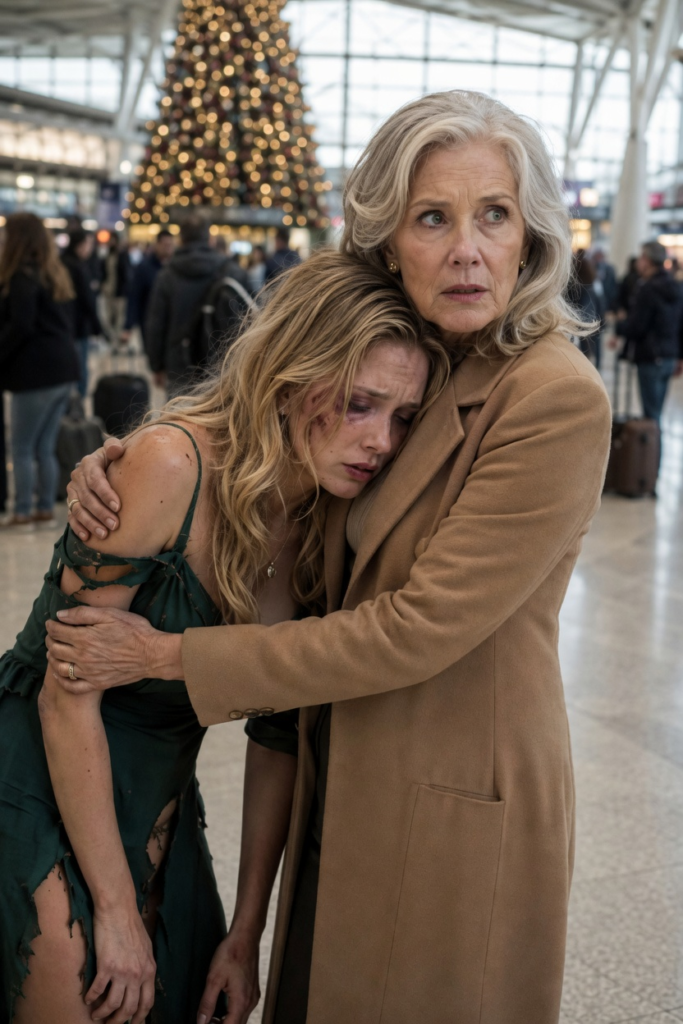
The ambulance arrived before the police car.
You stood beside Mariana on the cold metal bench, one arm around her shoulders and the other holding your phone, recording every second. Not because you were thinking like a mother now, but because some part of you had never stopped thinking like a prosecutor.
Evidence disappears when cruel people have money.
You knew that better than anyone.
Mariana leaned against you, trembling under your coat, her breath shallow and broken. Every time she inhaled, pain crossed her face like a shadow. You wanted to scream, to drive straight to Rodrigo’s house and drag him out by the collar.
But rage was useful only when disciplined.
So you became calm.
When the paramedics reached her, one of them asked what happened. Mariana tried to answer, but her voice failed. You answered for her, clearly, carefully, with dates, time, names, location, and the exact words Rodrigo had spoken on the phone.
“My daughter was assaulted by her husband, Rodrigo Salazar, and his mother, Beatriz Salazar. She was abandoned here after Christmas Eve with visible injuries and possible internal trauma. The aggressors are currently at their home and may be destroying evidence.”
The paramedic looked at you differently after that.
So did the two officers who arrived moments later.
You gave them your name, your ID, and the audio recording of Rodrigo’s call. When one officer heard Beatriz laughing and saying Mariana should be grateful she was still alive, his jaw tightened.
That sentence would follow Beatriz for the rest of her life.
The ambulance doors closed with Mariana inside, and you climbed in without asking permission. You took your daughter’s hand and held it while the city blurred through the small window. Christmas lights still hung across the streets.
They looked obscene now.
Mariana whispered your name.
“I’m here,” you said.
“They’ll say I started it.”
“I know.”
“They’ll say I’m jealous.”
“I know.”
“They’ll say I’m crazy.”
You leaned closer. “Then we will make them say it under oath.”
Her eyes filled with tears.
For years, Mariana had begged you not to interfere. She had told you Rodrigo was stressed, Beatriz was old-fashioned, marriage was complicated, and things always looked worse from the outside. You had listened more than you should have, because she was your daughter and grown women sometimes have to reach the door themselves.
But this time, Rodrigo had carried her to the edge of death and left her in a terminal like unwanted luggage.
The door had opened.
You were stepping through.
At the hospital, the doctors moved fast. Bruised ribs. A fractured wrist. Internal bleeding that required immediate attention. Cuts, swelling, and marks on her arms consistent with being restrained.
Every sentence the doctor spoke was another nail in Rodrigo’s future.
You signed what needed signing. You called the victim services unit. You called your old colleague from the Attorney General’s office, a woman named Patricia Rivas, who still owed you three favors and respected you enough not to ask unnecessary questions.
When Patricia answered, her voice was sleepy.
Then you said Mariana’s name.
She was fully awake in one second.
“What do you need?” she asked.
“A preservation order. Search support. Medical certification. Digital evidence collection. And I need the house watched before they clean it.”
There was a pause.
“Teresa,” Patricia said, “are you sure you want to step back into this world?”
You looked through the glass at Mariana lying under white hospital lights, her face swollen, her Christmas dress cut away and placed into an evidence bag.
“No,” you said. “I want to burn the road behind them.”
By 8:10 a.m., an officer was stationed outside Mariana’s hospital room.
By 8:40, the first formal report was filed.
By 9:15, a police unit was already outside the Salazar house in Las Lomas, watching every movement.
And inside that house, Rodrigo still believed he had won.
He had no idea you were sitting in a hospital hallway making phone calls that would collapse his entire family before lunch.
At 10:03, your phone rang.
Rodrigo.
You looked at the screen for three seconds before answering. Patricia was beside you by then, and she silently activated a recording device. You put the call on speaker.
“Teresa,” Rodrigo said, his voice controlled and irritated. “I hope you took Mariana somewhere to calm down.”
You looked at Patricia.
She nodded.
You said, “She’s in the hospital.”
A short silence.
Then Rodrigo sighed.
“Of course she is. Always dramatic.”
You closed your eyes.
If hate had a temperature, yours would have frozen the floor.
“She has a fractured wrist and possible internal injuries.”
“Maybe she shouldn’t have thrown herself around.”
Patricia’s eyebrows lifted.
You kept your voice flat. “You called me this morning and told me to pick her up from the terminal because another woman was taking her place.”
Rodrigo laughed softly. “You misunderstood. Mariana was upset. She left on her own.”
“You said Beatriz told her to be grateful she was alive.”
Another pause.
This one was longer.
Rodrigo’s tone changed. “You need to be careful with accusations.”
“No,” you said. “You do.”
His voice sharpened. “Listen to me, Teresa. Your daughter has no money, no children, no proof, and no one important behind her. If she tries to make this ugly, I will make sure everyone knows what kind of unstable woman she is.”
Patricia wrote something down.
You almost smiled.
He had just given you motive, threat, and character evidence in one sentence.
“You think no one important is behind her?” you asked.
Rodrigo exhaled like you amused him. “You sell cakes.”
You looked at the hospital doors.
“Yes,” you said. “And before that, I put men like you in prison.”
The line went silent.
You heard movement on the other side. A chair scraping. A door closing. Rodrigo breathing differently now.
“What does that mean?”
“It means you should stop talking unless your lawyer is present.”
You hung up.
Patricia looked at you with the same expression she used to wear twenty years ago when a suspect accidentally confessed to something not yet asked.
“He’s arrogant,” she said.
“They always are before they understand the room has changed.”
At the Salazar house, Christmas was still arranged like a performance.
The long dining table had gold plates, red napkins, crystal glasses, and an empty chair where Mariana had sat for five years trying to behave well enough to be loved. On that morning, according to the first officer’s report, Valeria was already there.
The other woman.
She had arrived wearing a cream coat and pearl earrings, probably expecting a glamorous Christmas lunch where Rodrigo would publicly introduce her as the woman who “understood him.” Instead, she found Beatriz ordering the housekeepers to scrub the hallway floor and remove a stained rug.
That rug became the first seized item.
When the officers entered with the warrant, Beatriz screamed.
Not out of guilt.
Out of outrage.
“You cannot come into my son’s house like this,” she shouted, blocking the entry with one hand pressed against her chest. “We are a respectable family.”
The lead officer looked past her to the rolled rug near the stairs.
“Ma’am, step aside.”
Rodrigo came down wearing a navy sweater and the expression of a man trying to look inconvenienced instead of afraid. He saw the officers, then the evidence technician, then Patricia walking in behind them.
His face changed.
Then he saw you.
You had left the hospital only after Mariana was stable and after your sister arrived to sit with her. You were still wearing the same coat from dawn. Your hair was pulled back. Your eyes were dry.
Rodrigo stared at you like you had entered the wrong story.
“Teresa,” he said.
You looked at the house.
The staircase garland.
The polished floor.
The table set for a celebration your daughter had been beaten out of.
Then you looked at him.
“Merry Christmas.”
Beatriz’s mouth opened. “How dare you bring police to my home?”
You turned your phone toward her and played the recording.
“Dile que agradezca que la dejamos viva.”
Her own voice filled the entryway.
The effect was immediate.
Valeria, standing near the dining room, stepped backward. Her face went pale. She looked from Beatriz to Rodrigo, and something like realization crossed her eyes.
That was the first time you understood she had not known everything.
Not enough to be innocent.
But enough to be shocked.
Rodrigo recovered first. “That was taken out of context.”
You tilted your head. “Please explain the context where a beaten woman should thank you for leaving her alive.”
He said nothing.
Beatriz stepped in. “Mariana attacked my son. She was hysterical. We only defended ourselves.”
You looked at the evidence technician lifting the rug.
“Then why clean the floor?”
Beatriz froze.
Rodrigo snapped, “Because she made a mess.”
Every officer in the entry heard it.
So did Valeria.
She flinched like the words had touched her.
You turned toward the dining table and saw the empty chair beside Rodrigo’s. A red napkin was folded over the plate. Someone had already placed a name card there.
Valeria.
Not Mariana.
You walked to the table slowly. Nobody stopped you. You picked up the card and held it between two fingers.
“You couldn’t even wait for the bruises to fade.”
Rodrigo’s face hardened. “My marriage was over long before last night.”
“Then you should have signed divorce papers, not used a golf club.”
Beatriz screamed, “Liar!”
The housekeeper in the hallway began crying.
You turned toward her.
She looked terrified, hands trembling around a cleaning cloth.
“What’s your name?” you asked.
“Rosa,” she whispered.
Beatriz snapped, “Rosa, go to the kitchen.”
“No,” Patricia said. “Rosa stays.”
You looked at the woman gently. “Did you see what happened last night?”
Rosa’s eyes darted toward Rodrigo.
He smiled at her.
Not kindly.
Threateningly.
You recognized the expression.
You had seen it on cartel accountants, corrupt officials, abusive husbands, and men who believed poor women were invisible.
“Rosa,” you said, “if anyone threatened your job, your immigration status, your family, or your safety, say it now. There are officers here. There are witnesses here. You are not alone in this room.”
The woman’s face collapsed.
Then she began to speak.
At first, softly.
Then faster.
She said Mariana had arrived during the Christmas Eve gathering and heard Rodrigo telling Valeria that soon she would sit “where a real woman belonged.” Mariana confronted him in the hallway. Beatriz grabbed Mariana’s arms. Rodrigo pushed her against the wall. Then came the golf club.
Valeria covered her mouth.
Rodrigo shouted, “She’s lying!”
Rosa sobbed. “You told me to wash the blood before the guests woke up.”
The room went silent.
Even Beatriz stopped breathing.
You felt something inside you settle.
There it was.
The witness they forgot to fear.
Because in families like the Salazars, the staff sees everything.
They only underestimate the day someone finally asks them safely.
The police began separating everyone.
Beatriz demanded her lawyer. Rodrigo demanded his phone. Valeria demanded to know whether she was “in trouble.” Rosa was escorted gently to another room to give a formal statement.
You watched Rodrigo’s confidence thin layer by layer.
He still believed his name could help him. The Salazars had old money, business contacts, political friends, and a talent for turning cruelty into “private misunderstandings.” He probably believed someone would make a call.
Someone always had.
But by noon, those calls were going unanswered.
Because Patricia had already made calls too.
And hers had warrants attached.
At the hospital, Mariana woke after the first procedure with your sister beside her and you on speakerphone. Her voice sounded small, far away, still caught between sedation and fear.
“Did they clean the house?” she asked.
“They tried.”
“Did anyone believe Rosa?”
“Yes.”
She cried then.
Not from pain, though there was plenty of that.
She cried because someone had seen.
For women like Mariana, being believed can feel almost as shocking as being hurt. Pain becomes familiar. Disbelief is expected. But a witness, a record, a hand reaching through the fog—that can break the dam.
You returned to the hospital before evening.
Outside her room, you paused to steady yourself. You had spent the day as Teresa Navarro, former federal prosecutor, calm and precise and impossible to intimidate. But when you entered and saw your daughter’s face under the fluorescent lights, you became only her mother.
You sat beside her bed and took her hand.
“I’m sorry,” you whispered.
Her eyes filled. “For what?”
“For every time I let you tell me it wasn’t that bad.”
She looked away.
“I would have lied harder if you pushed.”
“I know.”
You did know.
That was the cruelty of abuse. It taught victims to defend the cage because admitting the truth meant admitting how long they had been inside it. Mariana had not stayed because she was weak.
She stayed because leaving required a bridge she could not yet see.
You squeezed her hand.
“The bridge is here now.”
She cried quietly.
Outside the hospital room, two officers stood guard.
At the Salazar house, three people were no longer celebrating Christmas.
Rodrigo was taken in for questioning that afternoon. Beatriz followed shortly after, screaming that she had high blood pressure and could not be treated like a criminal. Valeria was not arrested that day, but her statement became part of the investigation.
At first, she claimed she had seen nothing.
Then Patricia showed her the name card, the cleaned hallway, Rosa’s statement, and screenshots from Rodrigo’s phone.
That was when Valeria changed her story.
Not completely.
People like her rarely become brave all at once.
But she admitted Rodrigo told her Mariana was “being removed” from the family. She admitted Beatriz had said Christmas Day would be the perfect time to introduce her because “people accept new arrangements when presented with confidence.” She admitted she heard a scream and saw Mariana on the floor.
Then she said the sentence that destroyed Rodrigo’s defense.
“I thought they were just scaring her.”
Just scaring her.
As if terror were a family tradition.
As if a woman’s body could be used as a warning and still leave everyone respectable.
When Patricia called you with that update, you were standing near the hospital vending machines, staring at a row of stale sandwiches.
“Good,” you said.
“Good?” Patricia asked.
“She placed herself in the room.”
“Yes,” Patricia said. “She did.”
By the next morning, the press had not yet found the story.
You wanted it that way.
At least for now.
Public outrage is loud, but legal groundwork is stronger when built before cameras arrive. You had seen too many families weaponize media sympathy, too many wealthy defendants cry persecution before victims could breathe.
So you focused on paper.
Medical reports.
Audio recordings.
Rosa’s testimony.
Valeria’s statement.
Evidence from the house.
Security footage from the neighborhood gate.
A timestamped video from a neighbor’s camera showing Rodrigo’s driver carrying Mariana toward a black SUV at 4:43 a.m.
And footage from the Central del Norte entrance showing her being left near the benches.
That video broke you.
You watched it once in Patricia’s office.
Mariana stumbled when they pulled her from the vehicle. She was barely standing. Rodrigo’s driver looked around nervously, then left her there with no phone, no coat, and no money visible in her hands.
You walked out before the clip ended.
In the hallway, you pressed one hand against the wall and tried not to vomit.
Patricia followed.
“I can handle the next viewing,” she said.
You shook your head.
“No. I needed to see what they thought she was worth.”
Your daughter.
Your only child.
Left under a bus terminal light on Christmas morning by people who had eaten at her table, accepted her gifts, and called themselves family.
When you returned to Mariana’s hospital room, you did not tell her about the video yet. She had enough pain inside her body. The legal details could wait until her lungs no longer hurt with every breath.
But Mariana knew you.
She opened her eyes and said, “It’s bad, isn’t it?”
You sat beside her.
“Yes.”
“Do I have to go back to that house?”
The question hit you like a blow.
Not will Rodrigo go to prison.
Not what happens to Beatriz.
Not is Valeria still there.
Do I have to go back?
That told you what marriage had become for her.
Not love.
A place she feared being returned to.
“No,” you said. “Never.”
Mariana closed her eyes and cried silently.
You made arrangements that afternoon. Your house in Coyoacán was prepared for her recovery. A nurse. A therapist referral. New locks. A security camera at the front gate. Clothes, toiletries, soft blankets, everything she would need so she would not have to ask Rodrigo’s family for a single sock.
Then you called a locksmith for the Salazar house too.
Because there was one fact Rodrigo had forgotten.
The house he lived in had not been bought with his money.
It was in Mariana’s name.
Her grandfather—your late husband—had left her enough from a quiet investment portfolio to purchase the property before she married Rodrigo. The Salazars had always acted like it was theirs because their last name sounded expensive and Mariana never corrected them publicly.
Rodrigo had told guests it was “the Salazar family house.”
Beatriz had called it “my son’s home.”
But the deed said Mariana Navarro.
And you had kept a copy.
On December 27, while Rodrigo’s attorneys were still arguing about his detention and Beatriz was giving dramatic medical complaints from a private clinic, you walked into that house with a court order, a locksmith, and Mariana’s signed authorization.
Rosa opened the door.
Her eyes filled with relief when she saw you.
“Señora Teresa,” she whispered.
“You don’t work for them anymore,” you said. “If Mariana chooses to keep staff later, that will be her decision. For now, you are safe, and your statement is protected.”
She began to cry again.
You wished people with money understood how many lives they casually held hostage in their living rooms.
The locksmith changed every exterior lock.
The security company reset the alarm.
The household accounts were frozen.
Personal items belonging to Rodrigo, Beatriz, and Valeria were packed under supervision and inventoried. Nothing was thrown away. Nothing was stolen. Nothing was dramatic.
Consequences look best when documented.
At 2:30 p.m., Beatriz arrived in a black car with oversized sunglasses and a scarf wrapped around her hair, looking like a woman arriving for a funeral she intended to blame on someone else. She marched to the front door and stopped when her key did not work.
You watched from inside.
She tried again.
Then again.
Her face changed.
You opened the door but left two officers visible behind you.
“Teresa,” she said, voice trembling with outrage. “Open my house.”
You looked at her.
“You mean Mariana’s house.”
Her mouth twisted. “Don’t be ridiculous.”
You held up the deed copy.
Her eyes moved across the page.
First confusion.
Then recognition.
Then panic.
“No,” she whispered.
“Yes.”
“Rodrigo said—”
You interrupted. “Rodrigo lies.”
Beatriz grabbed the paper, but you pulled it back before she could touch it.
“This house belongs to my daughter. You are not entering without her permission.”
Beatriz’s face turned red. “I lived here.”
“You abused the owner.”
“I am his mother.”
“And nothing to the deed.”
That sentence broke something in her.
For years, Beatriz’s power had rested on roles: mother, matriarch, hostess, judge of women, keeper of family dignity. But legal ownership did not care who hosted Christmas. It cared who signed.
And Mariana had signed.
Beatriz looked past you into the foyer. The garland was still there. The dining table was bare now, the name cards collected as evidence. The empty chair no longer waited for Valeria.
“You can’t put me out,” she said.
“I can,” you replied. “And I am.”
Her voice dropped into a hiss. “Your daughter will regret this. Rodrigo will destroy her in court. He knows things.”
You stepped closer.
“So do I.”
Beatriz’s face shifted.
Fear.
Real fear.
The kind she should have felt before laughing on the phone.
You lowered your voice. “I know about the shell account in your sister’s name. I know about the jewelry bought with Mariana’s card and reported as household expenses. I know about the medical records Rodrigo pressured her not to file. I know about the driver. I know about the rug. I know about the golf club.”
Beatriz’s lips parted.
“And by tomorrow,” you said, “I will know more.”
She stepped back.
Not because you shouted.
Because you didn’t.
When she left, she did not walk like a queen.
She walked like someone hearing sirens even when none were present.
That night, Mariana was discharged into your care.
She wore loose clothes your sister brought and moved slowly, one arm supported, ribs wrapped, face still swollen. When she entered your Coyoacán house, she stopped in the doorway and looked around like she did not trust peace.
You had decorated for Christmas before everything happened. There was a small tree in the corner, white lights along the window, and a nativity scene your husband carved years before. The house smelled of cinnamon again, but softer now.
Not like the morning phone call.
Like home.
Mariana lowered herself onto the couch and looked at the tree.
“I ruined Christmas,” she whispered.
You knelt in front of her, careful not to touch her injuries.
“No. They did.”
She swallowed.
“Everyone will know.”
“Yes.”
“They’ll talk.”
“Yes.”
“They’ll say I failed as a wife.”
You took her hand.
“Then we will let them talk until they run out of breath. Your job is to stay alive.”
She broke then.
All the fear, shame, pain, humiliation, and disbelief came out in harsh sobs that shook her injured body. You held her carefully while she cried, wishing you could go back in time and stand between her and every hand raised against her.
But mothers do not get time machines.
Only mornings after.
And what they choose to do with them.
The Salazars fought back within days.
Their attorneys released a statement calling the incident “a private marital conflict distorted by external influence.” They implied Mariana was emotionally unstable, jealous of Valeria, and financially dependent on Rodrigo. They said Beatriz was an elderly woman being persecuted by an aggressive former official.
You read the statement at your kitchen table with Patricia beside you and Mariana asleep upstairs.
Patricia looked angry.
You felt almost bored.
Bad men love predictable scripts.
Hysterical wife.
Overprotective mother.
Family misunderstanding.
Respectable man.
You had prosecuted that story in a hundred different costumes.
“This goes public now,” you said.
Patricia nodded. “Carefully.”
You did not give interviews at first.
You gave documents.
To the right journalist.
A serious one.
The story broke on January 2.
Not as gossip.
As an investigation.
“Businessman Accused of Assaulting Wife After Christmas Eve Gathering; Former Federal Prosecutor Mother Leads Legal Fight.”
The article did not publish Mariana’s private medical details. It did not sensationalize her injuries. It stated facts: the emergency call, hospital confirmation, property records, witness testimony, audio of Beatriz’s call, and the contradiction between the Salazar statement and evidence.
By noon, the Salazar name was everywhere.
Not admired.
Questioned.
By evening, business partners began distancing themselves from Rodrigo. A real estate firm paused negotiations. A charity board quietly removed Beatriz’s name from an upcoming gala. Valeria deleted her social media after people found photos of her at previous Salazar events wearing jewelry Mariana recognized.
Mariana watched none of it.
You made sure of that.
She had enough to rebuild without reading strangers debating her pain.
Two weeks later, Rodrigo requested a mediated conversation.
His attorney claimed he wanted to apologize.
You laughed when Patricia told you.
Not because it was funny.
Because the timing was.
He did not want to apologize when Mariana was on the terminal bench. He did not want to apologize when she was in the hospital. He did not want to apologize when Beatriz was laughing into your phone.
He wanted to apologize when his business partners stopped returning calls.
Mariana surprised you.
“I want to hear him,” she said.
You looked at her carefully.
“You don’t owe him that.”
“I know.”
“Then why?”
She sat in the garden wrapped in a blanket, her bruises fading into yellow shadows. She looked smaller than before, but her eyes were clearer.
“Because I want to hear whether I still believe him.”
That frightened you.
But you understood.
Sometimes the last chain is not love.
It is the need to see the mask fall one more time.
The meeting happened in a secure legal office with glass walls, two attorneys, and an officer nearby. Rodrigo appeared in a charcoal suit, clean-shaven, holding a folder he probably thought made him look responsible. His eyes found Mariana immediately.
He softened his face.
You hated him for knowing how to do that.
“Mariana,” he said. “You look better.”
She did not answer.
He sat across from her, careful to keep his hands visible. His attorney nodded for him to speak.
Rodrigo inhaled.
“I want to apologize for how things happened.”
You saw Mariana’s fingers tighten in her lap.
How things happened.
Not what I did.
He continued, “That night was emotional. There was alcohol. Misunderstanding. My mother overreacted. You were upset about Valeria, and I should have handled it better.”
Mariana stared at him.
Then she asked, “Did you hit me?”
Rodrigo’s mouth tightened.
His attorney shifted.
“That’s a complicated question.”
Mariana nodded slowly.
Something in her face changed.
The last chain broke.
“No,” she said softly. “It isn’t.”
Rodrigo leaned forward. “Mariana, you know me.”
“Yes,” she said. “I do now.”
He blinked.
She looked at his attorney, then at yours.
“I’m done.”
She stood.
Rodrigo’s mask cracked. “You think your mother can protect you forever?”
You rose so fast your chair scraped the floor.
But Mariana lifted one hand.
Not to stop you.
To stand on her own.
“No,” she said. “I think evidence can.”
Rodrigo laughed bitterly. “You were nothing before me.”
Mariana looked at him with a calm that made him shrink.
“I was safe before you.”
The room went still.
You wanted to cry.
Instead, you stood beside your daughter as she walked out.
After that meeting, Mariana changed.
Not overnight. Not beautifully. Healing was ugly some days. She woke from nightmares. She flinched when cars slowed near the house. She cried when Christmas decorations came down because she said the season had been stolen from her.
But she also began calling lawyers herself.
She asked for copies of documents.
She read her own property deed.
She met with a financial advisor and discovered Rodrigo had been using her accounts as if marriage made theft polite. She reopened old friendships he had quietly cut away. She started therapy and hated the first three sessions, then kept going anyway.
One morning, you found her in the kitchen making coffee with one hand.
The other was still weak.
“Need help?” you asked.
She shook her head.
“I need practice.”
So you sat down and let her spill sugar on the counter.
It was one of the proudest moments of your life.
The criminal case took months.
Rodrigo’s defense shifted constantly. First, Mariana attacked him. Then Beatriz acted alone. Then Mariana fell. Then the driver misunderstood instructions. Then Valeria was lying to protect herself. Every new version contradicted the last.
Truth is heavy, but it does not need to keep changing clothes.
Rosa testified behind protective measures.
Her voice shook at first, but she did not break. She described Beatriz holding Mariana’s arms. She described Rodrigo grabbing the golf club. She described the order to clean the blood. She described watching Mariana being taken away before dawn.
When asked why she didn’t call police immediately, Rosa cried.
“I was afraid,” she said. “They always said no one would believe people like me.”
The courtroom was silent.
You looked at Rodrigo.
He would not meet Rosa’s eyes.
Cowards rarely look at the people they depend on being powerless.
Valeria testified too.
She tried to protect herself, but she could no longer protect Rodrigo. She admitted the relationship. She admitted she knew Rodrigo planned to remove Mariana from the household. She admitted she saw Mariana injured and did not call for help.
Her voice cracked when she said, “I thought if I stayed quiet, I could still have the life he promised me.”
Mariana watched her without hatred.
Later, she told you, “That’s the saddest thing I’ve ever heard.”
You agreed.
Not because Valeria deserved pity more than accountability.
Because every woman in Rodrigo’s orbit had been asked to disappear in a different way.
Mariana through marriage.
Rosa through class.
Valeria through ambition.
Beatriz through denial.
And Rodrigo had stood in the center, feeding off all of it.
Beatriz’s testimony was the worst.
Not legally.
Emotionally.
She arrived dressed in black, carrying a rosary and looking smaller than the woman who once ran Christmas dinners like a royal court. Her attorney tried to paint her as a terrified mother protecting her son from a violent argument.
Then the recording played.
“Dile que agradezca que la dejamos viva.”
Her own voice echoed in the courtroom.
Beatriz closed her eyes.
The prosecutor asked, “What did you mean by that?”
Beatriz cried.
“I was angry.”
“Angry that Mariana was alive?”
“No.”
“Angry that Teresa Navarro had been called?”
“No.”
“Angry that your son’s plan failed?”
Beatriz looked at Rodrigo.
For the first time, he did not look back at her.
He stared straight ahead.
That was when Beatriz understood what you had known all along.
Men like Rodrigo use even their mothers as shields.
She began to sob.
“I protected him too much,” she whispered.
The prosecutor stepped closer.
“And Mariana paid for it?”
Beatriz did not answer.
She didn’t have to.
The trial ended before the next Christmas.
Rodrigo was convicted on multiple charges related to the assault, abandonment, threats, and evidence tampering. Beatriz was convicted for her participation and obstruction. The driver accepted a deal in exchange for testimony. Valeria faced lesser consequences but lost the life she had tried to enter before it even began.
The sentence did not give Mariana back the version of herself who loved Christmas without fear.
But it gave her something else.
A public record that said what happened to her was not a misunderstanding.
Not a marital conflict.
Not drama.
A crime.
After the hearing, reporters waited outside the courthouse.
You had avoided them for months, speaking only through documents and attorneys. But that day, Mariana asked to make a statement. You stood beside her, close enough to catch her if her strength failed, far enough to let the words be hers.
She wore a white coat.
Her scars were not visible, but you knew where every one lived.
She faced the cameras.
“My husband left me at a bus terminal on Christmas morning because he thought I had no one,” she said. “He was wrong.”
The reporters went silent.
“He thought a woman without children, without his last name, and without his family’s approval could be erased. He was wrong about that too.”
Her voice trembled, but she kept going.
“If someone hurts you and then tells you no one will believe you, please hear me. Start with one person. One call. One record. One photo. One truth. That is how the wall begins to crack.”
She stopped there.
No performance.
No tears for the cameras.
Just truth.
When she turned away, you put your arm around her, and she leaned into you without shame.
That was new too.
The next Christmas, you did not make ponche.
Mariana said the smell was too much.
So you made coffee, hot chocolate, and a terrible gingerbread cake from a recipe you found online. Rosa came too, no longer as staff, but as a guest. She brought tamales and sat at the table like someone still learning she was allowed to be served first.
Your sister came.
Patricia came.
A few neighbors came.
The house in Coyoacán glowed with simple lights, not the formal gold decorations of the Salazar dining room. There were no name cards. No assigned seats. No empty chair waiting to be stolen.
Mariana wore a red sweater.
At midnight, she stepped into the kitchen where you were washing cups.
“Mamá,” she said.
You turned.
She looked nervous.
“I want to sell the house.”
You knew which house she meant.
The Salazar house.
Her house.
The place of the Christmas Eve attack.
You dried your hands slowly.
“Are you sure?”
“Yes.”
You nodded. “Then sell it.”
She exhaled like she had been holding the decision for months.
“I thought I had to keep it to prove it was mine.”
You walked closer. “You don’t have to live inside proof.”
Her eyes filled.
“I want to use the money for something else.”
“What?”
“A legal fund. For women who need help leaving but can’t afford attorneys. And maybe emergency hotel rooms. Transportation. Medical exams. Things like that.”
Your throat tightened.
For almost thirty years, you had prosecuted cases after harm had already happened. You had learned the law was powerful, but often late. Mariana was thinking about bridges before the fall.
Your daughter had not only survived.
She was building exits.
“I think your father would be proud,” you said.
She smiled sadly.
“And you?”
You pulled her into a careful hug.
“I am so proud I don’t know where to put it.”
The house sold four months later.
Not to another family like the Salazars, thank God, but to a foundation that planned to turn it into administrative offices for a children’s health organization. Mariana liked that. She said the walls deserved better voices.
The first check from the sale funded the Navarro Safe Passage Fund.
You helped with the legal structure. Patricia helped with institutional connections. Rosa became one of the first outreach coordinators because she understood fear in a way no brochure could teach.
Mariana insisted the fund cover bus tickets.
You knew why.
The first woman they helped came from Puebla with two children and one backpack. Mariana met her at the station herself. Not Central del Norte. Another terminal. Still, when she returned home that night, she cried in the shower.
Healing does not mean the past stops echoing.
It means you choose what the echo becomes.
Two years after that Christmas morning, Mariana stood on a small stage at a community center opening. The room was full of women, lawyers, volunteers, social workers, and survivors. On the wall behind her was the name of the fund in simple letters.
Navarro Safe Passage.
You sat in the front row.
Mariana looked healthier now. Stronger. Not untouched by pain, but no longer defined by it. Her hair was shorter. Her voice was steady. Her smile, when it came, was real.
She told the room a careful version of her story.
Not everything.
A woman has the right to keep some wounds private.
Then she said, “My mother found me at a terminal when I believed my life was over. But she did not just rescue me. She helped me remember that I could still choose what happened next.”
You looked down because your eyes were full.
She continued.
“Safe Passage exists because no woman should have to prove she is almost dead before someone helps her leave.”
The applause that followed was not polite.
It was fierce.
After the ceremony, Mariana found you near the back table, pretending to organize pamphlets.
“You’re crying,” she said.
“I’m allergic to speeches.”
She laughed.
For a second, you saw the little girl she had once been, running through your kitchen with flour on her cheeks, stealing strawberries from cake batter. Then you saw the woman she had become: bruised by cruelty, yes, but not owned by it.
She took your hand.
“Thank you for coming for me.”
You squeezed her fingers.
“Always.”
That evening, after everyone left, you returned home to Coyoacán alone. The kitchen smelled faintly of cinnamon because you had begun making ponche again, slowly, carefully, reclaiming one ingredient at a time.
You poured one cup and stood by the window.
The city was loud outside. Cars, dogs, distant music, life continuing with its usual indifference and miracle. You thought of that morning at 5:17, the phone ringing, Rodrigo’s cold voice, Beatriz’s laugh, the terminal light flickering over your daughter’s bruised face.
You thought of the woman you had been before that call.
A retired prosecutor.
A quiet widow.
A mother who sold cakes and watered plants.
Then you thought of what Rodrigo had failed to understand.
You can retire from a job.
Not from being a mother.
Not from knowing how evidence speaks.
Not from recognizing evil when it calls before dawn and thinks your silence can be bought with shock.
Your phone buzzed.
A message from Mariana.
“Made it home. Love you. Also, Rosa says your gingerbread cake still tastes like cardboard.”
You laughed out loud in the quiet kitchen.
Then you wrote back, “Tell Rosa she is legally wrong.”
You placed the phone down and looked at the small Christmas lights around the window. This year, they did not feel like mockery.
They felt like testimony.
Rodrigo had wanted another woman in Mariana’s chair.
Beatriz had wanted your daughter erased from the family table.
They left her at a terminal believing she had no money, no power, no witness, and no one important coming for her.
They were wrong about everything.
Because you came.
Not with tears alone.
Not with pleading.
Not with fear.
You came with sirens, warrants, memory, law, motherhood, and the kind of calm that makes guilty people tremble.
And by the time Christmas ended, the woman they left behind was no longer alone on a metal bench.
She was the reason other women would one day find a way home.