THEY LAUGHED WHEN MY SISTER RIPPED MY DAUGHTER’S LEG BRACE OFF AT MY FATHER’S 60TH BIRTHDAY—UNTIL HER SURGEON WALKED THROUGH THE DOOR AND EXPOSED EVERYTHING
By the time I parked outside my parents’ house, I already knew something inside me was preparing for damage.
Not anger.
Not fear.
Something older than that.
The kind of dread that only comes from family.
The driveway was packed with cars.
Music drifted through the open windows.
Laughter exploded from inside the house like everyone had already decided this night would become a memory worth keeping.
For me, it already felt like a mistake.
My six-year-old daughter sat silently in the back seat, hugging her stuffed bunny so tightly its seams looked ready to split apart.

The pink brace wrapped around her right leg glimmered beneath the fading sunlight.
“Daddy,” she whispered. “Will Aunt Caroline be there?”
Not “How long are we staying?”
Not “Will there be cake?”
Not even “Can I play with my cousins?”
That was the first question she asked.
Children always know where danger lives.
I looked at her through the mirror.
Her face was pale.
Too careful.
Too small for the amount of fear she carried.
“Yes,” I admitted quietly. “But I’ll stay with you the whole time.”
She nodded slowly.
Like someone accepting terms they couldn’t change.
That nearly broke me before we even walked inside.
Three months earlier, Mia had undergone reconstructive knee surgery after years of pain caused by a congenital condition doctors warned could permanently damage her ability to walk.
The surgery was successful, but recovery was delicate.
Her surgeon, Dr. Caldwell, had explained it in words that still echoed through my head every night.
“One bad twist,” he told me, “and we could lose months of healing instantly.”
So we followed every rule.
Every therapy session.
Every brace adjustment.
Every painful exercise that made my little girl cry into pillows afterward because she wanted desperately to run like other children.
But my family never treated it like medical recovery.
To them, Mia’s pain was theater.
My sister Caroline especially loved making that clear.
She mocked the brace at Thanksgiving.
Called Mia “Tiny Tim” during Christmas dinner.
Once asked loudly whether the limp only appeared “when adults were watching.”
Everyone laughed every single time.
Not because it was funny.
Because cruelty becomes entertainment when nobody in the room has courage.
The moment we stepped into the house, I smelled roast beef, cheap cologne, wine, and old resentment.
The walls looked identical to my childhood memories.
Same framed family portraits.
Same yellow lighting.
Same suffocating feeling that certain people mattered more than others.
My mother rushed toward us dramatically, already smiling too hard.
“There they are!” she announced. “Our celebrities finally arrived.”
Then her eyes landed on Mia’s brace.
And her smile changed.
“Oh my God,” she sighed loudly. “She’s still wearing that thing?”
Not “How are you healing?”
Not “Are you feeling better?”
Just irritation.
I felt my jaw tighten instantly.
“It stabilizes her knee,” I said flatly. “The surgeon insists she wears it.”
My mother waved dismissively.
“Yes, yes, the famous surgeon. We’ve all heard about him for months.”
That sentence told me everything.
In my family, expertise only mattered when it benefited pride.
Otherwise, compassion became inconvenience.
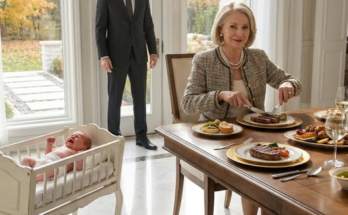
Inside the dining room, the noise grew louder.
My father already looked drunk.
My brother scrolled through his phone without acknowledging us.
Aunt Diane laughed with her mouth wide open like every moment required performance.
And then there was Caroline.
Perfect hair.
Perfect makeup.
Perfect smile designed entirely for cruelty disguised as humor.
She looked directly at Mia’s brace and smirked immediately.
“Well,” she said loudly, “the attention seekers are finally here.”
Mia shrank closer to me.
Still, she whispered politely, “Hi, Aunt Caroline.”
That destroyed me more than anything else.
Because children continue offering kindness long after adults prove they do not deserve it.
Caroline tilted her head dramatically.
“You’re still wearing the robot leg?”
“She has to,” I answered before Mia could speak.
Caroline rolled her eyes.
“Everything with you two is always so exhausting.”
My father laughed from across the room.
“There he is,” he shouted while pointing his beer toward me. “Try not making tonight about yourself for once.”
Everyone chuckled.
That was the family system.
Someone humiliates you.
Everyone laughs.
Then if you react, suddenly you become the problem.
Years of that conditioning can make victims question reality itself.
Mia stayed glued beside me while people ate dinner and talked over one another.
Every movement she made seemed cautious.
Measured.
Like she already understood the room was hostile territory.
Every time she adjusted her leg carefully, somebody glanced toward the brace.
Every glance carried judgment.
Not concern.
Judgment.
And the terrifying part is how common this has become everywhere now.
People no longer know how to respond to visible pain unless it entertains them.
Social media transformed empathy into suspicion.
Someone struggles publicly?
Half the internet accuses them of faking it.
Someone asks for accommodation?
They get labeled dramatic.
Someone shows vulnerability?
Millions suddenly become self-appointed experts overnight.
Children are not even spared anymore.
Especially disabled children.
Especially children who require visible support devices.
There is a sickness growing inside modern culture where compassion gets mistaken for weakness and cruelty gets rewarded as honesty.
And people like Caroline thrive inside that environment.
Because audiences reward humiliation now.
The louder the cruelty, the bigger the reaction.
The bigger the reaction, the more attention people receive.
Eventually, some people stop caring whether the target survives emotionally at all.
When my mother announced cake and family photos, Mia froze instantly near the dining room entrance.
“Daddy,” she whispered. “Can I stay here instead?”
I crouched beside her.
“You can stand with me.”
She nodded nervously.
The birthday candles smoked through the air while everyone crowded together for pictures.
Phones appeared.
Wine glasses clinked.

People shouted over one another.
Then Caroline looked down at Mia again.
And smiled.
That smile still wakes me up at night.
“Are you seriously keeping that ugly brace on for family photos?” she asked loudly.
Mia’s fingers tightened around my hand.
“It has to stay on.”
Caroline laughed dramatically.
“No, sweetheart. You just like attention.”
“Enough,” I snapped instantly. “Leave her alone.”
But Caroline had already found her audience.
She crouched directly in front of my daughter.
Wine still balanced casually in one hand.
“You know,” she said sweetly, “if you stopped pretending to be broken, maybe people would stop babying you.”
Mia’s eyes filled immediately.
“Please don’t touch it,” she whispered.
The room heard her.
Nobody intervened.
That matters.
Because silence during cruelty is participation.
Never let anyone convince you otherwise.
Caroline laughed again and looked around the room for approval.
And she got it.
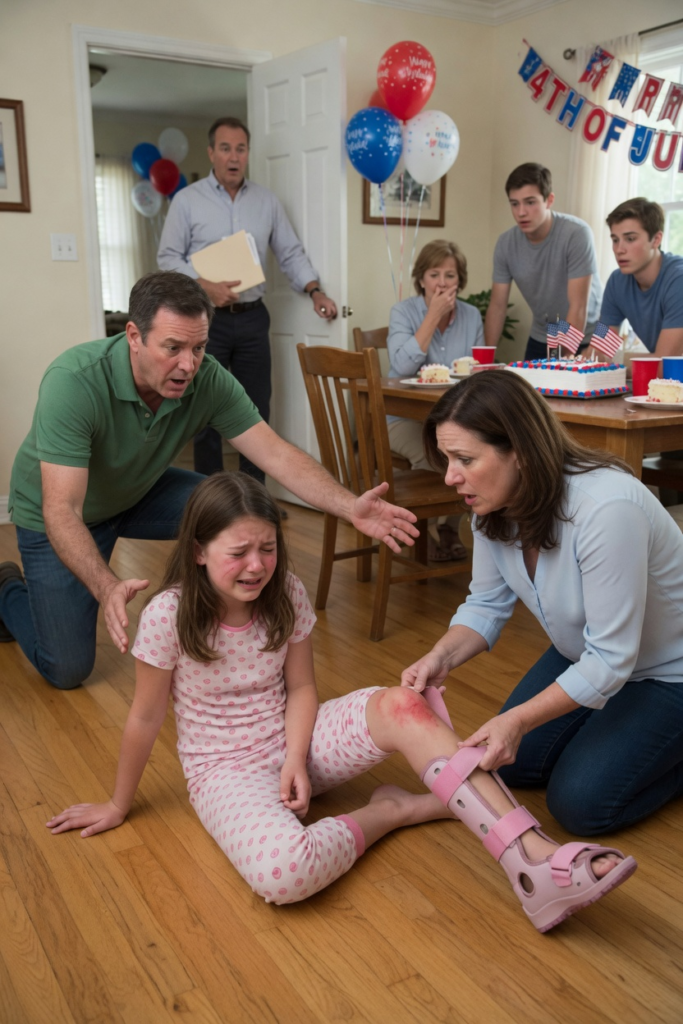
Then she grabbed the straps on Mia’s brace.
And yanked hard.
Everything happened in seconds.
The brace ripped loose violently.
Mia screamed instantly.
Her knee collapsed sideways beneath her weight.
She hit the hardwood floor so hard the sound silenced the room.
Her stuffed bunny flew across the dining room.
Then Caroline shouted the sentence I will remember until I die.
“STOP ACTING CRIPPLED! YOU JUST WANT PITY!”
My daughter screamed in pain.
And my family laughed.
Not nervous laughter.
Not shocked laughter.
Real laughter.
My aunt covered her mouth while snorting.
My brother shook his head smiling into his drink.
My father looked annoyed instead of horrified.
Even my mother looked more embarrassed by the scene than concerned about the child writhing on the floor.
That was the moment something inside me permanently changed.
Because when strangers hurt your child, rage comes naturally.
But when family watches suffering and finds entertainment in it, something colder replaces rage entirely.
Mia grabbed her knee with both hands, sobbing uncontrollably.
“Daddy,” she cried. “Help me please.”
I dropped beside her instantly.
Then a voice thundered from the doorway.
“DO NOT MOVE HER.”
The room froze.
Every head turned.
And there stood Dr. Caldwell.
Still wearing his dark coat.
Rehabilitation folder tucked beneath one arm.
Eyes locked directly onto Caroline’s hands gripping the open brace straps.
I had completely forgotten he planned to stop by later that evening to deliver updated recovery paperwork I accidentally left behind after Mia’s last appointment.
For one second, nobody breathed.
Then Dr. Caldwell walked slowly across the room toward Mia.
The silence became unbearable.
He knelt beside her carefully.
Professional.
Controlled.
But his face looked furious.
“What happened?” he asked quietly.
Before I could answer, Caroline laughed nervously.
“Oh my God, she’s fine. She’s dramatic.”
Dr. Caldwell looked up slowly.
I have never seen a human being communicate disgust so completely without raising their voice.
“You removed her stabilization brace?” he asked.
Caroline shrugged defensively.
“She doesn’t need it that much.”
The room stayed silent.
Nobody defended Mia.
Nobody apologized.
Nobody admitted what happened was monstrous.
Because people like this always assume authority will validate them.
They think confidence equals correctness.
Then reality arrives.
And suddenly their cruelty stops sounding funny.
Dr. Caldwell carefully examined Mia’s knee while she sobbed into my chest.
Every touch made her shake.

“She could have destroyed the graft,” he said finally. “Do you understand that?”
Caroline rolled her eyes again.
“Oh please. It’s not that serious.”
That sentence changed everything.
Because Dr. Caldwell stood up slowly after hearing it.
And then he addressed the entire room.
Not just Caroline.
Everyone.
“You laughed,” he said quietly. “While a recovering child hit the floor after having her medical equipment ripped off.”
Nobody answered.
My father shifted uncomfortably.
My mother stared at the tablecloth.
“You are witnessing,” Dr. Caldwell continued, “what medical neglect and emotional abuse look like in real time.”
The air changed instantly.
That word.
Abuse.
Families like mine survive by avoiding accurate language.
They call abuse teasing.
Cruelty becomes joking.
Humiliation becomes personality.
But once someone names it correctly, the illusion starts collapsing.
Caroline scoffed loudly.
“Oh my God. Abuse? Seriously?”
Dr. Caldwell stepped closer.
“Yes,” he said. “Seriously.”
Nobody laughed this time.
He explained exactly what could happen if Mia’s knee twisted incorrectly.
Additional surgery.
Permanent instability.
Chronic pain complications.
Every sentence made Caroline’s face lose more color.
But the most devastating moment came next.
Because Dr. Caldwell looked around the room and asked one question nobody could answer.
“Why was the only person protecting this child her father?”
Silence.
Heavy.
Humiliating.
Absolute silence.
That question shattered the performance.
Suddenly everyone looked smaller.
My father tried recovering control first.
“She overreacted,” he muttered. “This family jokes around.”
Dr. Caldwell turned toward him instantly.
“If your granddaughter requires reconstructive surgery again because someone ripped off her brace for entertainment,” he said coldly, “no court on earth will care whether you call it a joke.”
That landed like a bomb.
Because for the first time all night, consequences entered the room.
And people who enjoy cruelty panic the moment consequences appear.
Caroline’s confidence vanished almost immediately.
“I didn’t mean—”
But nobody wanted her excuses anymore.
Not after Mia’s screams still echoed through the house.
Not after the entire room watched a six-year-old beg adults for help while they laughed.
My daughter eventually looked up through tears and asked the question that destroyed whatever remained of my relationship with my family.
“Why were they laughing at me?”
No child should ever have to ask that question.
Ever.
You could see discomfort spreading through the room instantly.
Because children accidentally expose truths adults spend decades hiding.
Nobody answered her.
Not my mother.
Not my father.
Not Caroline.
Because there is no socially acceptable explanation for enjoying a suffering child.
Dr. Caldwell answered instead.
“They were wrong,” he told her gently. “And you did nothing wrong.”
Mia cried harder after hearing that.
Probably because validation feels shocking when someone spends years surrounded by emotional cruelty.
People online love talking about toxic families like they are rare horror stories.
They are not rare.
Millions of people grew up inside homes where humiliation functioned as bonding.
Where the cruelest person controlled every room because everyone else feared becoming the next target.
Where sensitivity became weakness.
Pain became inconvenience.
And children learned survival through silence.
The most dangerous families are not always physically violent.
Sometimes they are emotionally carnivorous instead.
They feed on embarrassment.
They reward dominance.
They weaponize mockery.
And if you resist, suddenly you are “dramatic.”
That word destroys people quietly every day.
Dramatic.
It convinces victims to distrust their own pain.
It teaches children their suffering annoys others.
It allows abusers to keep performing cruelty publicly while pretending innocence privately.
And society rewards it constantly now.
Look online for five minutes.
Someone cries publicly?
They become a meme.
Someone reveals trauma?
Comment sections debate whether they deserved it.
Someone struggles physically?
Half the audience accuses them of exaggerating.
Empathy is disappearing faster than people realize.
That is why this story exploded online later.
Because someone at that birthday party uploaded part of the incident anonymously.
Not the entire assault.
Just the aftermath.
Just enough footage showing my daughter crying on the floor while adults stood around awkwardly.
Within days, millions watched it.
And the internet split instantly into two horrifying camps.
One side was disgusted.
Parents of disabled children flooded the comments describing similar experiences.
Adults shared stories about families mocking medical conditions for years.
Physical therapists, surgeons, and pediatric nurses condemned everything publicly.
But another group focused entirely on defending Caroline.
“She was probably joking.”
“Kids fake injuries all the time.”
“The father sounds overprotective.”
“People are too sensitive now.”
That reaction terrified me more than the original incident.
Because it proved how normalized cruelty has become.
People now instinctively protect aggressors before injured children.
Especially confident aggressors.
Especially attractive aggressors.
Especially socially charismatic aggressors.
The internet rewards confidence more than morality.
Always has.
And the most dangerous people understand that perfectly.
Three days after the birthday party, my mother called me crying.
Not about Mia.
About reputation.
“People online are attacking this family,” she sobbed. “Your father is humiliated.”
I listened quietly.
Then I asked her one question.
“Did you cry when Mia begged for help on the floor?”
Silence.
Then she whispered the sentence toxic families always use when accountability finally arrives.
“You’re tearing this family apart.”
No.
Truth tears toxic systems apart.
Victims speaking publicly only exposes fractures already there.
Families like mine survive through silence contracts.
Everyone knows who gets protected.
Everyone knows who gets sacrificed.
Everyone knows which truths are forbidden.
Until one person refuses the arrangement anymore.
That person becomes dangerous.
Not because they lie.
Because they finally stop lying for others.
Caroline eventually posted a public statement online.
It was exactly what everyone expected.
“I never intended harm.”
“The video lacks context.”
“Our family jokes with each other.”
“I’m being unfairly attacked.”
Not once did she apologize directly to Mia.
Not once.
Because genuine apologies require empathy.
And empathy requires acknowledging another person’s pain matters as much as your pride.
Some people never learn that lesson.
What shocked me most afterward was how many strangers contacted me privately with nearly identical stories.
A grandmother ripping hearing aids from a child because she believed he was exaggerating deafness.
An uncle mocking a teenager’s feeding tube during Christmas dinner.
Parents refusing mobility aids because they thought disability looked embarrassing publicly.
Thousands of stories.
Thousands.
That is why people shared this incident so aggressively online.
Not because it was rare.
Because it was familiar.
Painfully familiar.
People recognized themselves immediately.
They remembered family dinners where humiliation became entertainment.
They remembered adults mocking visible weakness.
They remembered begging someone to intervene while entire rooms stayed silent.
The most viral stories are rarely the most shocking ones.
They are the ones exposing truths millions already survived quietly.
And that is what makes them dangerous.
Because once enough people recognize the pattern, denial becomes harder.
A month later, Mia asked me something while drawing at the kitchen table.
“Daddy,” she said carefully, “are braces embarrassing?”
I nearly stopped breathing.
That is what cruelty does to children.
Not just physical pain.
Identity damage.
One moment of humiliation can alter how children view themselves for years.
I sat beside her slowly.
“No,” I said. “The brace helps your body heal.”
She looked down at her drawing.
“Then why did everybody laugh at it?”
There are questions no parent can answer cleanly.
How do you explain adult cruelty to a child without destroying their belief in people entirely?
How do you teach kindness after they witness collective humiliation firsthand?
How do you explain that sometimes the people biologically closest to you are emotionally least safe?
I chose honesty.
“Some people laugh at things they don’t understand,” I told her. “And some people laugh because they want others to fear them instead of question them.”
She thought quietly for a moment.
Then she asked, “Like bullies at school?”
Exactly like that.
Except adults become better at disguising it.
That is the terrifying part.
Many adults never emotionally mature beyond middle school social hierarchies.
They simply upgrade environments.
School cafeterias become family dinners.
Playground humiliation becomes online mockery.
Childhood bullying becomes adult entertainment culture.
And vulnerable people continue paying the price.
Today, Mia is healing well.
Her knee recovered.
Her therapy continues.
Her laugh slowly returned over time.
But certain wounds linger invisibly.
She still hesitates when entering crowded rooms.
She still clutches my hand tighter around loud adults.
She still asks whether people are “nice” before family gatherings.
Children remember humiliation inside their bodies long after bruises disappear.
And honestly?
So do adults.
I no longer speak to most of my family now.
Some people online call that extreme.
But protecting your child from repeated cruelty is not extreme.
Allowing cruelty because perpetrators share DNA is what should horrify people instead.
Family is not automatic sanctuary.
Love is not automatic safety.
And blood relationships do not magically erase abusive behavior.
That myth destroys countless people every year.
The most controversial part of this story was never the brace.
It was the laughter.
Because deep down, people recognized something ugly inside it.
The mob instinct.
The social thrill humans sometimes feel when someone vulnerable becomes the target.
People want to believe they would intervene.
History repeatedly proves otherwise.
Most people freeze.
Most people follow crowds.
Most people stay silent until consequences appear.
That reality makes everyone uncomfortable.
Good.
It should.
Because silence is how cruelty becomes culture.
And culture is exactly what needs changing now.
Especially online.
Especially inside families.
Especially around children who already feel different from everyone else.
If a six-year-old recovering from surgery cannot expect basic protection from adults at a birthday dinner, then society has a much deeper sickness than people want admitting publicly.
And maybe that is why millions kept sharing this story afterward.
Not because it was unbelievable.
Because it was believable enough to terrify them.