Part 2
“Did Jason happen to tell you about his vasectomy?” I said. “Or that I’m the one who actually owns this house?”
For one perfect second, no one breathed.
Not the movers.
Not Margaret.
Not even Thomas on the phone.
The house went still around us, as if Lily’s lavender room had pulled every sound into itself and was waiting to see what would happen next.
Margaret blinked once.
Then twice.
Her lips parted, but no words came out.
I looked down at the clipboard again and gave a soft, humorless laugh.
“You didn’t know,” I said.
Her eyes flickered toward the movers, then toward the hallway camera, then back to the papers in my hand.
“I don’t know what kind of poison you’ve been putting in my son’s ear,” she said, but her voice had lost its polish. It scraped now. “Jason is perfectly capable of having children.”
“Jason had a vasectomy eight years ago,” Thomas said through the speaker.
Margaret whipped toward the phone like it had slapped her.
“That is none of her business.”
“It became her business when you dragged a fake deed transfer into our house and tried to use an unborn child as a crowbar.”
Her mouth twisted.
“It can be reversed.”
“It wasn’t,” Thomas said.
The words came out flat. Final.
Margaret’s fingers curled at her sides. For the first time since I had known her, she looked old. Not fragile. Never fragile. Margaret Harrington would have turned dying into an accusation if she could. But old in the way a cracked statue looks old when the gold paint starts flaking off and you realize it was never marble underneath.
I turned the top page toward the nearest mover.
“Did she tell you I authorized this?”
The man holding Lily’s bed frame swallowed.
“She said you’d signed off, ma’am.”
“I didn’t.”
His face reddened. “We can put everything back.”
“You will,” Thomas said. “Exactly where it was.”
Margaret snapped, “You do not give orders in this house.”
Thomas’s voice dropped.
“Yes, I do.”
I had heard him angry before. I had heard him frustrated over hospital bills, exhausted after forty-eight sleepless hours, broken when the doctors stopped saying “treatment” and began saying “comfort.” But this was different. This voice did not shake. It did not plead. It did not ask to be understood.
This was the voice of a man standing at a line no one else could see, deciding what would happen to anyone who crossed it.
“My wife owns that house,” Thomas said. “Her grandmother left it to her before we were married. I have no legal right to sell it. Jason has no legal right to buy it. You have no legal right to stand in it.”
Margaret’s eyes sharpened.
“Your wife,” she repeated.
There was so much poison in those two words that one of the movers looked at the floor again.
I watched her carefully.
Because grief teaches you things.
It teaches you how to read the small movements people make when they are about to hurt you.
The breath they take before the sentence.
The softening around the mouth before the knife.
Margaret had looked at me that way in the hospital cafeteria two weeks before Lily died, while I was peeling the paper from a cup of untouched coffee. She had sat across from me, pearls perfect, hair neat, grief nowhere in sight, and said, “Some people are meant to be mothers, Veronica. Some are simply meant to endure.”
I hadn’t answered then.
I had been too tired.
Too terrified.
Too full of the sound of Lily coughing through the night.
But today, standing in my hallway with my daughter’s things in boxes, I was not tired in that way anymore.
I was something else.
“What did you think would happen?” I asked. “That I’d come home, see strangers packing up my child’s room, and sign away my home because you put a clipboard in front of me?”
Margaret lifted her chin.
“I thought you would finally do something useful with all this tragedy.”
The words were ugly.
Even for her.
Thomas said my name softly through the phone.
“Veronica.”
But I didn’t break.
I didn’t scream.
I didn’t cry.
Not yet.
I stepped closer to Margaret, close enough to smell her perfume—white flowers and money.
“You came here while I was at Lily’s grave.”
Her eyes shifted away.
“You knew where I was.”
Nothing.
“You waited until I was gone.”
Still nothing.
“You brought movers.”
Her mouth tightened.
“You brought papers.”
Silence.
“You packed my daughter’s hospital bracelet with baby catalogs.”
Margaret’s eyes flashed. “It was a bracelet, Veronica. Not a relic.”
There it was.
Not carelessness.
Not misunderstanding.
Contempt.
Clean, hard, polished contempt.
I looked at the clipboard one last time, then laid it carefully on the entry table. I took a picture of every page. Each signature line. Each false statement. Each attempt to turn my dead daughter’s bedroom into a nursery for a baby that might not even be Jason’s.
Then I looked at the movers.
“Put everything back,” I said. “If you don’t know where something goes, ask me. If anything is damaged, I want your company’s insurance information before you leave.”
The older mover nodded quickly. “Yes, ma’am.”
Margaret made a sound of disbelief.
“You cannot be serious.”
I turned to her.
“I have never been more serious in my life.”
Thomas said, “I’m on my way home.”
“No,” Margaret said sharply. “You will stay at work and calm down before you humiliate this family further.”
There was a pause.
Then Thomas laughed once.
A short, cold sound.
“You broke into my daughter’s room.”
“She was not your daughter.”
The words left her mouth like a stone thrown through glass.
This time, Thomas did not answer immediately.
The silence that followed was worse than shouting.
I saw one of the movers flinch. I felt my own pulse in my hands.
When Thomas finally spoke, his voice was so quiet I had to lean closer to the phone.
“Say that again.”
Margaret’s face changed.
Not remorse.
Fear.
Because she heard it too.
The door she had just opened.
The room she could not walk back out of.
“I said,” she began, but her voice was smaller now, “that biologically—”
“No,” Thomas said. “Say her name.”
Margaret said nothing.
“Say Lily’s name.”
Her jaw flexed.
“She was a child you took in.”
I closed my eyes.
For a moment, I was back in the hospital room with the monitors dimmed and the window cracked open because Lily said she wanted to feel the rain. Thomas sat on one side of the bed, I sat on the other. Her hand was so small between his fingers. She had looked at him, sleepy and pale, and whispered, “Daddy, don’t let Bun-Bun get lonely.”
He had promised.
He had promised our dying child that her stuffed rabbit would not be lonely.
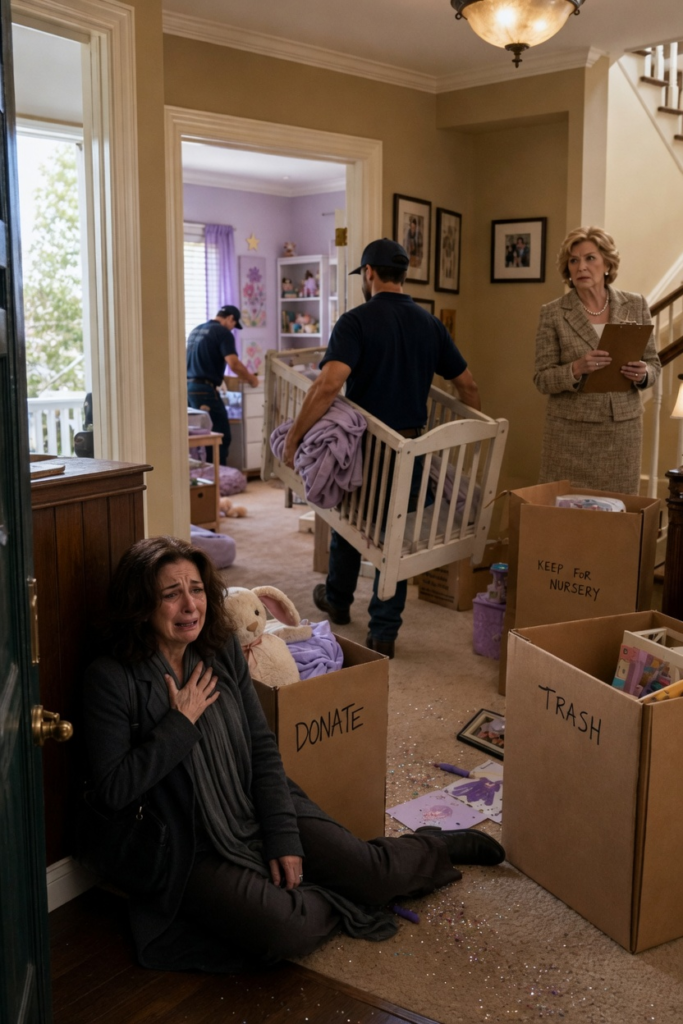
And Margaret had put Bun-Bun in a donation box.
Thomas spoke again.
“I loved her before I loved half the people I share blood with.”
Margaret recoiled as though he had insulted her.
“She was Veronica’s child.”
“She was mine.”
“You adopted grief that was never yours,” Margaret snapped.
“No,” he said. “I adopted Lily.”
The hallway seemed to tilt.
Margaret stared at the phone.
My breath caught.
“What?” I whispered.
Thomas exhaled, and for the first time, the coldness in his voice cracked.
“I was going to tell you tonight.”
My heart began to pound for a different reason.
“Tell me what?”
There was a sound on his end—a car door slamming, wind rushing, keys in ignition.
“The final paperwork came through yesterday,” he said. “The court signed it before…” His voice broke. “Before the funeral. Our lawyer called me this morning. I was waiting because you were going to the cemetery, and I didn’t want to put another thing on you.”
My hand went to the wall.
I needed it to stay upright.
“What paperwork?”
“The adoption,” he said.
The word landed inside me like light entering a locked room.
Margaret whispered, “No.”
Thomas ignored her.
“I filed before the last hospital stay. Lily knew. We told her it might take time, but we were doing it. She drew that picture of the three of us for the judge, remember? The one with the purple house and the crooked dog?”
I remembered.
Of course I remembered.
Lily had asked for her glitter pens and spent forty minutes drawing us with giant heads and stick legs. She had given Thomas a crown because, she said, “Daddy is king of pancakes.”
I had thought it was just something to keep her busy.
I slid down the wall until my knees hit the floor.
The movers stopped moving.
No one spoke.
Thomas’s voice came through the phone, shaking now.
“She was legally my daughter when she died, Ver.”
I pressed one hand over my mouth.
The grief that came then was not the same grief that had lived in me for weeks.
That grief had been black water.
This was fire.
It hurt, but it gave off heat.
Lily had not left this world as an almost.
Not as a child my husband loved but the law did not recognize.
Not as someone Margaret could erase with a bloodline and a clipboard.
She had died our daughter.
Ours.
I looked up at Margaret through tears.
She had gone pale.
Truly pale.
Because now, every word she had said had not only been cruel.
It had been wrong.
Thomas said, “I’m ten minutes away. Veronica, call the police.”
Margaret’s head snapped toward me.
“Don’t you dare.”
I wiped my cheeks with the back of my hand.
For the first time that afternoon, I smiled without pretending.
Then I picked up my phone.
Margaret lunged.
She was fast for someone wearing pearls and three-inch heels.
Her hand shot toward the phone, nails scraping my wrist. Pain flashed up my arm. The phone hit the floor and skidded under the entry table.
One of the movers shouted.
I stumbled back.
Margaret grabbed the clipboard.
For a split second, I thought she meant to run.
Instead, she turned toward the hallway.
Toward Lily’s room.
Toward the boxes.
Toward the proof of what she had done.
“No,” I said.
But she was already moving.
I went after her.
The older mover caught her arm at the threshold of Lily’s room. “Ma’am, don’t—”
Margaret slapped him.
The sound cracked through the house.
Everything stopped.
The mover let go, stunned.
Margaret swept into Lily’s room like a storm.
I followed.
And there it was.
My daughter’s room stripped open.
The bed frame half-disassembled. The mattress propped against the wall. Her painted stars peeled from the ceiling in ugly curled strips. Her art stacked wrong. Her books on the floor. The lavender curtains pulled down and crumpled beside a roll of pale blue wallpaper with tiny silver sailboats.
For a second, I forgot Margaret.
I forgot the deed.
I forgot Jason and Sarah and the Harrington name.
All I saw was the empty square on the wall where Lily’s height chart had been.
My knees almost buckled.
Margaret grabbed a cardboard box labeled KEEP FOR NURSERY and started tearing through it.
“What are you doing?” I asked.
She didn’t answer.
She pulled out baby catalogs, legal papers, a measuring tape, paint swatches. Then she found a manila envelope and clutched it to her chest.
I saw the corner of a document sticking out.
Not the fake deed.
Something else.
“Give that to me.”
She stepped back.
“This is private.”
“In my house?”
“It concerns my family.”
I held out my hand.
“Then it concerns me.”
Her eyes blazed.
“You are not my family.”
Behind me, the hallway camera clicked softly as it adjusted.
I glanced at it.
So did Margaret.
The knowledge that she was still being recorded passed between us like a blade.
Her grip loosened.
I moved before she could change her mind.
I took the envelope.
Inside were bank statements.
Copies of emails.
A printout of a text conversation.
And one folded sheet from a clinic.
I looked down.
Then I understood.
Not all at once.
Understanding came in pieces.
Jason’s name.
A date from eight years ago.
A procedure.
Confirmation.
Then another set of papers.
Sarah’s name.
Prenatal appointment.
Estimated conception date.
I flipped to the emails.
Jason to Margaret:
Mom, stop pushing this. The baby isn’t mine. Sarah knows. I know. We are handling it.
Margaret to Jason:
You will handle it by doing what your father failed to do—secure this family’s future.
Jason:
There is no family future in Thomas’s house.
Margaret:
There will be after Veronica signs.
Jason:
She won’t sign. Thomas won’t let her.
Margaret:
Thomas is weak when she cries. Veronica is weaker when Lily is involved. Timing matters.
Timing matters.
I stared at those two words until they blurred.
Margaret had not only waited until I was at Lily’s grave.
She had chosen that day because of it.
She had believed grief would make me easier to move.
Easier to corner.
Easier to rob.
I looked up slowly.
Margaret was watching my face, and for the first time, she looked afraid of what she saw there.
“You knew,” I said.
She said nothing.
“You knew Jason couldn’t be the father.”
No answer.
“You knew Sarah’s baby wasn’t his.”
Her jaw clenched.
“You knew this entire nursery story was a lie.”
Margaret’s voice came low and venomous.
“It could have been made true.”
I stared at her.
“What does that mean?”
She straightened, clinging to pride because it was the only weapon she had left.
“Jason would have raised the child. The baby would have had our name. That is what matters.”
“No,” I said. “That is what mattered to you.”
Her eyes glittered.
“You think love is enough? Love doesn’t preserve a family. Blood does. Property does. Names do.”
I looked around Lily’s destroyed room.
At the crooked dog drawing still taped to her closet.
At the paper moon above the lamp.
At Bun-Bun lying sideways near the donation box, one ear folded under.
“You came into the room of a child you refused to love,” I said, “to make space for a baby you were willing to turn into a lie.”
Margaret’s mouth trembled.
Just once.
Then it hardened.
“You should thank me.”
A laugh escaped me.
A broken little sound.
“For what?”
“For trying to pull this family out of your mourning pit. Do you know what you’ve done to Thomas? He used to have ambition. He used to have direction. Then he married you and took on your sick child and made hospitals his home. Now she’s gone, and you still won’t release him.”
Something slammed downstairs.
The front door.
Thomas.
His footsteps hit the stairs fast.
Margaret heard them too.
For one instant, panic flashed across her face.
Then she did the only thing people like Margaret do when truth corners them.
She performed.
She turned toward the door just as Thomas appeared in the hallway, breathless, tie loosened, face pale with rage and fear.
“My son,” she cried, “thank God you’re here. Veronica has lost control.”
Thomas did not look at her first.
He looked at me.
His eyes went to my wrist, where her nails had left four red scratches.
Then to Lily’s room.
The bed frame.
The boxes.
The torn stars.
His face changed.
I will remember that expression for the rest of my life.
Not because it was anger.
Because it was grief meeting betrayal and recognizing it as family.
He stepped into the room slowly.
Margaret reached for him.
“Thomas—”
He moved around her like she was furniture.
He knelt beside Bun-Bun and picked him up.
The stuffed rabbit looked even smaller in his hands.
For a moment, no one spoke.
Thomas brushed dust from one floppy ear with his thumb.
Then he looked at his mother.
“When Lily was five,” he said quietly, “she asked me if rabbits could be brave.”
Margaret blinked, thrown off.
“What?”
“She had a scan the next morning. She was scared. She held this rabbit so tightly the nurse had to work around it. I told her rabbits could be brave if they had someone to be brave for.”
His voice shook.
“She said Bun-Bun was brave for her.”
I covered my mouth.
Thomas stood.
“You put him in a donation box.”
Margaret looked at the rabbit with open disgust.
“It is a toy.”
“It was hers.”
“She is gone.”
The sentence hung in the room.
Thomas stared at his mother.
“Yes,” he said. “She is.”
The words were soft.
And devastating.
“She is gone. And somehow, in the one room where I can still smell her shampoo sometimes, you found a way to be jealous of a dead child.”
Margaret flinched.
“I was protecting you.”
“No,” Thomas said. “You were protecting a fantasy. The Harrington name. The Harrington bloodline. The Harrington house that was never Harrington property to begin with.”
Her eyes narrowed.
“I gave you life.”
“And Veronica gave me a reason to live it properly.”
Margaret’s face twisted.
“She gave you debt. Pain. A dead child’s memory.”
Thomas stepped closer.
“She gave me Lily.”
The room went silent again.
Downstairs, one of the movers cleared his throat nervously.
Thomas looked at me.
“Are the police coming?”
“I didn’t get to call,” I said. “She knocked the phone out of my hand.”
His gaze dropped again to my wrist.
Then he pulled out his own phone and dialed.
Margaret’s voice sharpened.
“You wouldn’t.”
Thomas put the call on speaker.
“911, what is your emergency?”
Margaret’s composure cracked.
“Thomas.”
He looked at her as he spoke.
“My mother entered my home without permission, hired movers under false pretenses, attempted to remove property, brought fraudulent legal documents, and assaulted my wife.”
Margaret sucked in a breath as if he had stabbed her.
I watched the last of her confidence drain away.
The operator asked questions.
Thomas answered all of them.
Our address.
No weapons.
Yes, she was still here.
Yes, we had security footage.
Yes, we wanted her removed.
When he hung up, Margaret stared at him with an expression I had never seen on her face before.
Not love.
Not guilt.
Betrayal.
As if Thomas had wronged her by refusing to be harmed correctly.
“You called the police on your mother,” she whispered.
Thomas put Bun-Bun on Lily’s pillow.
“No,” he said. “I called the police on a trespasser.”
Something in Margaret broke then.
Not enough to become remorse.
Just enough to become honest.
“You ungrateful boy.”
There it was.
The real mother beneath the pearls.
Thomas went still.
She pointed at me.
“She has ruined you. She and that sick little girl ruined you. Do you think I don’t know what people said? My son, changing bedpans and singing lullabies to someone else’s child while your brother built a future. Do you know how humiliating it was to watch?”
“You were humiliated,” Thomas said slowly, “because I loved a child with cancer?”
“I was humiliated because you threw yourself away.”
His face went white.
I moved toward him, but he lifted one hand slightly.
Not to stop me.
To tell me he was standing.
Really standing.
“You taught me my whole life that love had to be earned,” he said. “Grades. Trophies. Promotions. The right friends. The right wife. The right bloodline. And then Lily came along.”
His voice softened.
“She loved me because I cut her toast into triangles. Because I read the dragon book with voices. Because I let her paint my nails yellow when the chemo made her too tired to paint her own.”
A tear slid down his cheek.
“She loved me on days when I had nothing impressive to offer. No title. No money. No Harrington legacy. Just me.”
Margaret looked away.
Thomas wiped his face.
“That little girl taught me more about family in four years than you did in thirty-eight.”
Margaret’s eyes flashed.
“Don’t you dare compare me to—”
“To my daughter?” he cut in.
She stopped.
The word daughter hit the room with the full weight of law, love, and loss.
Thomas stepped aside and pointed to the hallway.
“Get out of her room.”
Margaret did not move.
So I did.
I walked to the closet, opened Lily’s purple backpack, and took out the folded paper inside.
The one with the crooked dog.
The three stick figures.
The purple house.
Daddy wearing a crown.
Mommy with huge red lips because Lily had borrowed my lipstick that day.
Lily in the middle, holding both our hands.
Underneath, in wobbly letters, she had written:
MY FAMILY.
I carried it to Margaret.
She stared at it as if it were a legal document more dangerous than the forged deed.
“Look at it,” I said.
“I don’t need to.”
“Yes,” I said. “You do.”
Her eyes flicked down.
Just for a second.
Long enough.
“That is what you tried to throw away.”
Margaret’s face changed again.
For the first time, something human moved behind her eyes.
It was small.
Brief.
Ugly with resentment.
But human.
Then sirens sounded faintly outside.
And whatever might have become of that moment disappeared.
Margaret stepped back.
“You’ll regret this.”
Thomas picked up the manila envelope from my hand and held it toward her.
“No,” he said. “You will.”
The police arrived five minutes later.
By then, the movers had begun putting Lily’s room back together under my supervision, their faces grave and careful. The younger one, who couldn’t have been more than twenty-two, carried Lily’s books one by one from the box and set them on the shelf as if handling glass.
When he found her copy of The Velveteen Rabbit, he paused.
“My sister had this,” he said quietly.
I nodded.
He placed it spine-out on the second shelf, exactly where Lily had kept it.
Downstairs, Margaret tried to become Margaret Harrington again.
I could hear it.
The calm voice.
The wounded maternal tone.
The phrases she had sharpened over decades.
A misunderstanding.
A family matter.
My son is grieving.
My daughter-in-law is unstable.
The officers listened.
Then Thomas showed them the security footage.
I came downstairs in time to see Margaret watching herself on Thomas’s phone.
Not the polished version.
The recorded version.
Her voice saying, “Not by blood.”
Her voice saying, “The first real Harrington heir.”
Her voice saying, “Timing matters,” when Thomas opened the email printout and laid it beside the footage.
The female officer’s mouth tightened.
Margaret stopped talking.
It was almost satisfying.
Almost.
But nothing about that day could become satisfying because upstairs my daughter’s room smelled like cardboard and strangers.
Still, when the officer asked whether I wanted to press charges for the assault, I said yes.
Margaret looked at me as if I had slapped her.
“Veronica,” she said softly.
It was the first time all day she had used my name without making it sound like an inconvenience.
I looked at the scratches on my wrist.
Then at Thomas.
Then toward the stairs.
“Yes,” I repeated.
The officer nodded.
Margaret was not dragged out.
People like her rarely are.
She was escorted.
There is a difference.
She walked with her shoulders back, lips pressed thin, pearls still centered at her throat. But at the front door, she turned.
Not to Thomas.
To me.
“This family will never forgive you.”
I almost laughed.
Instead, I said, “Good.”
The door closed behind her.
And the house exhaled.
For a while, no one moved.
Thomas stood in the foyer with one hand on the banister, staring at the front door like he expected it to bite.
Then the older mover came down the stairs.
“We put the bed back,” he said gently. “We’re sorry. We really didn’t know.”
I believed him.
That made it easier and harder.
Thomas paid them for the work they had done undoing Margaret’s damage. The older mover tried to refuse. Thomas insisted. Then they left, carrying nothing but their own tools and the pale blue sailboat wallpaper Margaret had brought.
When the last truck pulled away, silence filled the house.
Not peaceful silence.
The kind that comes after screaming.
I went upstairs.
Thomas followed.
We stood in Lily’s doorway.
Her room was not exactly the same.
It never would be.
The stars on the ceiling were torn. The height chart had a crease down the middle. Her art folder was bent. Her bed frame had one fresh scratch near the footboard.
But the bed was back.
The lavender sheets were back.
Bun-Bun sat against the pillow.
The crooked dog drawing hung on the closet door again.
Thomas leaned against the doorway and covered his face.
I had seen him cry in the hospital.
At the funeral.
In the shower when he thought the water hid it.
But this was different.
This was the sound of a man realizing the person who gave him life had tried to rob him of the child who gave him love.
I went to him.
He folded into me.
“I’m sorry,” he said over and over into my hair. “I’m so sorry. I should have known. I should have stopped her before she ever—”
“No,” I said.
My own voice surprised me.
Firm.
Clear.
“No. She did this. Not you.”
He pulled back, eyes red.
“I knew she was cruel. I knew she didn’t accept Lily the way she should have. But I thought…” He swallowed. “I thought grief would make her softer. I thought losing Lily would make her understand.”
I looked at the little purple lamp on Lily’s desk.
The one shaped like a moon.
“Grief doesn’t change what people are,” I said. “It reveals what they worship.”
Thomas stared at me.
Then he nodded slowly.
“My mother worships blood.”
“And control.”
“And the Harrington name.”
I looked at him.
“What do you worship?”
He answered without hesitation.
“You. Lily. The truth. Whatever is left that still deserves protecting.”
Something inside me loosened.
Not healed.
Not even close.
But loosened.
He reached into his jacket and pulled out a folded envelope.
Real paper.
Cream-colored.
From the court.
His hands shook when he gave it to me.
“I wanted it to be a good moment,” he said.
I took it carefully.
Inside was the adoption order.
Final.
Signed.
Stamped.
A legal recognition of what had been true long before the law caught up.
Lily Anne Mercer Harrington.
Child of Thomas Edward Harrington.
Child of Veronica Rose Mercer Harrington.
I touched her name.
The paper blurred.
“She knew?” I whispered.
He nodded.
“The lawyer said we could explain it to her in simple terms. She asked if it meant I would be her daddy even in heaven.”
A sound broke out of me.
Half sob.
Half laugh.
“What did you say?”
“I said yes.”
He wiped his eyes.
“She said, ‘Good, because heaven probably has paperwork too.’”
I laughed then.
I really laughed.
It hurt.
It sounded terrible.
But it was laughter.
Thomas laughed too, though tears ran down his face while he did.
We sat on Lily’s bed, holding the adoption order between us.
Outside, afternoon faded into evening. The house dimmed around us. Shadows stretched across the lavender walls.
For the first time since Lily died, I did not feel like the room was a museum.
I felt like it was a room that had witnessed something sacred.
Not because everything in it had to stay unchanged forever.
But because no one else had the right to decide when love was finished.
That night, Thomas slept on Lily’s floor.
Not because he had to.
Because he wanted to.
I found him there at 3:00 a.m., curled on the rug with Bun-Bun tucked under one arm, still wearing his dress shirt.
I covered him with Lily’s quilt.
Then I sat beside him until morning.
The next day, Jason came.
He did not call first.
Of course he didn’t.
A black SUV pulled into the driveway just after ten. I saw it through the kitchen window while rinsing coffee mugs neither of us had used.
Thomas was at the table, staring at a legal pad where he had written three names.
Margaret.
Jason.
Sarah.
Under each, he had drawn a line.
He had not written anything else.
The doorbell rang.
Thomas did not move.
I dried my hands.
“I’ll get it.”
“No,” he said, standing. “We both will.”
Jason Harrington stood on our porch in a navy coat that probably cost more than my first car. He looked like Thomas in the way bad copies resemble originals—same height, same dark hair, same sharp cheekbones. But where Thomas’s face opened when he felt something, Jason’s closed.
Sarah stood beside him.
Five months pregnant, one hand resting protectively over her stomach.
She was younger than I remembered. Or maybe she only looked younger without Margaret beside her coaching every expression. Her eyes were swollen. She had not slept.
Jason looked past me into the house.
“Where’s Mom?”
Thomas’s jaw tightened.
“Not here.”
“She called me from the station.”
“Then you know why.”
Jason dragged a hand over his mouth.
“Can we come in?”
“No,” I said.
All three of them looked at me.
I didn’t move from the threshold.
Jason’s expression hardened.
“Veronica, this is between family.”
I almost admired the stupidity.
Almost.
Thomas stepped closer.
“Careful.”
Jason looked at him.
“Tom—”
“Careful,” Thomas repeated.
Sarah’s hand tightened over her belly.
Jason exhaled.
“Fine. This is a mess. Mom overstepped.”
I laughed.
It came out before I could stop it.
Jason’s eyes snapped to me.
“Something funny?”
“She committed fraud in my hallway and packed my dead child’s things in trash boxes.”
His face shifted.
Not grief.
Not horror.
Annoyance.
“She shouldn’t have touched Lily’s things,” he said, like he was granting me a minor point in a business negotiation. “But calling the police was excessive.”
Thomas’s hand found mine.
“She assaulted my wife.”
Jason looked at the scratches on my wrist.
Then away.
“Mom was emotional.”
“No,” Thomas said. “Mom was strategic.”
Jason’s eyes flickered.
I saw it.
So did Thomas.
I stepped back into the foyer and picked up the manila envelope from the entry table.
Sarah went still.
Jason said, “Where did you get that?”
“In Lily’s room,” I said.
Sarah’s face crumpled.
Jason turned on her.
“You said Mom had everything.”
Sarah recoiled.
And there it was again.
A crack.
I looked at Sarah.
“You knew about this?”
Tears filled her eyes.
“I knew about the house,” she whispered. “Not the room. Not Lily’s room. I swear.”
Jason snapped, “Sarah.”
She ignored him.
Her gaze stayed on me.
“I told them not to do it today.”
The word today slid under my skin.
“So you knew there was a day planned.”
She closed her eyes.
“I’m sorry.”
I did not accept it.
Not because I wanted to be cruel.
Because apology offered too soon can become another theft.
Jason stepped forward.
Thomas blocked him.
“Don’t.”
Jason’s face flushed.
“You always do this.”
Thomas laughed under his breath.
“Do what?”
“Act morally superior because you married tragedy.”
The air changed.
Sarah whispered, “Jason, stop.”
But Jason was looking at Thomas now with years of resentment sharpened into one stare.
“You think I don’t know? Saint Thomas. The good brother. The one who stayed at hospital bedsides. The one who gave up weekends and promotions and family events because Lily needed him.”
Thomas said nothing.
Jason’s mouth twisted.
“Do you know what Mom said every time? Poor Thomas. Noble Thomas. Look what Veronica has done to him. And you ate it up. You loved being the martyr.”
I felt Thomas’s hand tense in mine.
“Leave,” he said.
“No,” Jason snapped. “You want truth? Let’s do truth. Mom didn’t invent the buyout alone. I needed money. Sarah’s pregnancy complicated things. The bank laughed in my face. Dad’s trust is tied up. Mom said Veronica would never sell unless Lily was involved.”
Sarah began crying silently.
Jason pointed at me.
“And she was right. Everything in this house revolves around a dead child.”
Thomas moved so fast I barely saw him.
He didn’t hit Jason.
He grabbed his coat and shoved him backward off the threshold.
Jason stumbled onto the porch.
Sarah gasped.
Thomas stood in the doorway, shaking.
“Her name was Lily.”
Jason adjusted his coat, face red with humiliation.
Thomas stepped onto the porch.
“Say it.”
Jason’s jaw worked.
“Thomas—”
“Say her name.”
Jason looked away.
“Lily.”
“Again.”
“Lily.”
Thomas nodded once.
“Now listen carefully. You don’t get money from us. You don’t get this house. You don’t get forgiveness because you admit your crime with an expensive haircut and call it truth.”
Jason’s eyes narrowed.
“You’ll destroy Mom over this?”
“No,” Thomas said. “She destroyed herself. You helped.”
Jason looked at me.
“You can’t prove fraud.”
I lifted the envelope.
“Emails. Texts. Fake legal documents. Security footage. The movers. Your mother’s statements. And now your confession on the porch camera.”
Jason went still.
I pointed above him.
The small black porch camera blinked from the eave.
For a second, he looked just like Margaret had.
Caught between arrogance and math.
Sarah made a broken sound.
“Oh my God.”
Jason turned to her.
“It’s fine.”
“No,” she said.
Her voice was small, but something in it had changed.
“No, it is not fine.”
Jason’s face hardened.
“Get in the car.”
Sarah did not move.
He stared at her.
“I said get in the car.”
Thomas stepped forward again.
“Don’t talk to her like that.”
Jason laughed bitterly.
“Oh, now you care about her too?”
Sarah wiped her face.
“Jason, I can’t do this.”
His expression flickered.
“What?”
She looked at me, and there was fear in her eyes. Real fear.
Not of me.
Of him.
“Margaret said it would just be paperwork,” Sarah whispered. “She said Veronica wanted to leave the house anyway. She said Thomas couldn’t afford it. She said Lily’s room was making everyone sick with grief.”
My stomach turned.
Sarah continued, voice shaking.
“She said the room would help the baby have a future. She said once it was done, you’d all see reason.”
Jason’s lips thinned.
“Stop talking.”
Sarah held her belly with both hands.
“I didn’t know she would throw Lily’s things away.”
“You knew enough,” I said.
She looked at me, tears spilling.
“Yes.”
The honesty was unexpected.
It did not fix anything.
But it was the first true thing anyone on that porch had offered without being cornered.
“I knew enough,” she repeated. “And I am sorry. Not because I’m caught. Because when I saw the boxes in your hallway yesterday—”
She stopped.
My pulse kicked.
“Yesterday?”
Sarah looked confused.
Then horrified.
Jason closed his eyes.
Thomas said, “What do you mean yesterday?”
Sarah whispered, “Margaret brought me here yesterday. She had a key.”
The world narrowed.
“A key,” I repeated.
Jason said, “Sarah.”
“She wanted me to see the room,” Sarah said, still looking at me. “To approve paint colors. I told her it felt wrong.”
My hands went cold.
Margaret had been in Lily’s room yesterday.
Before the movers.
Before the grave visit.
Before the clipboard.
She had walked through my daughter’s room while Thomas and I were downstairs trying to choose flowers for the funeral thank-you cards.
Or worse.
While we were asleep.
Thomas’s face had gone dangerously blank.
“She had a key?”
Jason said nothing.
Sarah nodded.
“She said Thomas gave it to her years ago.”
Thomas turned and went inside.
I followed him to the small hook beside the pantry where we kept spare keys.
The hook was empty.
Not one missing.
All of them.
Thomas stared.
Then he laughed.
Not because anything was funny.
Because the betrayal had become too large to hold in one shape.
“She took them,” he said.
Jason appeared in the doorway behind us.
“Mom has had keys forever.”
“To our house?” I said.
He shrugged.
“It’s family.”
Thomas turned so sharply Jason took a step back.
“It was never your family’s house.”
Jason’s face darkened.
“You married into ours.”
“No,” Thomas said. “I escaped it.”
That landed.
Jason flinched like he hated that it hurt.
Then Sarah said something none of us expected.
“Jason, whose name is on the loan?”
He froze.
She looked at him.
“The money you borrowed. Whose name is on it?”
Jason said, “Not now.”
Her face went white.
“Whose name?”
I saw Thomas understand before I did.
Jason’s silence answered.
Sarah backed away from him.
“No.”
“Sarah,” he said.
“No.” Her voice broke. “You said the papers were for the business. You said I was co-signing a business bridge loan.”
Jason reached for her arm.
She jerked away.
Thomas stepped between them.
Jason’s mask cracked.
“It was temporary.”
Sarah stared at him.
“You put debt in my name?”
“For us.”
“For you,” she whispered.
Jason’s eyes flashed.
“For the baby.”
The porch went silent.
The baby.
The child he knew was not his biologically.
The child he was using as a shield, a bargaining chip, a reason, a weapon.
Sarah looked down at her stomach.
Then at me.
“I need to sit down,” she whispered.
I should have said no.
After everything, I had every right to close the door and let them collapse on the porch.
But Lily’s room was upstairs.
And Lily had once asked me why grown-ups sometimes forget that babies are people.
I stepped aside.
“Sarah can come in,” I said. “Jason stays outside.”
Jason scoffed.
“You don’t get to decide—”
Thomas closed the door in his face.
Sarah sat at our kitchen table with both hands wrapped around a glass of water.
She looked smaller inside the house.
Not innocent.
But young.
Terrified.
And trapped in the wreckage of richer people’s plans.
Thomas stood near the back door, arms crossed, eyes fixed on the hallway as if Jason might crawl through the walls.
I sat across from Sarah.
“Start talking.”
She nodded.
And she did.
It came out unevenly at first.
Then all at once.
Jason’s investment firm had been failing for months. Not publicly. Not yet. He had borrowed money privately to keep up the appearance of success. Margaret knew. Margaret had always known more about her sons’ finances than she admitted.
When Sarah became pregnant, Jason panicked.
Not because the child was not his—he had already known that possibility.
Because Sarah had planned to leave.
The baby’s father was not some scandalous lover.
It was a man named Daniel, someone Sarah had dated briefly during a separation Jason had begged her to keep quiet. Jason and Sarah’s marriage had been over in every way except legally and socially. Margaret could tolerate cruelty. Debt. Lies. But not embarrassment.
So she made a plan.
Jason would claim the baby.
Margaret would present the child as the Harrington heir.
Thomas and I, weakened by grief, would be pressured into selling the house for far below value under the pretense of “helping family.”
Jason would refinance, use the house equity to cover his debts, and Margaret would move Jason and Sarah into the home to “restore joy” after tragedy.
Our tragedy.
Their opportunity.
By the time Sarah finished, her water glass was empty and Thomas looked like he might be sick.
I sat very still.
Because there are moments when rage becomes so clean it almost feels like calm.
“You were going to take my home,” I said.
Sarah closed her eyes.
“Yes.”
“You were going to put your baby in my dead daughter’s room.”
She flinched.
“Yes.”
“You knew Jason wasn’t the father.”
“Yes.”
“You knew Margaret was using Lily.”
A tear fell onto the table.
“Yes.”
I leaned back.
“Why are you telling us now?”
Sarah put one hand over her stomach.
“Because yesterday, when Margaret showed me the room, there was a drawing on the desk.”
My breath caught.
“What drawing?”
“She said it was trash.” Sarah’s voice cracked. “It was a picture of the three of you. Lily had written ‘my family’ on it.”
Thomas looked away.
Sarah continued.
“I picked it up. Margaret took it from me and said, ‘Don’t be sentimental over someone else’s loss.’ And I realized…” She swallowed. “I realized that if she could erase a little girl who died, she could erase my baby too the moment he stopped being useful.”
No one spoke.
Sarah looked at me.
“I am not asking you to forgive me. I wouldn’t forgive me. But I will give a statement. I will give you everything I have. Emails. Texts. Loan documents. Anything.”
Thomas said, “Why should we trust you?”
“You shouldn’t,” she said.
That answer surprised him.
Sarah wiped her face.
“But you can use me.”
I stared at her.
For the first time, I saw not an enemy exactly.
A witness.
A frightened woman who had helped carry gasoline and was now shocked the house had caught fire.
It did not absolve her.
But it mattered.
I stood.
“Call a lawyer.”
She blinked.
“I don’t have—”
“Not Jason’s lawyer. Not Margaret’s. Your own.”
Thomas looked at me.
I kept my eyes on Sarah.
“Then call Daniel if he’s safe. Someone who actually cares whether you and that baby are protected.”
Sarah began crying again.
Quietly this time.
Like the tears had no energy left.
From outside, Jason pounded on the front door once.
Thomas did not move.
I looked at Sarah.
“And after that, you give your statement to the police.”
She nodded.
“I will.”
By sunset, the house had become something between a crime scene and a confessional.
Police returned for copies of the footage. Sarah gave them her first statement from our kitchen table while Jason sat in his SUV for nearly an hour, calling Margaret, calling lawyers, calling anyone who might still believe his version of events.
No one came to rescue him.
That is the thing about powerful families.
They look enormous from inside their shadow.
But sometimes all it takes is light in the right corner, and you realize half the monster was painted on the wall.
By evening, Jason left.
Sarah did not go with him.
Daniel came for her.
He was ordinary-looking in the most reassuring way: brown jacket, tired eyes, work boots, a face that looked more worried than proud. When Sarah stepped onto the porch, he did not ask questions first. He wrapped his coat around her shoulders and said, “I’ve got you.”
Then he looked at me.
“I’m sorry,” he said.
He had no reason to apologize.
Maybe that was why it almost made me cry.
When they left, Thomas and I stood in the doorway watching the taillights disappear.
He slipped his hand into mine.
“What happens now?” he asked.
I looked back into the house.
At the stairs.
At the entry table.
At the faint trail of glitter still caught in the hallway carpet.
“Now,” I said, “we stop letting people decide what Lily meant.”
The next weeks were ugly.
There is no poetic way to say it.
Grief did not pause because legal war had begun.
Some mornings I woke up reaching for medication schedules that no longer existed. Some nights Thomas sat in Lily’s room for hours, not touching anything, just breathing in a place where she had once been alive.
But around the grief, we built walls.
Real ones.
Legal ones.
Emotional ones.
We changed every lock.
Then the alarm codes.
Then the beneficiaries.
Then the emergency contacts.
Thomas removed Margaret from every account, every medical proxy, every place where family had been mistaken for trust.
Our lawyer, Elaine Porter, was a woman in her sixties with silver hair, blunt glasses, and the calm voice of someone who had eaten men like Jason for breakfast and found them underseasoned.
She sat at our dining table three days after the incident, reading through the documents with a red pen.
“This is not just sloppy,” she said.
Thomas rubbed his eyes.
“It’s fraud?”
Elaine looked over her glasses.
“It’s fraud wearing a hat that says fraud.”
For the first time in days, I smiled.
Elaine continued, “The deed transfer is nonsense. The property is solely yours, Veronica. Purchased before marriage through inheritance. No mortgage. No lien. No shared title. No legal pathway for Jason or Margaret to touch it without your explicit consent.”
Thomas leaned back.
“And the lawyer header?”
Elaine tapped the paper.
“Likely fabricated. I called the number. Disconnected. The bar registration number belongs to a retired attorney in Ohio who died in 2019.”
I laughed.
I couldn’t help it.
Margaret had built her empire on appearances, and her fraud had fallen apart under a phone call.
Elaine’s expression softened.
“That doesn’t make what happened less serious.”
“No,” I said. “It makes it insulting.”
Elaine nodded.
“That too.”
Charges moved slowly at first.
They always do.
Margaret hired a lawyer who used words like misunderstanding and emotional distress. Jason hired one who used words like coercion and no intent. Sarah’s statement destroyed both.
Then the movers gave theirs.
Then the footage came in.
Then the emails.
Then the clinic document confirming what Margaret had known and when she had known it.
The story spread through the Harrington family like fire finding dry grass.
At first, the calls came for Thomas.
Aunts.
Cousins.
Family friends.
You know your mother.
She meant well.
This should stay private.
Think of the family name.
Thomas answered three calls.
By the fourth, he had a script.
“Lily was my daughter. My mother tried to erase her. Jason tried to steal my wife’s house. If you defend them again, do not call me.”
After that, the calls slowed.
The silence that followed was not emptiness.
It was space.
We needed it.
One afternoon, two weeks after the movers, a package arrived.
No return address.
Inside was Lily’s height chart.
The original.
Not the creased one I had found taped back to the wall.
This one had been cut cleanly from the doorframe.
Wrapped in tissue.
Preserved.
I stood in the kitchen holding it, unable to understand what I was seeing.
Thomas read the note first.
His face changed.
“What is it?”
He handed it to me.
The handwriting was Sarah’s.
Veronica,
Margaret removed this before the movers came. She said you would be too emotional to notice until it was too late. I took it from her car yesterday when I went to collect my things from Jason’s apartment.
I know returning it does not undo anything.
But Lily should be home.
Sarah
I sank into a chair.
The height chart trembled in my hands.
There were pencil marks from years of growing.
Lily, 4 years old.
Lily, first day of kindergarten.
Lily, before treatment.
Lily, after treatment, standing on tiptoe and laughing because she wanted to be “extra tall for science.”
At the very bottom, in Thomas’s handwriting:
Daddy’s pancake queen.
He had written it after Lily insisted that height charts should include achievements, not just inches.
Thomas knelt beside me and touched the wood.
“She saved it,” he whispered.
I nodded.
I did not know what to do with that.
Mercy can be harder to hold than anger.
Anger has handles.
Mercy is water.
A month later, Margaret took a plea.
Not because she was sorry.
Because Elaine and the prosecutor had built a neat little cage out of evidence, and Margaret was smart enough to recognize metal.
Trespassing.
Attempted fraud.
Misdemeanor assault.
Restitution.
A restraining order.
Community service she would consider worse than prison because it involved being useful to people who could not improve her social standing.
Jason’s consequences came differently.
Money leaves tracks.
Once investigators started pulling one thread, others came loose. Loan fraud. Misrepresentation. Private investors who had been told very different stories. Sarah’s forged co-signature.
He did not go to prison immediately.
People like Jason rarely fall all at once.
But he lost his firm.
Then the apartment.
Then the friends who had enjoyed his parties but not his subpoenas.
Sarah filed for divorce before her sixth month of pregnancy.
Daniel moved her into a small yellow house two towns over.
I know this because she wrote me once.
Not asking for forgiveness.
Just telling me the baby was healthy.
She said she planned to name him Samuel, after no one.
I kept the letter in a drawer for three days before answering.
My reply was short.
I’m glad he is healthy. Raise him with truth. That will be enough.
I did not sign it with love.
But I signed it.
As for Margaret, the restraining order kept her away physically.
But absence is not the same as peace.
Some nights Thomas would wake with his jaw clenched, reaching for a phone that had not rung.
Some mornings he would stare at old family photos like he was trying to locate the exact moment love had become obligation.
Healing from a cruel parent is not clean.
People think betrayal cuts the tie.
It does not.
It makes you feel every fiber while you pull it loose.
One Sunday in late spring, Thomas found an old voicemail from Margaret on his phone.
It had been left the week Lily entered hospice.
He played it by accident.
Her voice filled the kitchen.
Thomas, darling, I know things are difficult, but your father’s memorial luncheon is Saturday. People will ask questions if you aren’t there. Veronica needs to understand that life continues for everyone else.
Thomas froze.
The message ended.
He stood completely still.
Then he deleted it.
Not angrily.
Not dramatically.
Just one tap.
Gone.
I touched his arm.
He looked at me.
“I thought if I became good enough, she would become kind.”
My heart cracked for him.
“That was never your job.”
He nodded, but his eyes were wet.
“I know that now.”
Knowing is not the same as feeling.
But it is a beginning.
Summer came slowly.
The garden bloomed without permission.
Lilies, cruelly.
Beautifully.
White ones along the back fence. Pink ones by the kitchen window. Orange ones near the mailbox, bright as little flames.
I hated them at first.
Then one morning, I found Thomas outside cutting weeds around them with careful hands.
I watched from the porch.
“You don’t have to keep those,” I said.
He looked up.
His face was sunlit and tired.
“I know.”
“Then why?”
He touched one petal lightly.
“Because they’re not the thing that hurt us.”
That stayed with me.
A week later, we began repairing Lily’s room.
Not changing it.
Repairing it.
There is a difference.
We glued the stars back where we could. The torn ones we placed in a glass jar on her shelf, because Lily had believed broken things could become “treasure collections.”
We had the height chart restored and mounted in a frame.
The scratch on the bed frame stayed.
Thomas asked if I wanted it sanded out.
I said no.
It had become part of the room’s story.
A scar, yes.
But proof that something had tried to take her place and failed.
The donation boxes became memory boxes.
We did not keep everything.
That surprised me.
I had thought love meant holding on to every sock, every crayon, every empty bottle of bubble solution.
But grief is heavy.
And Lily had hated heavy things.
“This house needs more twirl space,” she used to say whenever furniture got in her way.
So we made twirl space.
We kept her favorite pajamas.
Her drawings.
Her rabbit.
Her moon lamp.
Her pancake crown.
Her hospital bracelet, which I placed in a small velvet box, not because Margaret had made it a relic, but because Lily had worn it while being braver than any adult I had ever known.
We donated unopened medical supplies.
We gave some books to the children’s ward.
We sent art materials to the therapy room where Lily had painted suns with purple centers because “yellow is too obvious.”
The first time we went back to the hospital, I thought I would collapse.
The automatic doors opened, and the smell hit me.
Antiseptic.
Coffee.
Fear.
Hope.
All mixed together.
Thomas took my hand.
“We can leave.”
I almost said yes.
Then I saw a little girl in a red hat sitting near the elevators, clutching a stuffed fox.
She looked at Bun-Bun in the tote bag over my shoulder.
“Is that your rabbit?” she asked.
I knelt.
“He belonged to my daughter.”
“Is she big now?”
My throat closed.
Thomas crouched beside me.
“She would be,” he said softly.
The girl nodded solemnly, as if this made perfect sense.
“My fox is brave,” she said.
“I can tell,” Thomas said.
We left a box of supplies with the art therapist. On top was a note in Thomas’s handwriting.
For children who need brave colors.
In memory of Lily Harrington.
Seeing her name there undid me.
Not Mercer.
Not almost.
Harrington.
Not because blood had made it true.
Because love had.
By August, the legal storm had become background thunder.
Margaret’s plea was finalized.
Jason was under investigation and living somewhere cheaper.
Sarah’s divorce moved forward.
Life, rudely and wonderfully, continued.
Then the letter came.
Not from Margaret.
From her lawyer.
A request.
Margaret wanted to meet Thomas.
Just Thomas.
Elaine advised against it.
I advised against it less gently.
“She will use it to hurt you.”
Thomas read the letter three times.
“I know.”
“Then don’t go.”
He sat across from me at the kitchen table, sunlight striping his hands.
“I don’t want to go because she deserves it.”
“Then why?”
“Because I need to know whether there is anything left to bury.”
I understood.
I hated that I understood.
He was not asking for reconciliation.
He was asking for an autopsy.
So we agreed on rules.
Public place.
One hour.
I would be nearby.
Elaine would know.
No promises.
No privacy she could weaponize.
They met at a small park near the courthouse on a Thursday afternoon.
I sat on a bench far enough away not to hear everything, close enough to see Thomas’s face.
Margaret arrived in beige.
She had always known how to dress for the role she wanted people to believe.
That day, she looked like a grieving mother from a magazine spread. Soft scarf. Minimal jewelry. Hair slightly less perfect than usual, as if humility had been styled into it.
Thomas did not hug her.
He did not stand.
She sat beside him.
For several minutes, neither spoke.
Then Margaret handed him something.
A small white envelope.
He looked inside.
Even from where I sat, I saw his body change.
Later, he told me what it was.
A photograph.
Lily at Christmas two years earlier, asleep on Thomas’s shoulder, paper crown slipping over one eye. Margaret had taken it without telling us.
“I thought you hated her,” Thomas had said.
Margaret had looked away.
“I hated what she cost.”
Thomas stared at her.
“She was a child.”
“I know.”
“No,” he said. “I don’t think you do.”
Margaret’s mouth tightened.
“I am trying.”
“Are you?”
She said nothing.
He held up the photo.
“Why give me this?”
“Because I kept it.”
“That isn’t an answer.”
Her eyes filled, but Thomas told me later the tears did not move him the way they once might have.
“I looked at it after court,” she said. “I thought I would feel angry. I did at first. Then I thought… she trusted you.”
Thomas’s voice went cold.
“She did.”
Margaret folded her hands.
“I was cruel.”
“Yes.”
“I was wrong about the house.”
“Yes.”
“I was wrong about Jason.”
“Yes.”
She swallowed.
“I was wrong about Lily.”
Thomas waited.
Margaret looked at him then.
Really looked.
“She was your daughter.”
Thomas closed his eyes.
For a moment, from my bench, I thought he might break.
But he didn’t.
He opened his eyes and said, “Yes. She was.”
Margaret reached for his hand.
He moved it away.
Her face crumpled.
“Thomas.”
“No,” he said. “You don’t get to touch the wound and call it healing.”
She began to cry then.
Maybe truly.
Maybe not.
It no longer mattered.
“I lost you,” she whispered.
Thomas stood.
“No. You spent years handing me reasons to leave. I finally accepted them.”
He put the photograph in his jacket pocket.
“Thank you for the picture.”
Margaret looked up at him.
“Will I ever see you again?”
Thomas was quiet for a long time.
Then he said, “I don’t know.”
It was not forgiveness.
It was not cruelty.
It was truth.
He walked away before she could turn it into anything else.
That night, he placed the Christmas photo in Lily’s room.
Not on the wall.
Inside a drawer.
When I asked why, he said, “Because it belongs to Lily’s story. But not every part of her story gets displayed.”
I kissed his shoulder.
We understood more and more that year that grief is not a room you leave.
It is a house you learn to live in differently.
Some doors stay closed for a while.
Some windows open.
Some days you find yourself laughing in the kitchen and feel guilty, as if joy is trespassing.
Then one day you realize joy has always had a key.
On the first anniversary of Lily’s death, we went to the cemetery before sunrise.
The grass was wet again.
The sky pale.
Thomas carried pancakes in a little container because Lily had once asked if heaven had breakfast. I brought purple flowers and the drawing she made for the judge.
Not the original.
A copy.
The original stayed safe at home.
We sat beside her grave as morning unfolded.
For a while, neither of us spoke.
Then Thomas cleared his throat.
“I got something.”
He pulled out another envelope.
I stared at him.
“More paperwork?”
He smiled faintly.
“Sort of.”
Inside was a certificate.
Not from a court.
From the hospital foundation.
A fund established in Lily’s name.
The Lily Harrington Brave Colors Fund.
To provide art supplies, comfort items, and family support for pediatric oncology patients.
I read it once.
Then again.
The words blurred.
“How?”
“Dad’s old watch,” Thomas said.
I looked up.
“What?”
“I sold it.”
His father’s watch had been a Harrington heirloom. Margaret had mentioned it at least once every Christmas, usually in the same tone other people used for sacred relics.
Thomas shrugged.
“It was supposed to go to the first Harrington heir.”
A laugh broke through my tears.
“Thomas.”
He smiled.
“I thought it finally should.”
I looked at Lily’s name.
Not on a deed.
Not in a bloodline chart.
Not on some brittle family tree Margaret could prune to fit her pride.
On something living.
Something useful.
Something kind.
At the bottom of the certificate, in small print, was the first funded donation:
Twenty-three Brave Boxes delivered to children beginning treatment.
Each included art supplies, a soft toy, a notebook, and a card that read:
Broken things can become treasure collections.
I pressed the paper to my chest.
For a long time, all I could do was cry.
Thomas put his arm around me.
“She would like it,” he said.
“She would say twenty-three is not enough.”
He laughed.
“She would.”
So we made more.
Not alone.
Friends helped.
Nurses helped.
Parents we had met in waiting rooms helped.
The young mover whose sister had loved The Velveteen Rabbit sent a donation with a note: For Lily’s brave rabbit army.
Sarah sent a box of sketchbooks two months after Samuel was born.
Inside was a photo of him wrapped in a yellow blanket, eyes squeezed shut, tiny fist near his cheek.
On the back, she had written:
I will tell him the truth when he is old enough. All of it. Thank you for giving me a sentence I could build a life around.
Raise him with truth.
I showed Thomas.
He looked at the photo for a long time.
Then he placed it in the memory box labeled Letters.
Not family.
Not enemy.
Just proof that people could step out of a lie before it swallowed them.
Jason never apologized.
Some people think every story requires that.
It does not.
Some people never become sorry.
They become consequences.
His came in stages.
Charges.
Settlements.
Bankruptcy.
A smaller life.
I saw him once, almost two years later, outside the courthouse after one of the final hearings tied to Sarah’s divorce and the loan fraud.
He looked thinner.
Less polished.
For a moment, I thought he might speak.
Instead, he looked past me at Thomas and said, “Was it worth it?”
Thomas frowned.
“What?”
“All of this.” Jason gestured vaguely. “Losing the family. The money. The name.”
Thomas looked at him with something almost like pity.
Then he said, “You still think those were the things we lost.”
Jason’s mouth tightened.
Thomas took my hand.
“We lost Lily,” he said. “Everything else was just cleaning out the rot.”
We walked away.
Jason did not follow.
Margaret remained at the edge of our lives like a locked gate we passed sometimes but did not open.
She sent cards.
Thomas returned the first three unopened.
The fourth came on Lily’s birthday.
I expected him to throw it away.
Instead, he opened it.
Inside was no long letter.
No excuses.
No request.
Just a donation receipt for the Brave Colors Fund.
And a card with one sentence.
She was your daughter.
Thomas read it silently.
Then handed it to me.
“What do you want to do?” I asked.
He looked toward Lily’s room.
“I don’t know yet.”
So we placed it in the drawer with the Christmas photograph.
Not forgiveness.
Not rejection.
A drawer.
Sometimes that is where unfinished things belong.
Years passed.
Not quickly.
Not kindly.
But they passed.
The house changed because houses must.
We painted the kitchen yellow.
Not because Lily had loved yellow—she had called it “bossy sunshine”—but because one morning I woke up and wanted light.
We turned the guest room into a workspace.
We replaced the cracked tile in the bathroom.
We planted lavender along the front path.
Lily’s room remained Lily’s room, but it became more than a place of loss.
On Saturdays, we packed Brave Boxes there.
Children from the neighborhood sometimes helped, carefully sorting crayons and stickers at Lily’s little desk.
We kept her bed made.
Bun-Bun supervised from the pillow.
Above the shelf, we hung a framed print of her words:
MY FAMILY.
Under it, Thomas added a smaller frame.
A copy of the adoption order.
Not because law mattered more than love.
Because love had deserved every witness it could get.
On what would have been Lily’s tenth birthday, we held a pancake breakfast in the backyard to raise money for the fund.
It rained.
Of course it did.
Lily had loved rain.
Not gentle rain.
Dramatic rain.
“Sky applause,” she called it.
So when the clouds opened, no one left.
People crowded under tents and umbrellas while Thomas flipped pancakes in a ridiculous purple apron that said KING OF PANCAKES in glitter letters.
I had ordered it as a joke.
He wore it like armor.
At noon, a small boy from the hospital walked up to him holding a Brave Box.
He was bald, round-cheeked, serious.
“Are you Lily’s daddy?” he asked.
Thomas’s face softened.
“Yes.”
The boy held up a drawing.
It showed a purple rabbit fighting a dragon.
“My mom says Lily helps kids be brave.”
Thomas knelt so they were eye level.
“I think kids like you help Lily’s memory be brave.”
The boy considered this.
Then he handed Thomas a sticker shaped like a star.
“For her,” he said.
Thomas pressed it to his apron.
“Thank you.”
I turned away before anyone could see me cry.
But of course Thomas saw.
He always saw.
Later, after everyone left and the yard smelled like rain and syrup, we sat on the back steps together.
The purple apron lay between us.
The star sticker still attached.
Thomas leaned his shoulder against mine.
“I used to think a perfect ending meant getting back what we lost.”
I looked at him.
“What do you think now?”
He watched the rain drip from the lavender.
“I think maybe it means nothing else gets stolen.”
I took his hand.
Inside the house, Lily’s room glowed softly from the moon lamp we still turned on every evening.
Not because she needed it.
Because we did.
That night, I dreamed of her.
It had been months since I had.
In the dream, she was healthy.
Not older.
Not younger.
Just Lily.
Wearing her purple pajamas, hair wild from sleep, glitter on her cheek.
She stood in the hallway outside her room, holding Bun-Bun by one ear.
“Mommy,” she said, very seriously, “you fixed it wrong.”
Dream-me knelt.
“What did I fix wrong, baby?”
She pointed toward her room.
“It’s not supposed to be only sad.”
I woke with tears on my face.
Thomas stirred beside me.
“You okay?”
I stared at the ceiling.
Then I laughed softly.
“No.”
He reached for me.
“But maybe I know what to do next.”
The next morning, we opened Lily’s room windows.
All of them.
Sunlight poured in.
Dust lifted from the shelves like tiny sparks.
We did not pack the room away.
We did not turn it into a nursery.
We did not erase her.
We added life.
A reading corner for hospital siblings who came by when their parents picked up Brave Boxes.
A small table for writing cards.
A wall where children could send drawings back to Lily.
The first drawing was from the boy with the purple rabbit.
The second was from a girl who drew herself riding a comet.
The third was from Samuel.
Sarah brought him herself.
He was two then, sturdy and bright-eyed, with Daniel’s gentle mouth and Sarah’s serious stare. She stood nervously in our foyer, holding his hand.
“I wasn’t sure if I should come,” she said.
I looked at Samuel.
He held a crayon drawing in both fists.
“What did you draw?” I asked him.
He held it up.
A swirl of colors.
“Dragon,” he announced.
Thomas crouched.
“That is an excellent dragon.”
Samuel nodded, pleased with this correct assessment.
Sarah’s eyes filled.
“He knows Lily’s name,” she said quietly. “Not everything. Not yet. But he knows we tell the truth in our house because of a girl named Lily.”
I swallowed.
Then I stepped aside.
“Come in.”
Sarah looked at me.
Really looked.
“Thank you.”
“I’m not doing it for you,” I said.
She nodded.
“I know.”
But maybe I was doing it a little for myself.
Not forgiveness as absolution.
Forgiveness as refusing to keep drinking poison from a cup someone else filled.
Samuel put his dragon on Lily’s wall.
Crooked.
Too low.
Perfect.
Thomas lifted him so he could press the tape himself.
Samuel squealed, delighted, and slapped the paper twice.
“For Wiwy,” he said.
I looked at Sarah.
She was crying.
So was I.
Some endings arrive like doors slamming.
Others arrive like children mispronouncing the name of the dead and somehow making it sound alive again.
That evening, after Sarah and Samuel left, Thomas and I stood in Lily’s room.
The wall of drawings had begun.
A dragon.
A comet.
A brave fox.
A purple rabbit army.
Lily’s crooked dog watched over them all.
Thomas slipped his arm around my waist.
“Do you think she’d like this?”
I leaned into him.
“She told me in a dream I fixed it wrong.”
He smiled.
“That sounds like her.”
“She said it wasn’t supposed to be only sad.”
Thomas looked around the room.
At the bed.
The drawings.
The moon lamp.
The framed adoption order.
The height chart.
Bun-Bun on the pillow, no longer lonely.
“No,” he said softly. “It isn’t.”
A few months later, we received one final letter from Margaret.
This one was different.
No lawyer.
No formal tone.
Just her handwriting on thick cream paper.
Thomas almost threw it away.
Then he opened it.
We read it together at the kitchen table.
Thomas,
I do not know how to be forgiven, and I am not asking you to teach me.
I have spent my life mistaking control for love. I called it family because family sounded better.
What I did in Lily’s room was unforgivable. I know that word is heavy. I am using it because it is true.
I wanted the Harrington name to continue. I did not understand that it already had, in the only way that should have mattered.
A child loved by my son carried it better than any heir I imagined.
I am sorry I did not know how to love her.
I am sorrier that she knew.
Margaret
Thomas read the last line three times.
Then he folded the letter.
His face was unreadable.
“What are you feeling?” I asked.
He breathed out slowly.
“Sad.”
I nodded.
“Angry?”
“Yes.”
“Relieved?”
He thought about it.
“A little.”
“What do you want to do?”
He looked toward the hallway.
“I want to put it in the drawer.”
So he did.
The drawer now held the Christmas photo, the birthday donation card, and the apology that did not demand an answer.
That was enough.
We never became one of those families who gathered around a table and pretended harm had been a misunderstanding.
Margaret did not come for holidays.
Jason did not return.
The Harrington family, as it had existed, ended.
But one autumn afternoon, Thomas received a notice from the hospital foundation.
The Brave Colors Fund had officially helped one hundred families.
One hundred.
I found him sitting in Lily’s room with the letter in his hands.
He looked up at me, eyes wet.
“She did that,” he said.
I sat beside him.
“We helped.”
“No.” He shook his head. “She did. We’re just following instructions.”
I laughed.
Because it was true.
Lily had left instructions everywhere.
In drawings.
In jokes.
In glitter ground into carpet fibers.
In the way she asked questions adults were afraid to answer.
In her insistence that broken things could become treasure.
That night, we held a small ceremony in the backyard.
Just us.
No guests.
No speeches.
Thomas lit a lantern.
I read Lily’s favorite page from The Velveteen Rabbit.
Then we sat under the stars until the candle burned low.
“I was afraid,” I said eventually.
Thomas looked at me.
“Of what?”
“That if we let her room change, it meant we were letting her go.”
He took my hand.
“And now?”
I looked through the kitchen window, toward the soft glow of the moon lamp upstairs.
“Now I think rooms are like hearts. They can hold more than one thing.”
Thomas kissed my fingers.
“Sadness and joy?”
“Memory and future.”
“Pain and love.”
I nodded.
“And dragons.”
He smiled.
“Definitely dragons.”
When winter came, we hosted the first Brave Colors holiday packing day.
Children, parents, nurses, neighbors, even the young mover and his sister came. She was grown now, shy and kind, with a worn copy of The Velveteen Rabbit tucked under one arm as a donation.
Our living room filled with boxes again.
This time, the labels were different.
CRAYONS
SKETCHBOOKS
SOFT TOYS
LETTERS
BRAVE BOXES
No trash.
No nursery.
No erasure.
Just gifts.
At one point, I stood in the hallway where Margaret had once held her clipboard and watched people carry color through my house.
Purple markers.
Yellow ribbons.
Blue notebooks.
Red stickers.
Glitter.
So much glitter.
It trailed across the carpet in bright little sparks.
Thomas came up beside me.
“You okay?”
I looked down at the glitter.
Once, it had looked like a memory bleeding.
Now it looked like a path.
“Yes,” I said. “I think I am.”
He followed my gaze and smiled.
“She would have loved the mess.”
“She would have made it worse.”
“Absolutely.”
From upstairs came Samuel’s voice, loud and delighted.
“BUNNY!”
Sarah called after him, apologizing.
Thomas and I exchanged a look.
Then we both laughed.
Lily’s room was full of children.
Not replacing her.
Never replacing her.
Honoring her in the language she understood best: noise, color, softness, questions, snacks, and absolutely no grown-up nonsense.
I climbed the stairs.
Samuel stood in the middle of the room, holding Bun-Bun with reverence.
“Gentle,” Sarah warned.
He nodded solemnly.
“Bunny brave.”
I knelt in front of him.
“Yes,” I said. “Very brave.”
He looked at the wall of drawings.
“Wiwy brave too?”
My throat tightened.
Thomas stood behind me, one hand on my shoulder.
“The bravest,” I said.
Samuel considered this.
Then he placed Bun-Bun back on the pillow and patted his head.
“Good bunny.”
Sarah wiped her eyes.
The room glowed around us.
Not untouched.
Not frozen.
Alive.
And there, above the shelf, Lily’s drawing still hung.
MY FAMILY.
For so long, I had thought those words meant three people.
Me.
Thomas.
Lily.
But standing there among the Brave Boxes, the children’s drawings, the repaired stars, the framed height chart, the letters from people who had been helped by a girl they never met, I understood something Lily probably knew before any of us.
Family was not a bloodline.
Not a deed.
Not a name guarded by cruel hands.
Family was who protected your room when you were gone.
Who said your name when others tried to erase it.
Who turned your pain into shelter.
Who made sure your rabbit was never lonely.
That night, after everyone left, Thomas and I went upstairs one last time before bed.
The moon lamp cast silver light over Lily’s pillow.
Bun-Bun sat upright, slightly crooked.
The wall of drawings fluttered faintly in the heat from the vent.
Thomas slipped his hand into mine.
“Do you remember what Margaret said?” he asked quietly.
I knew exactly what he meant.
“That the room should belong to family.”
He nodded.
I looked around.
At Lily’s bed.
At Samuel’s dragon.
At the brave fox.
At the purple rabbit army.
At the adoption order.
At our daughter’s name.
Then I smiled.
A real smile this time.
Warm.
Steady.
Certain.
“She was right about one thing,” I said.
Thomas looked at me.
“This room does belong to family.”
He squeezed my hand.
And in the soft lavender light, with grief beside us but no longer between us, we closed the door halfway.
Not to shut Lily away.
But because the house was peaceful.
Because the room was safe.
Because our daughter was loved.
And because, finally, no one was taking anything from her again.