I never told my family I had become a four-star Major General.
Not because I was ashamed of it.
Because I had learned, over the years, that some people could stand in front of a mountain and still call it dirt if it did not shine the way they wanted.
To my parents, I was Evelyn Carter, the daughter who had disappointed them by choosing the military instead of a corporate corner office.
The daughter who missed birthdays because she was deployed.
The daughter whose hands were never soft enough, whose clothes were never expensive enough, whose life never translated into something they could brag about at charity dinners.
My sister Jessica, on the other hand, was their masterpiece.
She was the CEO.
The polished one.
The woman with glossy interviews, investor panels, and a penthouse with glass walls.
My mother sent her articles to relatives with heart emojis.
My father introduced her as “my brilliant daughter” before anyone even asked.
When he mentioned me, his voice always changed.
“Evelyn is in the service,” he would say, as if explaining a parking ticket.
I let them believe what they wanted.
I let them picture me folding uniforms in some forgotten barracks or carrying boxes behind men they assumed were more important.
I let them talk over me during holiday calls.
I let Jessica smirk whenever she asked whether I had finally been promoted past “grunt work.”
The truth was locked behind classified doors, secure phones, and a life they had never cared enough to ask about.
So when Jessica’s wedding invitation arrived, thick cream paper tucked inside a gold-lined envelope, I almost did not go.
Then I saw the handwritten note at the bottom.
Family table reserved.
For one foolish moment, I believed it meant something.
I had flown through the night after a week of briefings in Europe, landed with two hours of sleep, and changed in an airport bathroom because my luggage had been delayed.
The only dress I had was an old navy-blue one I kept folded in my carry-on for emergencies.
It was plain, modest, and wrinkled at the hem.
Not wedding-magazine material.
But I was there.
That had to count for something.
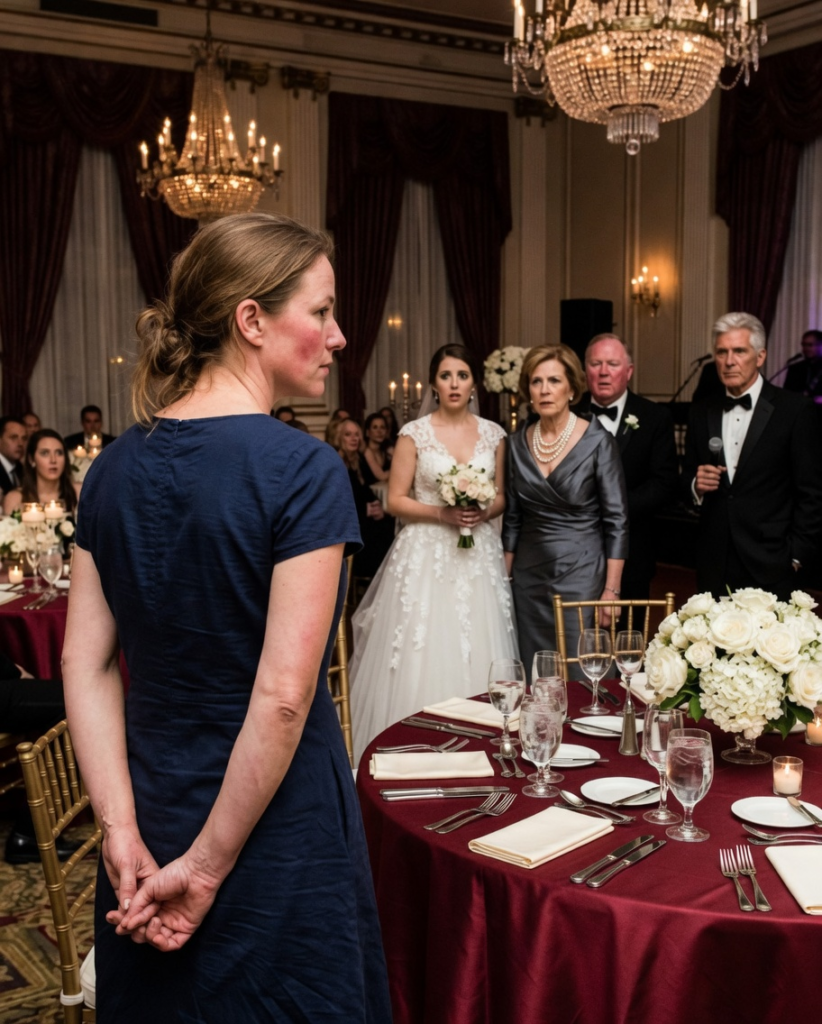
The Sterling Grand Hotel looked like a place built specifically for people who wanted the world to know they had money.
Marble floors glowed beneath golden chandeliers.
White roses spilled over silver vases.
Waiters moved between tables with trays of champagne balanced on gloved hands.
At the front of the ballroom, Jessica stood like a pageant winner in a lace gown that probably cost more than my first car.
She saw me before I reached her.
Her smile held for the cameras.
Then her eyes dropped to my dress.
The smile thinned.
“Evelyn,” she said, giving me a kiss that stopped an inch from my cheek.
“You came.”
“I said I would.”
Her gaze flicked to my hands.
I had forgotten to tuck them behind my back.
The scars were visible under the chandelier light.
Old white lines across my knuckles.
A crescent scar near my thumb.
A faint rope burn that circled one wrist like a ghost bracelet.
Jessica’s mouth tightened.
“Mom has been… stressed,” she said.
“So please don’t make anything difficult today.”
I almost laughed.
I had commanded operations with aircraft in the air, diplomats on secure lines, and lives hanging on seconds.
But in that ballroom, I was somehow the difficult thing.
“I just want to sit with the family,” I said.
“Of course,” she replied too quickly.
But when I walked toward the head table, my mother stepped into my path.
Margaret Carter had perfected the art of smiling with only her mouth.
Her pearls rested at her throat.
Her silver dress shimmered.
Every inch of her looked curated, controlled, and cold.
Her eyes landed on me like a verdict.
“You intend to sit in that chair looking like that?” she whispered.
I glanced behind her at the empty seat beside my father.
“My name is on the place card.”
She leaned closer, her perfume sharp enough to sting.
“Look at your hands, Evelyn.
Rough, calloused, scarred.
Do you intend to touch my imported silk tablecloth with those laborer’s hands?”
For a second, the ballroom blurred.
I saw a night desert lit by helicopter beams.
I saw a young medic screaming for help while fire rolled across a ridge.
I saw my own hand wrapped around a cable as it burned through my glove, because letting go meant leaving a man behind.
Those scars had names.
My mother only saw shame.
“I washed my hands before I came, Mother,” I said quietly.
Her nostrils flared.
Jessica appeared at her shoulder, wine glass in hand, veil trailing behind her like a white flag she had no intention of honoring.
“Mom is right,” she said, not bothering to lower her voice.
“Look at yourself.
Where did you get that dress? The discount bin? You are standing next to people who actually matter, Evelyn.
You look like someone wandered in from the service entrance.”
A few nearby guests turned.
One woman looked away, embarrassed for me.
Another leaned subtly toward her husband, hungry for the drama.
I kept my hands at my sides.
“I flew all night to be here,” I said.
“I’m not asking for attention.
I’m asking to sit with my family.”
Jessica’s eyes hardened.
“This is my wedding.
My photographers, my investors, my future in-laws.
I will not have you ruining the frame because you suddenly want to play wounded soldier.”
The words hit a place in me I thought had gone numb years ago.
Wounded soldier.
She said it like an insult.
My father heard the last part as he approached, cheeks already flushed from champagne and importance.
Richard Carter was a man who measured worth by proximity to power.
He had spent the morning telling anyone who would listen that his daughter was marrying into the Sterling family, as if Jessica had won a crown and he had polished it himself.
“What is going on?” he demanded.
“Evelyn is making a scene,” Jessica said.
“I’m standing beside a chair with my name on it,” I replied.
His gaze swept over me, and disappointment twisted his face before anger did.
“Why would you come dressed like this?”
“My luggage was delayed.”
“Excuses,” he snapped.
“Always excuses.
Your sister has worked too hard for this day.”
“So have I,” I said before I could stop myself.
He blinked as if I had spoken in a language beneath him.
“You?”
The contempt in that single word filled the space between us.
I felt years press against my chest.
Every missed Christmas because I was overseas.
Every medal locked in a drawer.
Every phone call where my mother asked whether I had found “real work” yet.
Every time Jessica laughed and asked whether soldiers got employee discounts on boots.
“Yes,” I said.
“Me.”
His face reddened.
Around us, conversations dimmed.
Forks paused above plates.
The wedding planner hovered near the floral arch, unsure whether to intervene.
My mother hissed, “Richard, people are watching.”
That only made him louder.
“You belong nowhere near this table,” he said.
“You want to sit beside CEOs, investors, and the Sterling family looking like a charity case?”
“Dad,” I said, keeping my voice low, “you have no idea what I’ve done.”
“I know exactly what you’ve done.
You threw away every opportunity we gave you.
I fed you.
I educated you.
And you crawled into some barracks to do menial labor while your sister built something respectable.”
The word menial moved through the ballroom like a stain.
I saw the groom, Daniel Sterling, standing near the altar with his jaw tight.
He was handsome in a practiced way, dark suit immaculate, hair perfect, expression uncertain.
His eyes darted from Jessica to his father, who sat at the Sterling family table with both hands folded in front of him.
I recognized the older man immediately.
Arthur Sterling.
Defense contractor.
Philanthropist.
Former diplomat.
A man whose name had appeared in briefings, donor lists, and security files.
A man I had met once under conditions no one in that ballroom could imagine.
He had not looked at me closely when I entered.
Now he was watching.
My father followed my glance and mistook it for fear.
“You are embarrassing me in front of Mr.
Sterling,” he barked.
“Do not make these important men smell your failure.”
“Richard,” my mother whispered, but there was no concern in it.
Only panic over the audience.
I straightened.
“I’m not leaving because you are ashamed of a dress.”
His hand moved before his face changed.
The slap cracked through the room.
My head snapped to the side.
The ballroom went silent so suddenly I could hear the ice shift in Jessica’s glass.
Heat spread across my cheek.
My lip split against my tooth.
For one second, the instinct drilled into me by years of command rose like fire: assess, stabilize, respond.
But this was not a battlefield.
This was my sister’s wedding.
And the man who had struck me was my father.
He stood there breathing hard, finger trembling as he pointed toward the entrance.
“You are a disgrace to this family,” he said.
“Get out.
Go back to whatever hole you crawled out of.
Don’t come near this table again.”
No one moved.
My mother stared at the floor.
Jessica’s expression was not horror.
It was irritation.
As if the slap had been unfortunate only because it disrupted her timeline.
I touched my lip.
My fingers came away with a small smear of red.
Then I looked at each of them.
My mother, guarding silverware as if I were dirt.
My sister, guarding a photograph.
My father, guarding his pride.
Something inside me settled into a cold, clean silence.
I turned to leave.
The sound of a heavy chair dragging across marble stopped me.
It came from the Sterling table.
Arthur Sterling stood slowly.
He was tall, silver-haired, dressed in a black tuxedo with old-world precision.
The room shifted toward him instantly.
Men like him did not need to raise their voices to control a space.
The space rearranged itself around them.
He took the microphone from the wedding band’s stand.
The planner made a tiny protesting noise and then thought better of it.
Arthur’s eyes remained fixed on me.
“Madam General,” he said.
The words landed like glass breaking.
My father’s arm dropped.
Jessica went still.
My mother looked up so sharply one pearl earring swung against her neck.
Arthur Sterling inclined his head, not to my family, not to the guests, but to me.
“Major General Evelyn Carter,” he said into the microphone, each syllable clear.
“I apologize that you were received this way in my presence.”
A murmur rose across the ballroom.
Jessica’s wine glass trembled in her hand.
My father stared at me as if my face had rearranged itself.
“What did he call you?” he whispered.
I did not answer him.
Arthur turned toward the guests.
“Three years ago,” he said, “a convoy carrying my wife, my younger son, and twelve humanitarian workers was trapped during an overseas evacuation.
Communications failed.
The road was compromised.
Every official option was too slow.”
Daniel Sterling’s face lost color.
He knew where this was going.
Arthur’s voice hardened.
“General Carter led the operation that brought them out alive.”
The ballroom inhaled.
My mother lifted one hand to her mouth.
Jessica whispered, “No.”
Arthur looked at her.
“Yes.”
The word was quiet, but it had more force than my father’s shout.
“She stayed behind after the first extraction because one vehicle was missing,” Arthur continued.
“She refused to leave until the last civilians were accounted for.
My wife spent six weeks in recovery afterward.
She still keeps the note General Carter wrote to her in the transport aircraft.”
He paused.
His gaze moved to my hands.
“The scars your family mocked were received while saving mine.”
Something in the room changed then.
Not loudly.
Worse.
People began looking at my family with recognition, not confusion.
They understood what they had witnessed.
My mother’s lips parted, but no words came.
My father’s face drained from red to gray.
Jessica stepped forward, trying to pull the moment back into her control.
“Mr.
Sterling,” she said, voice shaking under its sweetness, “there must be some misunderstanding.
Evelyn never told us any of this.”
Arthur stared at her.
“Did you ever ask?”
Jessica flinched.
Daniel looked at his bride as if seeing her for the first time without makeup, lighting, or ambition between them.
“Jess,” he said quietly, “you told me your sister was unstable.”
The room went colder.
My eyes moved to Jessica.
She swallowed.
Daniel’s voice sharpened.
“You said she exaggerated her service record.
You said your family kept her away from important events because she was jealous of you.”
My mother closed her eyes.
There it was.
Not just neglect.
Not just cruelty.
A story had been built around my absence, brick by brick, and every brick had my name carved into it.
Jessica’s cheeks flushed under her bridal makeup.
“I was protecting the wedding,” she said.
“You don’t understand our family dynamic.”
Arthur’s mouth tightened.
“I understand character.”
Then he turned to his son.
Daniel did not move for a long second.
He stared at Jessica, at her clenched jaw, at the father who had struck his own daughter in public, at the mother who had sneered over silverware, at me standing alone with a split lip and my shoulders still squared.
“Dad,” he said, his voice low.
Arthur gave him one brief look.
That was enough.
Daniel removed the boutonniere from his lapel.
Jessica’s breath caught.
“Daniel,” she whispered.
He placed the flower on the table beside an untouched champagne flute.
“I can’t marry into this,” he said.
The words were not loud, but they ended the wedding more completely than any scream could have.
Jessica stumbled back as if the floor had shifted beneath her gown.
“You’re humiliating me,” she said.
Daniel looked at her with tired disbelief.
“You watched your father hit your sister and worried about the photographer.”
Her mouth opened.
Nothing came out.
Arthur raised the microphone again.
“This wedding is canceled,” he said.
The sentence traveled through the ballroom like a gavel.
The band stopped pretending to tune.
The planner pressed both hands to her headset.
Guests began whispering openly now, their polished manners cracking under the weight of what they had seen.
My father took one step toward Arthur.
“Mr.
Sterling, please.
This is a family misunderstanding.
Evelyn has always been difficult.
She should have told us if she had some fancy title.”
Some fancy title.
For the first time that day, I almost smiled.
Arthur did not.
“Your daughter’s rank was not required for you to treat her with basic dignity,” he said.
My father looked at me then, really looked, but not with love.
With calculation.
The same calculation he had used all his life when deciding which child reflected better on him.
“Evelyn,” he said, voice suddenly softer, “why didn’t you tell us?”
I wiped my lip with the edge of a napkin someone had finally handed me.
“Because every time I tried to tell you anything about my life, you changed the subject to Jessica’s quarterly revenue.”
Jessica’s face twisted.
“This is not fair,” she said.
“I didn’t know.”
“You didn’t want to know,” I replied.
The room went quiet again.
There was no satisfaction in saying it.
Only exhaustion.
My mother reached for me then, one hand trembling, pearls flashing under the light.
“Evelyn, sweetheart—”
I stepped back.
The word sweetheart sounded foreign in her mouth.
She looked wounded, as though my distance was the cruelest thing that had happened that afternoon.
“I didn’t mean it like that,” she said.
“Yes, you did.”
Her eyes filled, but I had seen real grief.
I had held soldiers through pain that emptied the body of pride.
This was not grief.
This was fear of exposure.
Jessica turned suddenly to the guests.
“Everyone, please,” she said, voice cracking as she tried to smile.
“We can fix this.
Daniel, tell them we can fix this.”
Daniel shook his head.
“You lied about who she was because you needed me to believe you came from a perfect family.”
“I do come from a successful family,” Jessica snapped.
The old Jessica flashed through then, sharp and furious beneath the lace.
Daniel’s expression closed.
“That’s not the same thing.”
Arthur stepped away from the microphone and approached me.
When he reached me, he did something no one in my family had done all day.
He offered respect without asking for proof.
“General Carter,” he said quietly, “my wife would have come today if her doctors had allowed travel.
She speaks of you often.”
My throat tightened before I could stop it.
“How is she?”
“Alive,” he said.
“Because of you.”
Two words.
Because of you.
I had received medals with less weight than that.
Behind him, my father sank into his chair.
He looked smaller suddenly, not because the room had taken anything from him, but because truth had.
My mother stood rigid beside the table she had defended from my hands.
Jessica’s veil had slipped from one shoulder.
She looked around at the guests, searching for someone still willing to see her as the victim.
No one stepped forward.
The wedding dissolved piece by piece.
Guests gathered their coats.
Waiters removed champagne from tables that would no longer toast anything.
The white roses remained, absurdly perfect, while the family beside them came apart.
I walked toward the lobby without looking back.
Halfway there, my father called my name.
“Evelyn.”
I stopped, but I did not turn immediately.
When I did, he was standing a few feet behind me.
His face had collapsed into something like regret, but regret arriving after consequences always has a different shape.
“I didn’t know,” he said.
“No,” I replied.
“You didn’t care.”
His eyes flicked to the guests passing behind us.
Even now, part of him was watching who watched him.
“I was angry,” he said.
“I shouldn’t have hit you.”
“No,” I said.
“You shouldn’t have needed to know my rank to know that.”
He flinched.
For years, I had imagined some version of this moment.
My parents discovering the truth.
Their faces changing.
An apology landing like a bandage over every old wound.
But standing there, I understood something with painful clarity.
An apology forced by public shame is not the same as remorse.
Jessica appeared behind him, tears streaking her makeup now.
“You ruined my life,” she said.
There it was.
Not “I’m sorry.”
Not “I was wrong.”
Just another accusation dressed in white lace.
I looked at my sister, the golden child whose shine had depended on keeping me dim.
“No, Jessica,” I said.
“You built a life on what people thought of you.
Today, they saw you.”
Her face crumpled, but I turned before she could answer.
Arthur’s driver took me back to my hotel.
On the ride, my phone buzzed over and over.
My mother.
My father.
Unknown numbers.
Jessica.
Then Jessica again.
I turned it face down.
Outside the window, the city moved on as if nothing had happened.
Traffic lights changed.
Couples crossed streets.
A little girl in a red coat skipped beside her father, holding his hand without fear.
I watched until the hotel came into view.
That evening, Arthur Sterling sent a handwritten note to my room.
It said his family remained in my debt, and that dignity should never have to reveal its rank before being recognized.
I kept that note.
Not because it came from a powerful man.
Because it said what my family never could.
In the weeks that followed, Jessica’s engagement ended quietly and then very publicly.
Sponsors withdrew from her company’s wedding campaign.
Daniel released a short statement about values, respect, and stepping away from a marriage that no longer reflected them.
My parents tried to call through relatives, through old neighbors, through anyone who thought blood should automatically erase humiliation.
I did not block them.
But I stopped answering quickly.
Months later, my mother left a voicemail.
Her voice was small.
“I saw a ceremony online,” she said.
“They were honoring you.
I didn’t know people stood when you entered a room.”
I listened once.
Then I deleted it.
Maybe that sounds cold.
Maybe some people believe family deserves endless chances, even after years of cruelty disguised as disappointment.
But I had spent my life learning the difference between rescue and surrender.
That day in the ballroom, I did not lose my family.
I finally stopped volunteering to be their lowest-ranking member.