My ex-husband left me to marry another woman.
He did not leave in shame.
He did not leave with regret.
He left like a man walking out of an old apartment he had already outgrown, carrying expensive suitcases, humming under his breath, barely glancing at the woman he had once sworn to protect.
Three days before that, he had still been standing in my kitchen, asking whether I had paid the electric bill.
By the day he left, he had a fiancée.
Her name was Sofia.
She was younger than me, polished in the careful way some women become when they are trying very hard not to look nervous, and according to half the whispers I heard after Daniel announced the engagement, she had been around for much longer than anyone had admitted.
I believed that immediately.
Men like Daniel did not leap from one life to another without building the second one in secret first.
The divorce had barely been finalized when he posted a photograph of the ring.
Sofia’s hand over his, champagne on the table, his smile smug enough to crack glass.
Friends of his called it fate.
His mother called it a blessing.
One woman from church wrote, “When one door closes, God opens another.”
I stared at the post for ten seconds and put my phone face down.
Betrayal is ugly, but it is rarely surprising once you have lived inside a marriage like mine.
The real shock came a week later.
Daniel had taken his mother, his younger brother, and Sofia out of state to “prepare for the wedding.” That was how he phrased it, as if the whole trip were a sparkling family celebration instead of a performance staged around my humiliation.
The morning they left, I received a text.
When we get back, this house won’t be yours anymore.
That was all.
No explanation.
No courtesy.
No effort to soften the threat.
Just a sentence dropped into my morning coffee like poison.
I read it once.
Then again.
My pulse did not race.
I did not cry.
I did not call anyone to ask what he meant.
Instead, I felt something colder settle over me.
Clarity.
The house stood on a piece of land my grandmother had left to me when I was twenty-seven.
It was never Daniel’s.
The deed had always been in my name.
Years later, after our marriage, we built a modest one-story house there.
By “we,” I mean I paid from an inheritance account my grandmother had set aside, and Daniel managed to make himself sound important whenever contractors were around.
He had opinions about everything.
The roof pitch.
The window trim.
The placement of the back steps.
He also had a talent for contributing almost nothing while talking as if the entire structure rose because he approved of it.
During the marriage, I signed too many papers too quickly.
Tax forms.
Insurance forms.
Refinance discussions that never quite became refinances.
A power of attorney packet he once pushed in front of me when I had the flu, insisting it was “just temporary, just in case.” Most of the time I refused to sign anything without reading it.
Sometimes I was tired.
Sometimes I trusted him because that is what wives are trained to do in the quiet stages before the real damage is obvious.
Daniel’s greatest skill was not rage.
It was confidence.
He could speak a lie in such a practical tone that you felt silly for doubting it.
By the time his text arrived, I knew exactly the kind of move he thought he had made.
Some hidden filing.
Some transfer attempt.
Some loophole twisted through my earlier trust.
He would not threaten me unless he believed he had already arranged the outcome.
So I called a lawyer before noon.
Her name was Mara Levin, and she had represented a friend of mine in a business dispute years earlier.
She listened without interrupting while I read the text aloud.
Then she said, “Do not answer him.
Come to my office.
Bring every document you have related to the property.
Every deed copy.
Every tax statement.
Everything.”
By two that afternoon, I was sitting across from her conference table while she worked through the papers with quick, precise hands.
For a long time she said nothing.
Then she pulled out a filing from the county records and slid it toward me.
I knew my own signature.
I also knew when it was mine and when it was only pretending to be.
My name sat at the bottom of a transfer document, shaky in places where my hand would never shake, forceful in places where I would never press that hard.
The filing attempted to shift an interest in the property into a shell company.
The shell company, Mara explained, was connected to Daniel’s cousin, who was known in town for skimming the edges of legality without ever quite stepping where cameras could see him.
“He’s trying to cloud title,” Mara said.
“Maybe force a sale.
Maybe leverage the appearance of ownership.
Maybe use it as collateral before anyone catches it.
There are several ugly possibilities.”
I stared at the page until the letters blurred.
“So he forged this.”
“In my opinion? Yes.”
“And he thought I’d just panic.”
“He thought you’d feel cornered.”
Mara leaned back, studying me.
“You have options.
We can file for an emergency injunction, freeze any attempted transfer, and open a fraud claim.
But if he has been reckless, he may still show up expecting control.
The question is whether you want to wait for him to make the next move.”
That was the moment something shifted in me.
For years, my strategy with Daniel had been survival.
Delay the argument.
Avoid the escalation.
Protect the peace if possible.
Make myself smaller so his temper would have less to strike.
But fear has a shelf life.
Mine had expired somewhere between the forged signature and the smug engagement post.
I looked at Mara and asked, “How legal is it to move a house?”
She blinked.
“The house itself?”
“Yes.”
“Well,” she said slowly, “if the structure is yours, the permits are secured, utilities are handled properly, and the destination property is lawful, you can relocate it.”
I let out a breath that felt almost like laughter.
My grandmother had owned another parcel on the far edge of town, a quiet stretch of land with old pecan trees and a gravel road leading to it.
I had inherited that too, though I barely used it except to walk sometimes when I wanted to hear something other than traffic and other people’s lives.
Mara followed the thought on my face before I spoke it.
“You want him to come back to an empty lot,” she said.
I met her eyes.
“I want him to come back to reality.”
She did not smile.
But something in her expression warmed.
“Then let’s make sure reality is well documented.”
The next forty-eight hours were the strangest of my life.
Permits were pulled.
Utility disconnections were scheduled.
A structural moving company from two counties over came to assess the house.
The owner, a broad-shouldered woman named Teresa, walked around the foundation with a tape measure and a flashlight, then glanced at me and said, “You really want the whole thing moved?”
“Yes.”
She grinned.
“I like you.”
Everything cost more than I wanted to think about.
Nearly all my liquid savings disappeared into deposits, transport fees, temporary road closures, escorts, and new foundation work on the second parcel.
Every time I signed another check, a small voice in me whispered that this was madness.
Every time that voice spoke, I pictured Daniel reading his own text with a smirk, already tasting victory.
Madness became easier to afford.
The movers began before sunrise two days later.
I stood in the yard in an old sweatshirt while crews slid steel beams beneath the house and lifted it with hydraulic jacks inch by impossible inch.
The walls groaned.
The porch trembled.
Dust shivered from corners that had not been touched in years.
I thought I would cry.
Instead I felt a fierce tenderness.
That house had watched me survive ten years of criticism disguised as advice, apologies that were really blame, and silences that punished me for not surrendering fast enough.
It had also held quieter things: my grandmother’s china in the dining room cabinet, the quilt my aunt sewed, the fig tree outside the kitchen window, the first nights after the divorce when I fell asleep with every light on because empty rooms can sound like judgment.
Watching it rise from the foundation felt less like destruction and more like rescue.
By afternoon it was rolling slowly down the road, a whole home balanced on a moving platform under a tangle of wires and escort lights, as if some giant invisible hand had finally decided it deserved better ground.
I followed in my car all the way to the second parcel.
When they settled it onto the new foundation beneath the pecan trees, I stood there with dirt on my shoes and breathed for what felt like the first time in years.
The old lot looked wounded after the move.
Exposed earth.
Tire impressions.
A square emptiness where the house had been anchored.
We removed the fence panels too.
Packed the planters.
Took the porch swing.
Even the rusted metal rooster Daniel’s mother hated disappeared into the truck.
By the eve of their return, nothing remained but bare land and a silence so complete it almost felt staged.
Mara filed the injunction that same afternoon.
“Tomorrow,” she said, handing me a thick envelope of copies, “if he approaches you, say only what you need to say.
Let the paperwork do the rest.”
I slept four hours that night.
The next morning I bought coffee I barely drank and parked half a block away from the old lot.
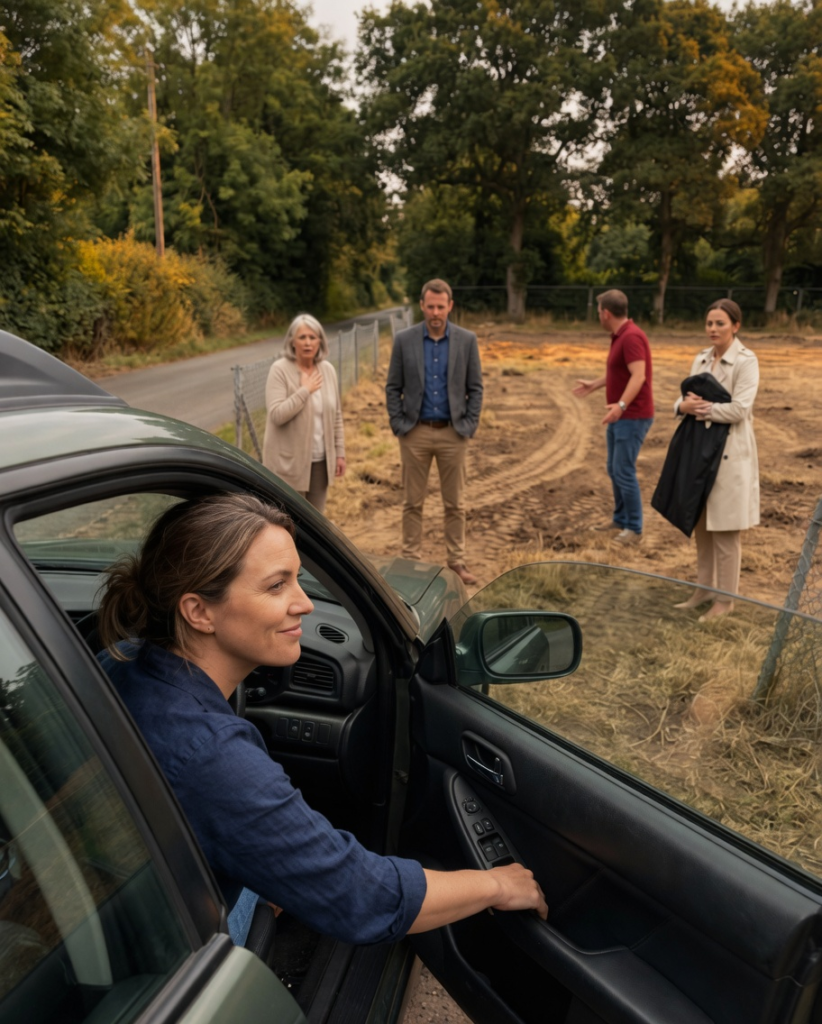
I saw their vehicles before they turned into the drive.
Daniel’s SUV in front, his mother’s sedan behind it, his brother’s pickup trailing, all of them carrying wedding bags and bright expectations home like party favors.
Then they saw the land.
I will remember those first ten seconds for the rest of my life.
Daniel hit the brakes so hard the SUV jolted sideways.
His mother’s sedan nearly clipped the bumper.
Sofia’s face appeared in the passenger window, smiling at first, then frowning, then going perfectly blank.
Doors flew open.
Daniel got out slowly.
His mother climbed out clutching her purse.
His brother spun once in a full circle, scanning the road, the trees, the neighbors’ yards, as if a three-bedroom house might be hiding behind a mailbox.
Sofia stepped onto the dirt in pale shoes clearly meant for bridal appointments, not shock.
“No,” Daniel said, almost to himself.
He walked to the center of the lot and stopped where the living room used to be.
No porch.
No foundation walls.
No fence line.
Nothing.
His brother started swearing.
His mother whispered, “This can’t be right.” Sofia clutched a white garment bag to her chest and looked at Daniel like she was seeing him from a distance for the first time.
Then he said it.
“Where… did it all go?”
I lowered my window.
He turned.
The moment he saw me, he changed.
Panic sharpened into anger because anger was the only language he spoke fluently when fear embarrassed him.
He strode toward my car.
“What did you do?”
I did not get out immediately.
I let him come close enough to see that I was calm.
“I moved my house,” I said.
His mouth opened, then shut.
“You’re insane.”
“Legally permitted, actually.”
His brother barked a laugh that had no humor in it.
“You can’t just move a house.”
I lifted the envelope from the passenger seat.
“Apparently I can.”
Daniel saw the law firm name and went still.
It was almost beautiful, that tiny collapse.
His mother stepped closer.
“Daniel? What is that?”
“Nothing,” he snapped.
Sofia did not look at me.
She looked only at him.
“Why is she holding legal papers?”
He ignored her.
“Give them to me.”
“No.”
I stepped out of the car then, closing the door behind me.
The breeze moved through the empty lot where my home had once stood, and for the first time Daniel looked shorter than I remembered.
“You sent me a message,” I said.
“You told me that when you got back, this house wouldn’t be mine anymore.”
His jaw tightened.
“You don’t know what you’re talking about.”
“Don’t I?”
I opened the envelope, pulled out the county filing, and held it where all of them could see the stamp.
Mara had told me not to perform.
But some truths deserve an audience.
“This is a petition to investigate fraudulent transfer of property,” I said.
“Along with an emergency injunction against any sale, financing attempt, encumbrance, or possession action connected to my land.”
His mother frowned.
“Fraudulent?”
Sofia finally spoke.
“Daniel, what did you do?”
He reached for the paper.
I stepped back.
“Tell her,” I said.
“I didn’t do anything,” he snapped.
“Then explain the forged signature.”
Silence.
He looked at Sofia.
Then at his mother.
Then at the empty lot, as if maybe the house would return and save him from answering.
Sofia’s voice dropped lower.
More dangerous.
“What forged signature?”
I handed her the copy before Daniel could stop me.
She took it with stiff fingers and read.
Her eyes moved once across the page, then again more slowly.
When she reached the bottom, she looked up at him with a face I recognized instantly.
It was the face of a woman realizing she had not been chosen.
She had been used.
“You said the property issue was settled,” she whispered.
“It was supposed to be.”
There are moments when people reveal themselves not because they planned to, but because their next instinct arrives before they can dress it in lies.
Daniel’s did.
He turned to me and hissed, “Do you know what you’ve cost me?”
Not I’m sorry.
Not this is a misunderstanding.
Not I didn’t forge your name.
Just: Do you know what you’ve cost me?
Sofia heard it too.
Her hand fell away from the garment bag.
“Cost you what?”
He said nothing.
His mother, pale now, grabbed his arm.
“Daniel.”
Mara’s car pulled up at the curb then, followed by a county investigator I had not expected to arrive so quickly.
He stepped out with a folder tucked beneath his arm and asked, with bland professional calm, whether Daniel Mercer was present.
The color left Daniel’s face.
The investigator explained that there were questions regarding a recorded document, a possible forged signature, and an attempted use of disputed property in connection with a loan application.
Loan application.
That landed harder than the rest.
Sofia stared.
“You used her house?”
Daniel said, “It wasn’t like that.”
The investigator, who had likely heard every variation of guilt in his career, replied, “Then you’ll have every opportunity to clarify.”
What came out over the next week was uglier than even I expected.
Daniel had tried to leverage the appearance of partial ownership over my property to secure financing through a private lender.
The money, according to messages recovered later, was meant to pay for wedding expenses, pay off some personal debts he had hidden from almost everyone, and cover losses from a business scheme with his cousin that had been bleeding money for months.
He had not only planned to take my house.
He had planned to use it to fund the life he intended to flaunt in front of me.
The forged transfer had been rushed, sloppy under legal scrutiny, and doomed once Mara moved quickly enough.
But Daniel had counted on time, confusion, and my fear.
He misjudged all three.
Sofia left before sunset that same day.
She did not cry in front of them.
She simply set the garment bag in the back seat of her car, took off the engagement ring, placed it carefully on the hood of Daniel’s SUV, and said, “You weren’t building a future.
You were looting one.”
Then she drove away.
His mother sank onto the curb and wept.
His brother refused to look at him.
The investigator asked Daniel several more questions, and Daniel answered with the brittle arrogance of a man who still believed a louder voice might count as innocence.
It did not.
The civil case moved first.
The criminal investigation followed.
Mara handled everything with efficient precision.
The forged filing was challenged and voided.
The injunction remained in place until the title was fully cleared.
The private lender, now aware of the fraud, withdrew immediately and turned over its correspondence.
Daniel’s cousin disappeared for a while, then resurfaced with his own attorney.
As for the house, it stayed exactly where I had moved it.
The second parcel turned out to be better than the first.
Quieter.
More private.
The pecan trees cast long shade across the porch in the evenings.
I painted the front door a deep green my grandmother once loved and planted white roses near the steps.
For the first month, I still woke in the middle of the night expecting a message, a knock, an accusation.
Trauma teaches the body to stay on guard even after the danger has lost its map.
But slowly the new place became home in a different way.
Not the old home I had defended too long.
A truer one.
Months later, after a hearing, Daniel was ordered to stay away from both parcels and was held liable for damages tied to the fraudulent filing and legal costs.
The broader criminal case ended in a plea agreement that spared a trial but marked his record permanently.
By then, most people in town knew enough of the story to stop calling what happened a messy divorce.
It was fraud.
It was greed.
It was a man so certain of his power that he texted his victim before the theft was complete.
I never replied to that message.
I kept it, though.
Sometimes people ask whether moving the house was worth the money.
The truthful answer is complicated.
Financially, it hurt.
Emotionally, it saved something in me that had been collapsing for years.
Because the day Daniel came home to bare land was not the day I destroyed anything.
It was the day he discovered I was no longer standing still so he could strip my life for parts.
Every now and then, usually when the evening light hits the pecan leaves just right, I sit on my new porch and think about that moment on the road: Daniel staring at the empty lot, his family frozen around him, the future he had promised himself suddenly gone.
I wonder what shook him more.
Losing the house he thought he could steal, or realizing I had learned how to move an entire life without asking his permission.
And if I am honest, one question still lingers after all the paperwork, all the consequences, all the silence that followed.
Was his biggest mistake forging my name, or believing for even a second that fear would keep working on me forever?