Rain has a way of making every sound feel final. At Samuel Hale’s funeral, it tapped against black umbrellas, ran down the cemetery tent poles, and soaked the hem of Claire’s black dress until the fabric clung to her legs.
She stood beside the open grave with both hands wrapped around the brass handle of her husband’s casket. Nine months pregnant, newly widowed, and surrounded by people who kept speaking about strength as if it were a choice.
Samuel had died at thirty-four after a sudden accident that turned one hospital call into a life sentence. The night before the funeral, Claire had sat in their laundry room holding one of his shirts because it still smelled faintly like soap and sawdust.

Samuel had always fixed small things before anyone asked. A loose porch rail. A broken cabinet hinge. The mailbox flag that stuck every winter. That was how he loved people. Quietly. Practically. Before they had to beg.
His mother, Vivian Hale, loved differently. She loved through control, appearances, and inheritance language. At the funeral, she wore pearls and black lace, accepting condolences with a hand pressed to her chest like grief had been rehearsed.
Derek, Samuel’s older brother, stood beside her checking his watch. Samuel had bailed Derek out more than once, but Derek spoke of those rescues as if they were family obligations, not debts.
Claire had spent seven years trying to be accepted by them. She had brought casseroles to Vivian’s holiday dinners, sent birthday cards, stayed polite when Vivian corrected her clothes, her house, and even the name they had chosen for the baby.
Samuel always noticed. On the drive home, he would squeeze Claire’s hand and say, “You don’t have to earn a place you already have.” It became one of the small sentences she carried like a folded note.
At the grave, the baby shifted low and hard. Claire tightened her fingers around the casket handle and tried to breathe through it. Then a sharper pain tore through her abdomen, sudden enough to bend her knees.
A warm rush soaked through her tights and into her shoes. For one second, she simply stared at the wet grass because her mind refused to put the truth into words.
Her water had broken.
Claire reached toward Vivian, catching the sleeve of her expensive wool coat. “Vivian,” she whispered, her voice thin from panic. “Please. My water just broke. Call 911.”
Vivian looked at Claire’s hand before she looked at Claire’s face. That tiny delay would stay with Claire for years. It was the moment she understood concern was not coming.
“We are grieving,” Vivian said under her breath. “This is my son’s moment. Do not make a scene. Call a taxi yourself.”
Claire turned toward Derek. He had heard everything. Instead of helping, he stepped forward and pressed one hand against her shoulder, guiding her away from the grave as if she were blocking the view.
“Not tonight,” Derek muttered. “I have a meeting with the estate attorney in an hour. Get an Uber. You’ll be fine.”
The mourners froze in the rain. A woman held a paper coffee cup halfway to her mouth. A cemetery worker looked down at the artificial turf. The little American flag near the veterans’ section snapped once in the wind.
Nobody moved.
Claire wanted to scream. She wanted to grab Vivian by the pearls and make her say those words loudly enough for everyone to hear. Instead, another contraction hit, and Claire put both hands under her belly.
She walked away from Samuel’s grave alone.
At 4:18 p.m., the cemetery security camera recorded Claire leaning against the iron fence. At 4:26, a groundskeeper called 911. At 5:03, the hospital intake desk printed her wristband under “Claire Hale, emergency labor.”
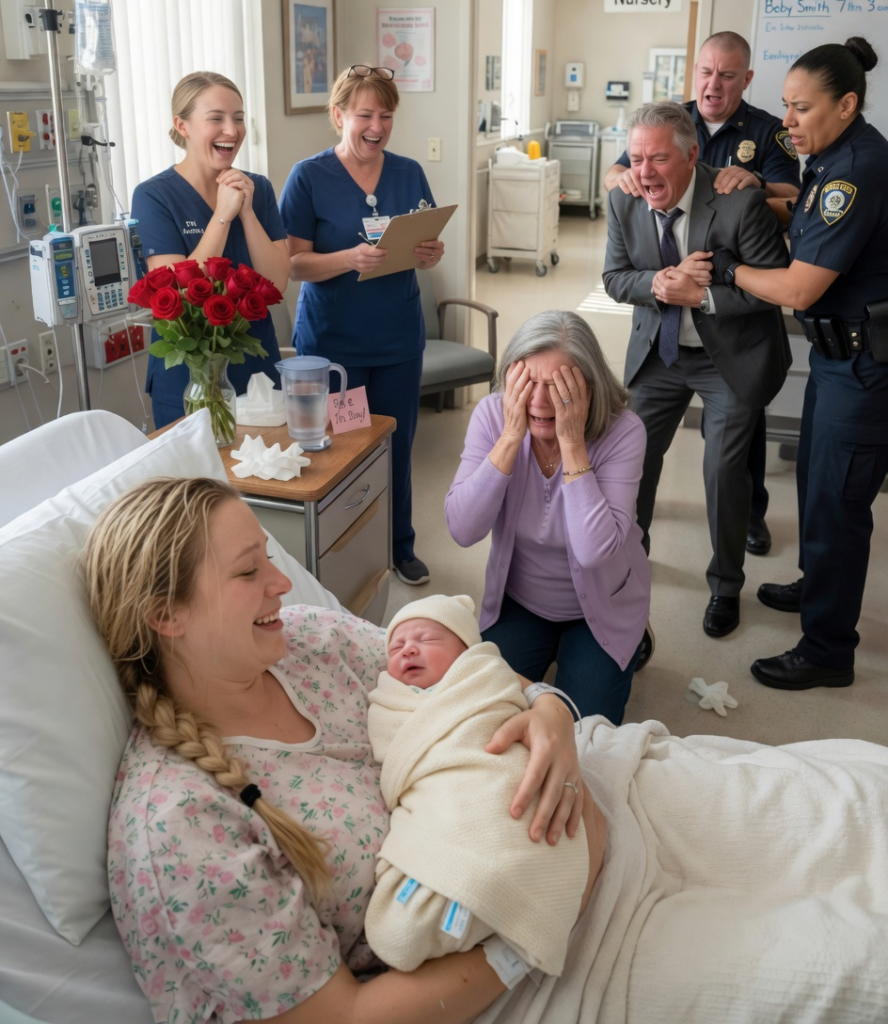
She delivered her son without Samuel beside her and without one member of the Hale family in the waiting room. When the nurse placed the baby on her chest, Claire cried so hard she could barely say his name.
“Noah,” she whispered. “Noah Samuel Hale.”
For three days, Claire slept in broken pieces. She learned to feed Noah while answering sympathy texts from people who had not seen what happened at the cemetery. Vivian sent nothing. Derek sent nothing.
On the third afternoon, Samuel’s attorney arrived at the hospital. He was an older man with tired eyes and rain on his coat. He placed a sealed legal folder on Claire’s tray table and asked if she felt strong enough to hear something important.
Claire almost said no. Then she remembered Samuel fixing the mailbox flag in the freezing cold because she had mentioned it once. Samuel had never left problems for later.
The folder held trust papers, corporate authorization updates, medical directives, and a notarized letter addressed to Claire. Samuel had changed several documents months before his death, after discovering irregularities in Hale family accounts.
The attorney did not accuse anyone that day. He simply used careful words. Review. Audit. Signature authority. Protective transfer. Claire listened while Noah slept against her shoulder.
By day eight, Hale corporate bank accounts were frozen pending federal audit review. By day ten, Derek had learned his name no longer opened doors it used to open. By day twelve, Vivian arrived at Claire’s front porch.
The doorbell rang at 9:17 a.m. Claire checked the security monitor and saw Vivian under the small porch flag Samuel had hung every Fourth of July. Derek stood behind her holding a stuffed bear with the tag still attached.
Claire opened the door but did not invite them in.
“Claire, darling,” Vivian said, wearing the kind of soft smile people use when they need something. “We are so sorry we have not been by sooner. We came to see my grandchild.”
Derek lifted the bear. “And we need to talk about the estate accounts.”
Claire looked at them for a long moment. The cemetery came back in pieces: rain in her shoes, Vivian’s sleeve under her fingers, Derek’s palm pushing her away.
“Which grandchild?” Claire asked.
Vivian’s smile cracked. Derek’s face hardened, but then he saw the documents on the entry table. A county clerk envelope. A hospital discharge folder. Samuel’s sealed letter. Copies, scanned and cataloged, exactly as the attorney had instructed.
The first document confirmed Noah as Samuel’s legal heir. The second confirmed Claire as trustee over Samuel’s protected shares. The third was Samuel’s written statement explaining why Derek’s authority had been removed.
Derek reached for the envelope. Claire moved it back with two fingers. “Don’t,” she said. “Everything here has already been copied.”
Then a black SUV pulled into the driveway. Samuel’s attorney stepped out carrying a brown envelope with a red evidence sticker across the flap. Vivian saw him and went pale.
That was the real answer to Claire’s question. Vivian did not fear losing a grandson. She feared losing access.
The attorney delivered the certified copy Samuel had ordered released after his funeral. Inside was a timeline of transfers, loan guarantees, and account changes Samuel had documented before his death.
Derek’s name appeared again and again. Vivian’s appeared less often, but in places that mattered more. Samuel had not been careless. He had been building a record.
Claire did not shout. She did not have to. She stood in the doorway holding her newborn’s future in one hand and her husband’s last act of protection in the other.
Vivian tried one final time. “Claire, we are family.”
Claire remembered Samuel’s sentence from all those drives home. You don’t have to earn a place you already have. Then she looked at Vivian and understood the opposite was also true.
Some people lose their place the moment they show you exactly what they would do with it.
The audit continued for months. Derek hired lawyers. Vivian gave statements through counsel. The estate accounts remained locked until the review separated Samuel’s protected assets from the family company’s tangled debts.
Claire focused on Noah. She learned the rhythm of bottles, laundry, pediatric appointments, and nights when grief arrived after midnight with no warning. She kept Samuel’s porch flag up because it had mattered to him, not because it mattered to the Hales.
When Noah was old enough to smile at the sound of her voice, Claire stopped thinking of the cemetery as the day everyone abandoned her. It became the day she stopped begging cruel people to become kind.
Rain, grief, and labor had carried her out of that cemetery alone. Samuel’s final papers helped her protect their son. But the strength was hers before the documents ever arrived.
And when Vivian later asked through attorneys for supervised visitation, Claire’s answer was calm, documented, and final: any relationship with Noah would begin with the truth of what happened on the day he was born.