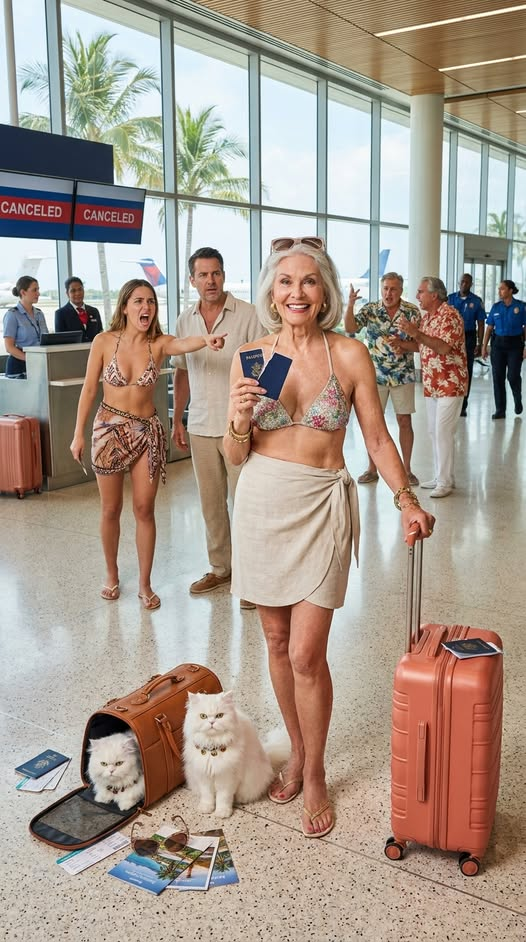
The sharp, jagged rip of paper echoed louder than any jet engine roaring outside the terminal windows. In one vicious, rehearsed motion, my stepdaughter Vanessa snatched my passport from my trembling hand and tore it cleanly in half right there in the check-in line.
“You’re not going to Hawaii, Maggie,” she said with a smug, razor-thin smile. Her voice carried just far enough for the family in matching floral shirts behind us to stop and stare. “You’re staying home to watch my two cats. Someone has to be the adult here.”
I stood frozen. I am sixty-four years old. I was surrounded by the chaotic energy of excited travelers and the rhythmic clicking of rolling suitcases. I watched as the boarding passes for the entire family—the ones I had paid for—vanished into her designer tote. My daughter, Emily, wouldn’t meet my eyes. Her husband, Derek—Vanessa’s trophy of a spouse—let out a low, condescending chuckle and patted my shoulder as if I were a confused golden retriever.
“Come on, Maggs. It’s for the best. You’d only slow us down on the trails anyway. Think of it as a staycation,” he said.
The terminal at O’Hare International Airport smelled of overpriced espresso and industrial cleaning solution. Fluorescent lights buzzed overhead like a migraine. I could feel the weight of curious stares from strangers who were suddenly very interested in our little domestic tragedy. My heart hammered against my ribs, a trapped bird in a cage.
But I didn’t cry. I didn’t scream. I simply adjusted the strap of my leather planner on my shoulder—the one I’d carried for thirty years through boardrooms and budget reviews—and let the silence stretch until it became a physical weight between us.
My name is Margaret Thompson. Most people call me Maggie. For seven years, since my husband, Richard, passed away, I have been the quiet foundation holding this blended family together. I was the one who provided the down payment on the house Vanessa and Derek live in. I covered Emily’s wedding when her savings were depleted. I funded private school for the grandchildren, car repairs, medical emergencies, and more vacations than I care to count. All the while, they treated my generosity like an ATM with a pulse.
This Hawaii trip was supposed to be my “Grand Finale.” It was my retirement gift to myself, and a chance to create lasting memories with my grandchildren before they grew too old to want to hold Grandma’s hand. First-class seats, an oceanfront villa on Maui, private snorkeling trips, and sunset dinners at the best restaurants on the island. I had meticulously budgeted using my points and a lifetime of careful savings. I had even bought new walking shoes and a lightweight suitcase in soft coral—the color Richard always said made me look alive.
But standing in that line, watching Vanessa casually drop the torn pieces of my identity into a nearby trash bin, I finally saw the ledger for what it was. To them, I wasn’t family. I was staff. And staff doesn’t get a seat at the first-class table.
“You’ll be fine,” Vanessa continued, flipping her salon-perfect hair. “The cats need their special wet food twice a day, and the litter boxes have to be scooped religiously. You know how Princess gets if her routine is off. Derek and I need this break. Emily agrees, don’t you?”
Emily murmured something that might have been agreement, her eyes fixed on the scuffed linoleum floor. She had always been the peacemaker, caught between the fiery Vanessa and the reality of our lives. But lately, the pull toward her stepsister’s glossy, subsidized lifestyle had grown too strong to resist.
Derek just smirked, checking his Rolex—the one I’d helped finance when his “groundbreaking” startup collapsed for the third time.
The agent at the counter called the next group forward. My family moved ahead without me, chatting excitedly about luaus and poolside cocktails, as if I had already evaporated into thin air. The humiliation burned hot up my neck, but beneath it, something colder was forming—something precise, calculated, and familiar.
It was the same calm I used to feel in windowless audit rooms when I caught executives cooking the books. I had spent decades as a senior corporate accountant for a Fortune 500 company. I knew numbers. I knew contracts. And most importantly, I knew exactly whose name was on every major financial thread holding their comfortable lives together.
Vanessa glanced back once, expecting to see me shuffling away obediently toward the exit. Instead, I turned in the opposite direction. I wheeled my coral suitcase behind me, the wheels making steady, rhythmic clicks against the polished floor.
The wheels sounded like a countdown.
I didn’t need to make a scene. Scenes were for people who still cared about being liked. I had moved past that at approximately 10:32 AM. What I needed now was corrective action.
As I walked toward the customer service counter, the weight of decades of quiet enabling fell away. Every time I had said yes when I should have said no; every check I wrote to “bridge the gap”; every vacation I funded while they complained about my “outdated” opinions. It all crystallized.
The young woman at the service desk looked up with a polite, tired smile. “How can I help you today, ma’am?”
I placed my leather planner on the counter and opened it to the page with every confirmation number, reservation code, and credit card detail, neatly noted in my precise, slanted handwriting. My voice came out steady, professional—the same tone I once used to negotiate multi-million dollar contracts.
“I need to cancel an entire family reservation,” I said. “It’s under my name, and it’s my card on file. All five tickets, the villa, the excursions, the car rental. Everything.”
The agent blinked, glancing toward the check-in line where my family was now at the very front, handing over their bags. “The whole party? Are you sure?”
I looked back one last time. Derek was laughing at something on his phone. Vanessa was posing for a selfie with the grandchildren. Emily stood slightly apart, biting her lip.
“Yes,” I replied, turning back to the agent. “I’m quite sure. In fact, I’ve never been more certain of anything in my life.”
As her fingers began typing, I felt the first real shift inside my chest. Not rage, not even sadness anymore. Just clarity. Cold, administrative, unstoppable clarity.
Chapter 1: The Audit of a Lifetime
The customer service agent’s keyboard clicked steadily while I stood there, my coral suitcase resting against my leg like a quiet ally. Outside the tall windows, planes taxied down the runway, their lights blinking against the gray, overcast Chicago sky. I watched through the glass partition as my family reached the ticket counter. Vanessa was gesturing dramatically, likely complaining about the wait, while Derek flashed that confident grin he reserved for service workers he intended to underpay.
They didn’t see me. They had already erased me from the itinerary.
“Ma’am,” the agent said gently, “the cancellation is processing. Since you are the primary cardholder and it’s more than twenty-four hours before the land-based reservations, I can process a full refund for the villa and the excursions. The flights will be credited back to your account as well.”
“Thank you,” I said. “Please ensure that the gate agent is notified immediately. I wouldn’t want them to be confused when their boarding passes fail to scan.”
The agent looked at me, and for a second, a flicker of understanding passed between us. She had likely seen this story before: the older woman, the silent provider, being pushed to the edge. “It’s done, Mrs. Thompson. Your account is clear.”
I walked away from the counter, the terminal noise fading into a low hum. The smell of cinnamon pretzels mixed with the faint scent of jet fuel. My new walking shoes felt solid on the floor. I pulled my planner closer to my chest.
For seven years, I had played the role of the “Gracious Widow.” After Richard died, I told myself that supporting his daughter, Vanessa, was a way to keep a piece of him alive. I welcomed the blended chaos. I funded the SUV when Derek’s business ventures failed. I paid the private school tuition so my grandchildren wouldn’t suffer for their parents’ incompetence. I had treated their lifestyle like a company I managed, quietly covering shortfalls while they enjoyed the dividends.
But passports don’t lie. And torn paper is a very loud declaration of war.
I found a quiet corner near a window overlooking the tarmac and sat down. My knees ached slightly from the tension, but the discomfort felt distant. I opened my planner to a fresh page and began writing. My mind worked with the surgical focus of a woman who had spent thirty years rising through the ranks of corporate finance.
Step one: Secure the assets.
Step two: Cut off unauthorized spending.
Step three: Restructure the entire operation.
They believed I would simply go home, feed the cats, and wait for their return to hear stories of a vacation I wasn’t allowed to attend. Vanessa had even texted me a feeding schedule the night before, complete with heart emojis, as if she were instructing a hired teenager.
I closed the planner and exhaled. I hailed a taxi and gave the driver the address of an upscale hotel downtown—the Fairmont. Not the house. I wasn’t going to be a pet-sitter in a home I had practically bought for them.
As the city blurred past the taxi window, I felt lighter. I wasn’t the “reliable grandma” anymore. I was the Chief Financial Officer of my own life, and I was about to initiate a hostile takeover.
When I arrived at the hotel, the lobby smelled of fresh lilies and expensive polish. I checked into a corner suite on the 22nd floor, paying with the same card that was supposed to have funded their Hawaiian dream. Once inside, I kicked off my shoes and stood at the large window. Somewhere out there, at the gate, my family was realizing that their “staff” had just closed the bank.
I poured a glass of water, sat at the mahogany desk, and dialed my longtime private banker, David.
“Maggie? Is everything okay?” David asked. “I thought you’d be halfway to Maui by now.”
“Plans changed, David,” I said, my voice as clear as a bell. “I need to make some urgent changes to several accounts. Specifically, the supplementary cards issued to Vanessa and Derek.”
“Of course. What are we doing?”
“Cancel them,” I said. “Immediately. And I want to freeze the home equity line of credit on the Willow Creek property.”
There was a brief pause on the other end. David knew the family dynamics. He had seen the transfers for years. “Are you sure, Maggie? That might leave them in a… precarious position.”
“David,” I replied, “they just tore up my passport at the airport to ensure I stayed home to scoop cat litter. I think ‘precarious’ is exactly where they belong.”
“Understood. I’ll have the confirmation sent to your email within the hour.”
I hung up. Thread one: Cut.
Next, I called the Elite Pet Resort. “Hello, this is Margaret Thompson. I’d like to arrange a VIP transport for two Siamese cats from the Willow Creek address. I want them boarded in your best suite for the next month. Full grooming, premium care.”
“Certainly, Mrs. Thompson. We can have a van there in forty-five minutes.”
“Perfect. Bill it to my card. And please, inform the residents—if they are there—that the cats are being moved to a professional facility for their own safety.”
Thread two: Secured.
Finally, I called the dealership. Derek’s black SUV—the one he loved to parade around as a sign of his “success”—was still in my name. I had never transferred the title because Derek “forgot” to bring the paperwork every time I asked.
“This is Margaret Thompson. I’d like to report a vehicle for repossession. I am the sole owner on the title, and the primary user is no longer authorized to possess the asset. It’s currently in the long-term parking lot at O’Hare, Section G.”
The manager at the dealership had known Richard and me for years. “We’ll have a truck there by sundown, Maggie.”
I set the phone down and looked at my reflection in the darkened window. For the first time in seven years, the woman looking back didn’t look tired. She looked dangerous.
Chapter 2: The Return of the Auditor
The hotel suite was silent, save for the hum of the city below. Around 7:30 PM, my phone began to vibrate. It didn’t stop for forty minutes.
First came the texts from Emily: Mom? Where are you? The gate agent says our tickets are cancelled. There’s some mistake. Please call.
Then came the calls from Derek. I let them go to voicemail.
Finally, the storm arrived. Vanessa.
I answered on the tenth ring.
“Maggie! What the hell is going on?” she shrieked, her voice echoing off the terminal walls in the background. “They wouldn’t let us on the plane! They said the reservation was voided! We’re stuck here with the kids and all this luggage! Fix it! Now!”
I took a slow, deliberate sip of my chilled Chardonnay. “I did fix it, Vanessa. I corrected a glaring error in my personal budget.”
“What are you talking about? My kids are crying! Derek is about to lose his mind! Use your card and get us on the next flight!”
“I’m afraid that’s not possible,” I said evenly. “The card you’re referring to has been restricted to ‘Primary User Only.’ And since I’m currently enjoying a lovely suite at the Fairmont, I won’t be needing any additional flights today.”
“You… you cancelled our vacation? Because of the passport?” Vanessa’s voice dropped to a hiss. “It was a joke, Maggie! You’re so sensitive. We were just trying to make sure the house was looked after.”
“A joke is something people laugh at, Vanessa. Tearing up a legal document to force a sixty-four-year-old woman into unpaid labor is called ‘abuse of power.’ I’ve spent my life auditing power. I know exactly how to deconstruct it.”
“You crazy old woman!” she screamed. “Wait until we get home. You’re going to regret this!”
“Actually,” I interrupted, “speaking of home, I’ve had the cats moved to a luxury resort. You don’t have to worry about Princess’s wet food. I’ve also had the SUV repossessed from the parking lot. I hope you kept your Uber app updated.”
The line went dead.
I sat back in the plush armchair, feeling the silence return. I wasn’t being cruel—I was being fair. I had spent years subsidizing their arrogance. I had paid for the air they breathed and the ground they walked on, and in return, they had treated me like a piece of furniture they could discard when it didn’t fit the room.
The next morning, I met with Richard Harland, my attorney. He was an old friend of my late husband, a man who spoke in “Ironclad Clauses” and “Legal Precedents.”
“Maggie,” he said, opening a thick file on his mahogany desk. “I’ve reviewed the promissory notes you had them sign when you helped with the house. You were very smart to include the ‘Appreciation and Conduct’ clause we discussed.”
“I was an auditor, Richard,” I said, smoothing my skirt. “I never trust a balance sheet that hasn’t been verified.”
“Well, technically, because the mortgage is in your name and they are essentially ‘tenants at will’ under the loan agreement, you have the right to initiate a formal restructuring of their residency. Especially given the financial elder exploitation we can now document.”
“I don’t want them on the street,” I said. “But I want them to understand that the ATM is permanently out of service.”
“We’ll start with the ‘Notice of Financial Separation,’” Harland said. “It gives them thirty days to secure their own financing for the house or face a forced sale of the equity. I’ll also send the revocation of the auto-pay for their utilities and insurance.”
As I left his office, I felt a strange sense of mourning. Not for them, but for the family I thought I had. I walked through Millennium Park, watching the tourists take photos at the Bean. I remembered Richard telling me, “Maggie, you’re the engine. Without you, the car doesn’t move.”
He had meant it as a compliment. But he’d forgotten to tell me that if the passengers start slashing the tires, it’s time to get out of the car.
Chapter 3: The Siege of Willow Creek
When I finally returned to the house on Willow Creek—the one I had built with Richard and later “leased” to Vanessa and Derek—the tension was thick enough to taste.
The SUV was gone, replaced by a dusty rental car in the driveway. The lawn, which I usually paid a service to maintain, was already looking shaggy. Inside, the air was hot; I had already suspended the auxiliary payment for the central air conditioning unit’s maintenance contract.
I walked in through the front door, my coral suitcase in hand. Vanessa was sitting at the kitchen island, a mountain of credit card bills and legal notices spread out before her. Derek was pacing, his face red, shouting into his phone. Emily was on the sofa, clutching a pillow, looking like she wanted to disappear into the fabric.
“Oh, the Queen has arrived,” Vanessa spat, her eyes rimmed with red. “Are you happy? We had to take a bus back from the airport. A bus, Maggie! The kids are traumatized!”
“The kids will be fine, Vanessa. It’s a valuable lesson in logistics,” I said, setting my planner on the counter. “Did you get the letter from Mr. Harland?”
“You’re trying to take our house?” Derek roared, stomping over. “We live here! This is our home!”
“No, Derek,” I said, meeting his gaze without flinching. “This is my asset. You are residents who have failed to meet the ‘Good Faith’ requirements of our arrangement. Tearing up my passport was the final breach of contract.”
“I’ll sue you!” he yelled.
“With what money?” I asked quietly. “The cards are cancelled. The equity line is frozen. Your business account—which I co-signed—is currently under audit. I suspect the bank will find those ‘personal travel’ expenses quite interesting.”
Derek stopped mid-stride. The color drained from his face. He knew I had the records. He knew I had been the one quietly fixing his “accounting errors” for three years.
“Mom, please,” Emily whispered, standing up. “This is too much. We’re family.”
“Family respects each other, Emily,” I said, turning to her. “You sat there and watched her tear up my passport. You were going to leave me at the airport to scoop cat litter while you drank margaritas on my dime. Where was the ‘family’ then?”
Emily looked down, her voice breaking. “I… I was afraid of Vanessa.”
“And that,” I said, “is why this is happening. Because fear isn’t family. And money isn’t love.”
Vanessa slammed her hand on the counter. “Fine! Keep your stupid money! We don’t need you! We’ll move out tonight!”
“I doubt that,” I said, pulling a chair out and sitting down. “You have no credit, no car, and your Siamese cats are currently at a resort that costs two hundred dollars a night—a bill you now owe me. You’re not going anywhere because you have nowhere to go.”
“So what do you want?” Vanessa hissed. “You want us to beg?”
“No,” I said. “I want a new contract. One where you pay rent. One where you handle your own utilities. One where you treat me with the respect a board member deserves. Or, you can leave. Those are the only two options on the table.”
The room was silent. I could hear the clock ticking in the hallway—the grandfather clock Richard had bought us for our twentieth anniversary.
Derek looked at Vanessa. Vanessa looked at the legal papers. For the first time in years, they realized the power had shifted. The ATM was gone. The Auditor had returned.
Chapter 4: The New Balance Sheet
The next three months were a masterclass in boundary-setting.
Vanessa and Derek stayed, but the atmosphere had changed. The house was no longer a playground; it was a residence with rules. Derek got a job—a real one—at a local logistics firm. It wasn’t “groundbreaking,” but it paid the rent I now charged them. Vanessa started working part-time at a boutique downtown.
Emily? Emily was the most surprising. She took a job as a teacher’s aide and started attending therapy. She and I began having coffee once a week, away from the house, away from the shadow of Vanessa.
“I didn’t realize how much I was disappearing, Mom,” she told me one rainy Tuesday. “I just got used to being the one who stayed quiet.”
“The quietest person in the room is often the one with the most information, Emily,” I said, squeezing her hand. “But you have to use that information to protect yourself.”
As for me, I finally went to Hawaii.
I didn’t take them. I took a solo tour of the islands. I sat on my balcony at a resort in Hanalei Bay, watching the sunset over the Pacific. I wore my soft coral dress and my new walking shoes. I didn’t have to scoop a single litter box. I didn’t have to pay for anyone’s cocktails.
I sat with my leather planner, but instead of auditing their lives, I was planning my own. A trip to Vancouver. A cooking class in Italy. A volunteer position at the local library.
When I returned home, the house was quiet. Vanessa was in the kitchen, actually cooking dinner for the kids. She looked up as I walked in. She didn’t smile, but she gave me a curt, respectful nod.
“How was the trip?” she asked.
“Enlightening,” I said. “How are the cats?”
“They’re fine. Princess missed you, actually.”
I smiled and walked toward my room. My passport was new, pristine, and tucked safely in my planner.
I had learned that you can’t force people to love you. But you can certainly stop financing their disrespect. Sometimes, the only way to save a family is to remind them that the foundation isn’t a gift—it’s a commitment.
And as Richard always said, the engine only runs as long as it’s maintained.
I was finally doing the maintenance. And the view from the driver’s seat was spectacular.
Epilogue: Six Months Later
The Chicago winter had settled in, painting the trees on Willow Creek in a shimmering coat of ice. I sat in my favorite armchair, the one by the fireplace that Richard used to love. The house felt warm—not just from the heat, but from the lack of tension.
Emily was in the kitchen with the kids, helping them with their homework. Derek was out at a late-shift meeting. Vanessa was at her desk, actually balancing their own checkbook.
I opened my planner to the final page of the year. The numbers were clear. The debts were being repaid. The boundaries were holding.
I had not destroyed a family. I had simply demanded that they become one.
I looked at the framed photo of Richard on the mantel. I could almost hear him whispering, “Good job, Maggie. You always were the best at spotting the truth.”
I closed my planner, leaned back, and watched the snow fall. I was Margaret Thompson. I was sixty-four. I was a traveler, an auditor, and a mother. But most importantly, I was free.