Chapter 1: The Weight of the Shears
The air in my botanical workshop was thick with the scent of crushed eucalyptus, damp earth, and blooming white peonies. It was a humid Tuesday afternoon, exactly three days before my wedding. I was thirty-two years old, standing at my massive wooden workbench, my hands stained with green sap and soil, meticulously assembling the cascading floral arrangements for the cathedral.
I was exhausted, running on adrenaline and caffeine, but my heart was incredibly light. I was finally marrying Marcus, the man who had taught me what unconditional love actually looked like.
The heavy iron pruning shears in my right hand snapped shut, severing a thick stem, just as my cell phone buzzed violently against the wood. The caller ID flashed my father’s name.
I wiped my hands on my canvas apron and answered, expecting a question about the rehearsal dinner logistics.
“Hi, Dad,” I said cheerfully, wedging the phone between my ear and my shoulder. “Did you pick up the tuxedo rental?”
There was a long, heavy silence on the other end of the line. The kind of silence that precedes an execution.
“Darcy,” my father began. His voice was low, strained, and stripped entirely of its usual booming patriarchal authority. It dropped to a shameful, miserable whisper. “I need to talk to you about Saturday.”
My hands paused over the peonies. A familiar, cold dread began to pool at the base of my spine. I knew that tone. I had heard it a hundred times over the last thirty years. It was the tone he used right before he was about to sacrifice me on the altar of my older sister, Vanessa.
“What’s wrong, Dad?” I asked, my voice tightening.
“It’s… it’s Vanessa,” he stammered, clearing his throat nervously. “She’s incredibly stressed right now, Darcy. You know her marriage is falling apart. The divorce proceedings are getting nasty, and she’s just in a very dark place seeing you so happy.”
“I know she’s struggling, Dad, but what does that have to do with my wedding?”
My father sighed, a heavy, cowardly sound. “She called me an hour ago. She was hysterical. She said that if I walk you down the aisle on Saturday, if I stand up there and participate in this ‘spectacle’ while her life is in ruins… she won’t bring the kids to the house for Christmas. She said she’ll cut your mother and me off from the grandchildren completely.”
The heavy iron pruning shears slipped from my grasp. They hit the concrete floor of the workshop with a loud, ringing CLANG that echoed in the quiet room.
Vanessa was thirty-five. She was the undeniable, fiercely protected golden child of the family. She had always used her children as currency, weaponizing access to them whenever she wanted our parents to bend to her narcissistic demands. Because her own lavish, heavily subsidized marriage was collapsing under the weight of her infidelity and debt, she simply could not tolerate the idea of the spotlight shifting to me for a single day.
“And?” I whispered, my vision tunneling. “What did you tell her, Dad?”
“I… I can’t lose the grandchildren, Darcy,” my father choked out, his voice cracking with pathetic self-pity. He had accepted the extortion without firing a single shot. “I’m sorry. I won’t be walking you down the aisle. I’ll attend the ceremony, sit in the back, but I can’t participate. You’ll have to walk alone.”
Before I could even process the magnitude of the betrayal, the line clicked, and my mother’s voice intercepted the call. She had clearly been listening on the other extension.
“Now, don’t make a scene, Darcy,” my mother commanded, her voice crisp and dripping with the toxic gaslighting I had endured my entire life. “This isn’t about you. You need to be the bigger person here. Think about what your sister is going through. Walking down the aisle solo is very modern. It’s empowering! This is not the hill to die on. We’ll see you Saturday.”
The line went dead.
I stood in the center of the workshop, shivering despite the humidity. They had done it again. For the thousandth time in my life, I was the collateral damage. My joy, my milestone, was casually discarded to appease the emotional terrorism of my sister. I was entirely, profoundly alone.
The workshop door swung open. Marcus walked in, holding two cups of coffee, a warm smile on his face.
The smile vanished instantly when he saw me. He dropped the coffees onto a side table, the hot liquid spilling across the wood, and crossed the room in three massive strides. He wrapped his strong, steady arms around my trembling shoulders, pulling me tightly against his chest.
“What happened?” Marcus demanded, his voice a low, protective rumble.
“He’s not walking me,” I sobbed, the tears finally breaking free, soaking into the fabric of his shirt. “Vanessa blackmailed him with the kids. He chose her again. I have to walk alone.”
“I don’t want to walk alone, Marcus,” I confessed, my voice breaking, the decades of rejection finally crushing me.
I felt the muscles in Marcus’s arms turn to solid rock. He pulled back slightly, framing my face with his large, warm hands. He didn’t offer empty platitudes. He didn’t tell me it was going to be okay.
His jaw tightened, a dangerous muscle ticking in his cheek. His eyes, usually so warm and gentle, went entirely dark. He was already calculating, operating three steps ahead of the chaos my family had just unleashed.
“Then you won’t,” Marcus promised. His voice wasn’t a comfort; it was a lethal, absolute vow of retribution. “I swear to God, Darcy, they are going to regret the day they made you feel like you had to.”
Marcus let go of my face, reached into his pocket, and pulled out his cell phone. He began dialing a number, walking toward the large workshop windows. I realized, watching the terrifying, cold focus in my fiancé’s eyes, that my wedding day was no longer just a celebration of our love.
It was about to become the stage for a spectacular, absolute execution.
Chapter 2: The Cathedral Doors
The afternoon of the wedding arrived with brilliant, mocking sunshine.
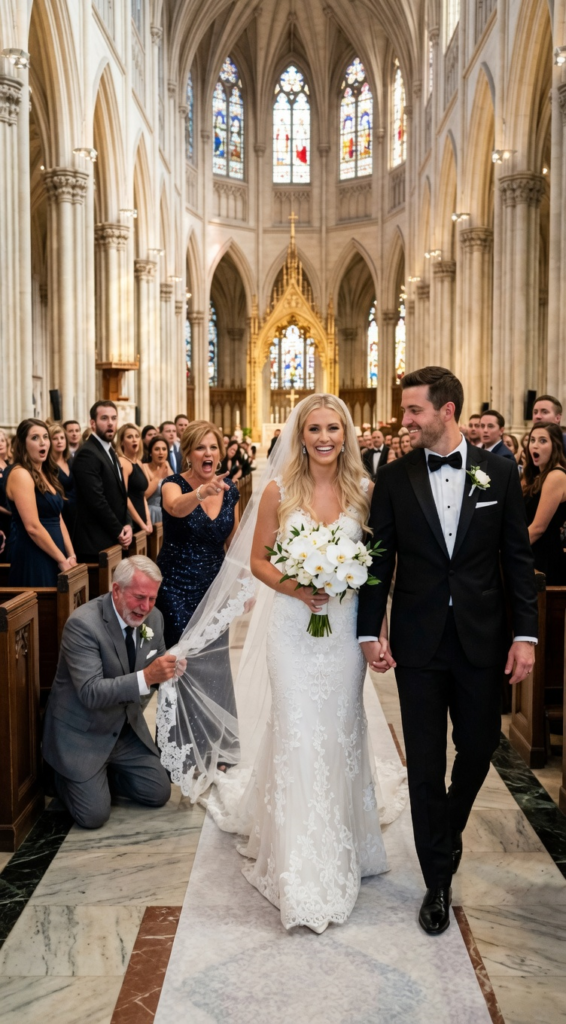
Inside the stunning, towering Gothic cathedral, the atmosphere was electric. The pews were packed with three hundred guests—friends, colleagues, and the extensive network of the agricultural industry where both Marcus and my father worked.
The heavy scent of the white peonies and eucalyptus I had meticulously arranged filled the cavernous space.
Sitting in the third row, entirely too close to the front for a guest who had caused such misery, was Vanessa. She was wearing a sleek, floor-length dress that was undeniably, aggressively white. She sat with her legs crossed, a smug, satisfied smirk playing on her lips, occasionally leaning over to whisper to our mother.
“It’s really for the best,” Vanessa stage-whispered, ensuring the guests in the rows ahead could hear her. “Darcy has always been so fiercely independent anyway. She practically insisted on walking alone. She never really needed a father figure.”
Beside her, my father sat rigidly in his tailored suit. He looked incredibly uncomfortable, sweating slightly under the stained-glass light, but he remained firmly committed to his cowardice. He stared straight ahead at the altar, refusing to make eye contact with the few relatives who were shooting him confused, judgmental glances.
They expected me to walk through the heavy oak doors at the back of the church entirely alone. They expected my solitary walk to be a public, humiliating symbol of my eternal second-place status in the family—a visual confirmation that Vanessa’s grip on our parents was absolute.
Outside the heavy oak doors, standing in the quiet, cool vestibule of the cathedral, I adjusted the veil of my breathtaking lace gown.
My heart was pounding against my ribs like a trapped bird, but it wasn’t beating with fear or the sting of abandonment. It was beating with a terrifying, liberating, electric anticipation.
I looked at the man standing beside me.
He was not my father. He was a man in his late sixties, wearing a custom, immaculate black tuxedo. He possessed a posture of unyielding, aristocratic authority, his silver hair perfectly styled. He looked at me with eyes that radiated fierce, protective pride.
“You look absolutely beautiful, Darcy,” he said, his voice a deep, resonant baritone.
“Thank you, Arthur,” I whispered, reaching out to gently touch his sleeve. “Thank you for being here. I know you flew in early just for this.”
Arthur Vance smiled warmly, placing a large, comforting hand over mine.
Arthur was not a random family friend. He was a billionaire titan of industry. He was the founder and CEO of Vance AgriCorp—the massive, multinational agricultural conglomerate where my father had spent the last thirty years working as a mid-level regional manager, terrified every single day of losing his pension.
More importantly, Arthur was the man who had discovered my early, amateur botanical patents for drought-resistant floral hybrids. He had mentored me, funded my first workshop, and championed my business when my own family told me I was wasting my time playing with dirt. He knew my worth long before my parents ever bothered to look.
And Marcus, knowing exactly how deep my father’s corporate subservience ran, had called Arthur the moment the pruning shears hit the floor.
“I wouldn’t miss this for the world, my dear,” Arthur said softly, extending his right arm toward me. “Your father is a fool. And today, we are going to teach him the cost of his foolishness. Are you ready?”
I took a deep breath, the heavy, dark anxiety of trying to win my family’s love completely evaporating from my chest. I slipped my hand through Arthur’s arm, gripping his sturdy bicep.
“I’m ready,” I said.
The heavy, dramatic chords of the pipe organ began to echo through the thick wood of the doors, signaling the beginning of the bridal march.
The massive oak doors slowly, dramatically swung open, flooding the vestibule with blinding sunlight and exposing us to the packed cathedral.
Chapter 3: The Titan’s Walk
As the doors opened, the entire congregation stood up, turning in unison toward the back of the church.
I stepped over the threshold, moving from the shadows into the brilliant light pouring through the stained glass. The long train of my lace gown glided smoothly over the stone floor. My hand rested securely on the arm of Arthur Vance.
For a fraction of a second, there was silence. Then, a collective, audible gasp was sucked from the lungs of the three hundred guests, pulling the air entirely out of the cathedral.
My father’s colleagues, the executives and managers from Vance AgriCorp who filled the middle pews, immediately recognized the billionaire founder of their company. Whispers erupted like wildfire, frantic and confused, as they watched the man who signed their paychecks escorting a regional manager’s daughter down the aisle.
I kept my eyes fixed straight ahead, but out of my peripheral vision, I watched the third row.
My father let out a choked, desperate sound—a cross between a gasp and a whimper. His eyes bulged in pure, unadulterated terror as he recognized the man beside me. The man he had spent three decades terrified of crossing, the man who controlled his entire livelihood, his pension, and his identity.
Driven by sheer panic, my father instinctively half-stood up from the pew, his hands reaching out defensively, before his knees gave out and he collapsed back onto the hard wooden bench. All the blood completely drained from his face, leaving him looking like a corpse.
Beside him, Vanessa’s smug, triumphant smirk shattered into pieces.
Her jaw dropped open, her eyes darting frantically between me, Arthur, and our hyperventilating father. The realization that her petty, manipulative blackmail had not resulted in my humiliation, but had instead elevated me to a status she could never comprehend, hit her like a physical blow. The white dress she wore suddenly looked incredibly cheap and foolish.
Arthur’s posture was impeccable. He moved with a slow, commanding grace, projecting absolute power with every step we took down the long aisle. He didn’t look at the altar. He didn’t smile at the guests.
As we approached the third row, Arthur slowly turned his head.
He locked his piercing, flint-gray eyes directly onto my father. Arthur didn’t yell. He didn’t sneer. He simply stared at my father with an expression of cold, lethal, bottomless disappointment—a look that promised absolute, inescapable professional ruin.
My father visibly flinched, shrinking down into the pew, trying to hide behind my mother, who was currently covering her mouth with her hands in shock.
Arthur held the stare for three agonizingly long seconds, establishing dominance so profound it felt like the temperature in the room dropped ten degrees. Then, he smoothly turned his attention back to the front of the church.
We reached the altar, where Marcus was standing. He looked devastatingly handsome in his tuxedo, tears of fierce pride shining in his eyes.
Arthur stopped, gently turning to face me. He leaned in and kissed my cheek. “Be happy, Darcy,” he whispered.
He turned to Marcus, extending his hand. Marcus shook it with genuine, profound warmth and respect.
“Take care of her, Marcus,” Arthur commanded softly.
“With my life, sir,” Marcus replied.
Arthur nodded. But before he took his seat in the front row—a row conspicuously and deliberately absent of my parents—he leaned down and whispered something quickly into the ear of the officiating priest.
The priest’s eyes widened slightly, but he nodded in agreement.
The ceremony proceeded beautifully. I said my vows to Marcus, my voice clear and unwavering, surrounded by the love of a man who would burn the world down to keep me safe. We exchanged rings, we kissed, and the church erupted into applause.
But as we turned to walk back down the aisle as husband and wife, my father remained slumped in the third row, sweating profusely, completely unaware that the true execution had not yet begun. It was scheduled for the reception.
Chapter 4: The Public Tribunal
The reception was held in the grand ballroom of the city’s most exclusive, historic hotel. It was an opulent affair, with towering floral centerpieces, crystal chandeliers, and a massive champagne tower glowing under the warm lights.
But beneath the celebration, the tension among the guests was palpable. The executives from Vance AgriCorp were huddled in tight, whispering groups, glancing nervously between Arthur Vance, who was seated at the head table with Marcus and me, and my father, who was pacing frantically near the bar, downing his third scotch.
Vanessa was furious. Her attempts to command attention had failed miserably. No one cared about her white dress or her loudly broadcasted complaints about the catering; everyone was entirely focused on the billionaire who had walked the bride down the aisle.
As the dinner plates were cleared and the jazz band began to play a soft, melodic tune, my father finally broke under the pressure of his own panic.
He couldn’t stand the suspense any longer. He needed to save face. He needed to grovel.
Sweating profusely, his tie loosened, my father marched across the ballroom floor. He bypassed my mother’s frantic, whispered attempts to stop him and headed directly toward the champagne tower, where Arthur had just stood up to mingle with some of the guests.
“Mr. Vance! Mr. Vance, sir,” my father stammered loudly, his voice cracking, drawing the immediate attention of the surrounding crowd.
Arthur stopped. He turned slowly, his face an impenetrable mask of stone, and looked down at my father.
“Richard,” Arthur said, his voice cold and devoid of any warmth.
My father swallowed hard, attempting a pathetic, ingratiating smile. “I… I just wanted to say, I had absolutely no idea you were so close with my daughter. I mean, it’s a tremendous honor that you walked her today, but I assure you, it was just a minor family miscommunication that kept me from the aisle. I—”
Arthur raised a single, large hand. The gesture was so commanding, so absolute, that my father instantly snapped his mouth shut.
The jazz band, sensing the sudden shift in the room’s atmosphere, trailed off into silence. The surrounding guests, including dozens of my father’s colleagues, went dead quiet, turning to watch the confrontation.
“You don’t know many things about your daughter, Richard,” Arthur said. He didn’t lower his voice. He pitched it perfectly so that it carried clearly across the silent ballroom.
My father blinked, a bead of sweat rolling down his temple. “Sir?”
“You don’t know her strength. You don’t know her character,” Arthur continued, his voice heavy with aristocratic disgust. “And you apparently don’t know that Darcy is the brilliant, solitary mind who designed and patented the new drought-resistant botanical hybrids for Vance AgriCorp. Her patents are currently saving our global supply chain millions.”
Whispers erupted from the corporate executives in the crowd. They stared at me with newfound, profound respect.
“She is an invaluable asset to my company,” Arthur stated, taking a step toward my trembling father. “A company that you, Richard, no longer work for.”
The words hung in the air, heavy and lethal.
My father staggered backward, clutching his chest as if he had been physically shot. “You’re… you’re firing me?” he gasped, his voice a pathetic, high-pitched wheeze. “Here? At my daughter’s wedding?”
Arthur’s eyes were completely devoid of mercy.
“No, Richard,” Arthur replied smoothly, loud enough for the entire room to hear. “I am not firing you. You fired yourself. You fired yourself three days ago when you demonstrated to me that you possess the moral spine of a jellyfish. A man who will abandon his own flesh and blood at the altar because he is too weak to stand up to a bully is not a man I trust to manage my regional accounts.”
Arthur turned slightly, his gaze sweeping over the crowd until it locked onto Vanessa, who was standing frozen near the dessert table.
“Clean out your desk by Monday morning, Richard,” Arthur commanded. “Your pension will be frozen pending a thorough, rigorous audit of your department.”
A shrill, hysterical scream ripped through the ballroom.
It wasn’t my mother. It was Vanessa.
Vanessa dropped her champagne glass, shattering it on the marble floor. She realized, in that agonizing, explosive second, that without her father’s massive, six-figure executive salary, her own life was entirely over.
Her parents had been secretly funneling thousands of dollars a month to Vanessa to pay her exorbitant credit card bills, her luxury car lease, and the mortgage on her McMansion because her own husband was freezing their accounts in the divorce. With my father fired and his pension audited, the money spigot was instantly, permanently shut off.
“You can’t do this!” Vanessa shrieked, running toward the champagne tower, her white dress looking ridiculous as her face contorted in panic. “Daddy, tell him he can’t do this! How am I supposed to pay for the house?!”
My father ignored her, dropping to his knees on the ballroom floor, weeping openly, his entire identity, his wealth, and his status annihilated in a single, surgical strike.
The hotel security, alerted by the screaming, quickly moved in. As they firmly escorted my frantically sobbing father, my hyperventilating mother, and a shrieking Vanessa out of the reception hall, the guests watched in stunned, awe-struck silence.
Marcus stepped up beside me. He didn’t look at the doors closing behind my ruined family. He looked down at me, offering his hand.
“May I have this dance, Mrs. Vance?” he asked, a fierce, loving smile on his face.
I took his hand. “You may.”
We stepped onto the dance floor. The jazz band, recovering from the shock, smoothly launched into an upbeat, joyful tune. As Marcus spun me around, my laughter rang out clearly over the music, entirely, profoundly unbothered by the chaos of their exit.
Chapter 5: The Greenhouse and the Ghost
Six months later, the contrast between the worlds of the guilty and the innocent was absolute.
The fall of my family had been swift and brutal. My father, stripped of his severance package and facing a lengthy corporate audit regarding his expense accounts, was forced into an early, humiliating retirement. Unable to afford the massive mortgage on their suburban McMansion without his executive salary, my parents had to quickly sell the house at a loss. They were currently living in a cramped, two-bedroom apartment on the loud side of the city, trying to navigate life on a drastically reduced, basic social security income.
Vanessa’s fate was a different kind of hell. When the secret financial lifeline from our parents was severed, her entire fabricated lifestyle collapsed within weeks. The luxury cars were repossessed. Her husband, realizing she had been hiding massive debts from him, finalized the divorce in a brutal, highly public court battle. Because she had no income and a history of erratic behavior, he was awarded primary custody of the children. Vanessa was currently facing personal bankruptcy, completely ostracized by the wealthy friends she used to impress, living in a cheap rental and blaming everyone but herself.
Across the country, a very different reality was unfolding.
Sunlight poured through the soaring, arched glass ceilings of the massive, state-of-the-art greenhouse attached to my newly expanded corporate headquarters in California. The air smelled of damp earth, blooming orchids, and massive success.
I stood in the center of the greenhouse, wearing comfortable jeans, heavy boots, and a canvas apron, holding a clipboard as I reviewed the latest growth metrics for a new patent.
Marcus stood beside me. He was holding a steaming cup of coffee, watching me work with a look of sheer, unfiltered adoration.
I was thriving. With Arthur’s backing, my botanical patent business had expanded globally. I wasn’t just a florist anymore; I was the CEO of a multi-million-dollar agricultural innovation firm.
The crushing, heavy heartbreak of losing my family, the agonizing anxiety of trying to shrink myself to earn their approval, was completely gone. It had been replaced by the fierce, unapologetic, intoxicating relief of excising a massive tumor from my life. The wound had healed perfectly.
As I made a note on my clipboard, my cell phone buzzed violently in my apron pocket.
I pulled it out. The caller ID flashed an unknown local number, but the voicemail transcription software immediately generated the text on the screen.
It was my mother.
Darcy, please, the transcription read, her voice frantic and desperate even in text. Your father is so depressed he won’t leave the apartment. Vanessa is about to be evicted, she has nowhere to go. Please, you have so much money now. You owe us. We’re family. Just a small loan to help your sister—
I didn’t even read the end of the message.
I didn’t feel a spike of guilt. I didn’t feel the old, familiar tug of obligation that used to make me reach for my checkbook. I felt the cold, vast, untouchable peace of total indifference.
I pressed ‘Delete,’ my thumb perfectly steady, permanently erasing the message and blocking the new number.
“Everything okay?” Marcus asked, taking a sip of his coffee.
“Perfect,” I smiled, dropping the phone back into my pocket.
Marcus reached out, tucking a stray lock of hair behind my ear. “Your assistant left something on your desk inside. It arrived via courier this morning.”
I handed him the clipboard and walked through the sliding glass doors into my modern, sunlit office. Resting on the center of my desk was a heavy, cream-colored, gold-embossed envelope.
I opened it. It was an exclusive invitation from the Global Agricultural Innovation Board. They were hosting their annual, highly prestigious industry gala in New York next month, and the letter formally announced that I was to be honored as the Innovator of the Year.
I looked at the invitation, running my fingers over the gold lettering. I hadn’t just survived the rain; I had learned how to control the weather.
Chapter 6: The True Power of Walking Alone
One year later.
The grand ballroom of the Plaza Hotel in New York was a sea of bespoke tuxedos, thousand-dollar gowns, and the sharp, intellectual chatter of the world’s elite innovators. Crystal chandeliers cast a brilliant light over the hundreds of guests seated at the tables.
I stood on the center stage, the bright flashes of press cameras illuminating my radiant, unburdened smile. I wore a stunning, emerald-green silk evening gown, holding the heavy, glass Innovator of the Year award in my hands.
I looked out into the crowd. In the front row, Marcus beamed at me, his eyes shining with pride. Beside him sat Arthur Vance, clapping enthusiastically, looking like a proud father watching his daughter conquer the world.
As the applause began to die down, my eyes swept toward the back of the massive ballroom.
Near the heavy double doors, standing near a stack of extra chairs, was a man wearing the ill-fitting, standard black uniform of a catering manager. He was holding a tray of empty champagne flutes, looking exhausted, old, and completely broken by life.
It was my father.
He must have taken a minimum-wage job with the hotel’s event staff to make ends meet.
For a fraction of a second, across the vast expanse of the glittering ballroom, our eyes met.
He froze, the tray of glasses rattling slightly in his trembling hands. He looked at me, standing in the light, holding an award, surrounded by the absolute pinnacle of success and respect. His eyes widened with a desperate, pathetic mixture of profound regret and longing. He took a hesitant half-step forward, his mouth opening as if he might call out my name.
I stood perfectly still.
My heart rate didn’t increase. My hands didn’t shake. I didn’t feel a surge of vindictive anger, nor did I feel the slightest drop of pity.
I felt absolutely nothing.
It was the profound, untouchable emptiness one feels when looking at a complete stranger on the subway. The man holding the tray was not my father. He was just an employee at an event I was headlining.
I didn’t smile at him. I didn’t glare. I simply broke eye contact, turning my attention smoothly back to the microphone waiting on the podium.
I leaned forward, looking out at the crowd, and delivered my acceptance speech. My voice rang out clear, confident, and powerful, met with thunderous, standing applause.
As I walked off the stage a few minutes later, stepping securely into Marcus’s waiting arms, I thought back to that humid day in my floral workshop.
My father had told me that walking down the aisle alone would be “empowering.” He had said it as a coward’s excuse, trying to gaslight me into accepting his abandonment.
I smiled, letting Marcus lead me out of the ballroom, leaving the catering manager far behind in the shadows where he belonged.
My father had been absolutely right. It was empowering. But he never realized the true depth of his own words. He thought the power came from surviving the walk down the aisle without him.
He never understood that the true, absolute power wasn’t in walking alone; the true power was the unshakeable, terrifying resolve of never, ever letting him walk back into my life again.