My whole family laughed when Grandpa’s will gave my cousins millions in cash and houses and gave me nothing but a plane ticket to Monaco.
They laughed in that ugly, relieved way people do when they think life has finally confirmed what they always wanted to believe about you.
That you were less.
That you mattered less.
That the person who worked quietly in the background was exactly where she belonged.
I was twenty-six, and in my family, I had been underestimated for so long it had become a kind of tradition.
My name is Rose Thompson.
I was the dependable granddaughter.
The one who stayed late.
The one who called back.
The one who knew how to read a budget, fix a scheduling crisis, and calm a furious client without turning it into drama.
In my family, those qualities were treated as useful, but never glamorous.
Necessary, but never celebrated.
My cousins were different.
Brad was thirty and had somehow turned irresponsibility into a personality.
He drifted between expensive hobbies, half-finished business ideas, and girlfriends who usually realized too late that his confidence was almost entirely funded by other people.
Stephanie was polished, photogenic, and permanently convinced the universe owed her a soft life because she looked good in natural light.
Between them, they had extracted an astonishing amount of money, patience, and attention from my grandfather over the years.
And still, when people talked about “the family legacy,” they pictured them.
Never me.
My grandfather, Charles Thompson, had built an empire out of logistics, property, energy contracts, and the kind of quiet international partnerships that never made magazine covers but made other rich men stand up straighter when he entered a room.
Publicly, everyone knew him as a hard businessman.
Privately, he was harder.
He did not waste words.
He did not perform affection.
He loved in the form of expectation.
I was one of the few people in the family who understood that.
I started working for him at eighteen in one of his regional offices in Chicago.
I answered phones, handled complaints, learned databases, memorized contract flows, and listened.
That mattered to him.
Listening.
Not in the polite, nodding way.
In the dangerous way.
The kind where you notice who lies, who stalls, who blames, who delivers, and who protects themselves when pressure rises.
Every few months he would call me into his office and ask me a question that sounded ordinary until it sat in my head for three days.
What do you do with a profitable executive everyone hates?
What costs more, incompetence or ego?
Who do you promote first: the person who performs, or the person everyone depends on?
I answered honestly.
Sometimes he nodded.
Sometimes he didn’t.
But he always watched.
When he died, none of that seemed like it would matter.
The will reading happened six days later in a dark law office that smelled like polished wood and old power.
My parents were there.
My aunt.
Brad.
Stephanie.
Two family lawyers.
A financial adviser.
Everyone dressed as if grief and greed could comfortably occupy the same chair.
For the first half hour, the will unfolded exactly how I expected.
Two million to Brad.
A beach house in California and another million to Stephanie.
Investment accounts to my aunt.
Properties sold off and divided.
A charitable foundation endowed in Grandpa’s name.
A series of gifts that were all large enough to make the room buzz.
My mother actually exhaled with satisfaction at one point, the way people do when the universe seems to be organizing itself in their favor. Then the lawyer turned to me.
“And to my granddaughter Rose,” he read, “Charles leaves this envelope with instructions that she must travel to Monaco immediately.”
Silence.
Then laughter.
Brad leaned back first, grinning.
“Guess Grandpa finally figured out who the disappointment was.”
Stephanie covered her mouth, pretending she was shocked while smiling with her eyes.
My aunt looked down at the table to hide her expression.
My father stayed still, which was somehow worse.
My mother gave me one tight little glance, and I knew exactly what it meant.
You shouldn’t have expected more.
I opened the envelope.
Inside was a first-class ticket to Nice, a hotel reservation in Monaco, and a handwritten note.
Trust the journey.
That was all.
No figures.
No explanations.
No account numbers.
But my grandfather did not make whimsical gestures.
He did not believe in sentimental puzzles.
If he had sent me to Monaco, there was a reason.
So I folded the note, stood up, and thanked the lawyer as calmly as I could.
Brad laughed again when I left.
“Don’t spend your whole inheritance at the airport, Rosie.”
I did not answer.
At home, I packed one carry-on, my navy dress, basic makeup, my laptop, and every shred of composure I could find.
I checked my bank account before I left for the airport.
Four hundred and twelve dollars.
That number grounded me.
Whatever fantasy my family was building around my “trip,” I knew who I was.
I was a woman with a decent work history, no trust fund, one small apartment, and enough self-respect not to beg for crumbs from people who enjoyed watching me go hungry.
At the gate, an airline representative approached me by name and handed me a cream envelope sealed in gold.
“Your grandfather requested that this be delivered after boarding.”
Inside was an invitation embossed in a formal script.
I was to present myself at the Prince’s Palace in Monaco at noon the following day and ask for Henri.
I read it three times before the meaning settled into me like ice water.
A palace.
The flight felt unreal.
Champagne.
Linen napkins.
A seat that turned into a bed.
Flight attendants who moved around me with the practiced gentleness reserved for people who lived very different lives from mine.
But I barely noticed any of it.
I kept staring at the invitation and hearing Brad’s laughter.
Somewhere over the Atlantic, that laughter stopped feeling insulting and started feeling premature.
Monaco looked impossible from the air.
The sea was too blue, the harbor too clean, the boats too white, the buildings too expensive.
It looked less like a place people lived and more like a polished secret.
The Hotel Hermitage was all marble, crystal, fresh flowers, and staff who greeted me as though I belonged there.
My suite overlooked the harbor.
There was fruit on the table, pressed linens, and a garment bag in the wardrobe.
Inside was a cream dress in my size.
That was the first moment I felt genuinely shaken.
My grandfather had not just arranged a trip.
He had anticipated me.
I stood on the balcony that night with the invitation in one hand and watched the lights shimmer over the water.
I thought about all the times he had asked what I thought instead of what I wanted.
All the moments he had seemed more interested in my judgment than my ambition.
All the times he let other people underestimate me without correcting them.
Maybe he had not been ignoring that.
Maybe he had been studying it.
The next morning, I put on the dress, pinned back my hair, and went to the palace.
A guard examined the card, spoke into a radio, and opened a side gate.
Moments later, a silver-haired man in a flawless dark suit came across the courtyard.
“Ms.
Thompson,” he said.
“I am Henri.
His Serene Highness has been expecting you.”
Expecting me.
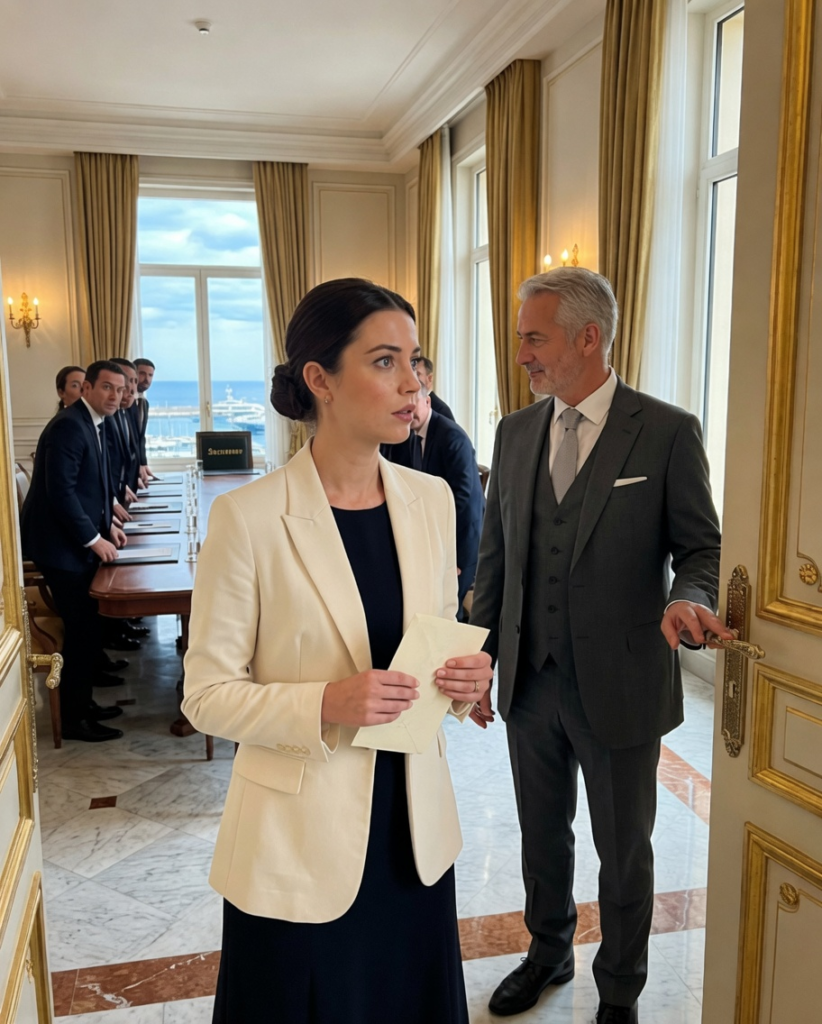
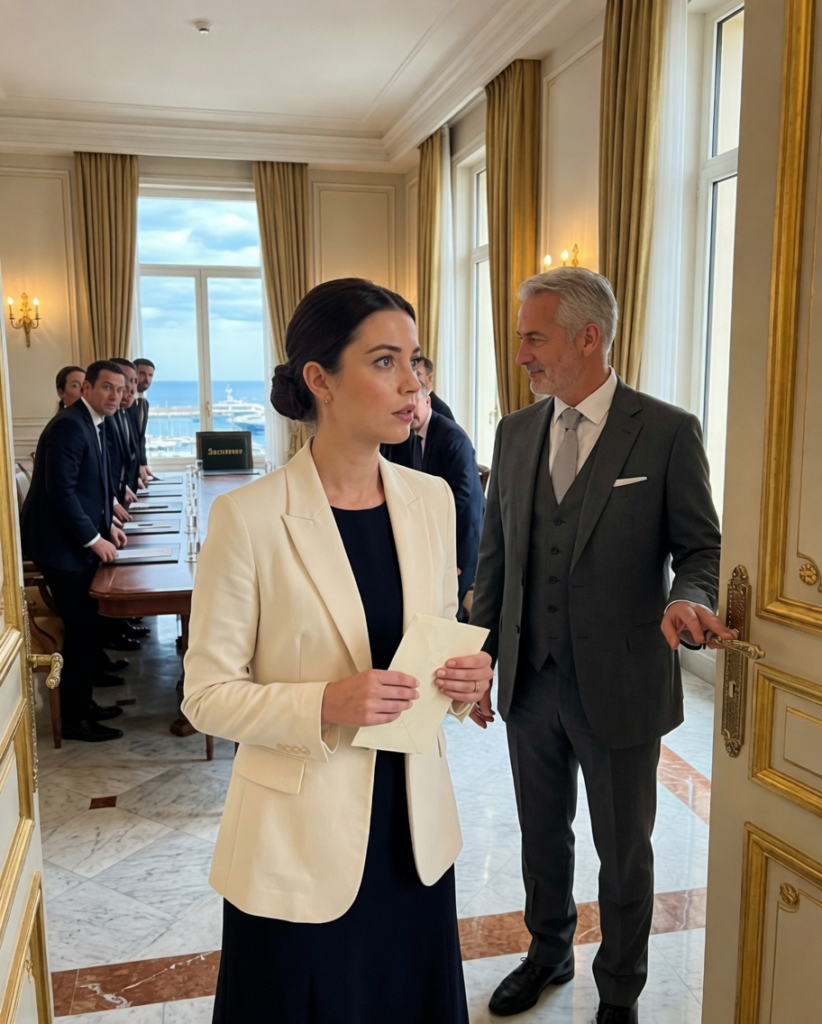
Henri led me through quiet marble corridors into a pair of gilded doors.
Just before opening them, he handed me another envelope.
My name was written on the front in Grandpa’s handwriting.
Inside was a single note.
If they laughed, you’re exactly where I hoped you’d be.
Cash is what I left the family.
The future is what I left you.
Henri opened the doors.
It was not a ceremonial room.
It was a boardroom.
Long polished table.
Floor-to-ceiling windows.
Flags.
Lawyers.
Advisers.
Men and women in tailored suits who all rose when I entered.
At the head of the table sat a black leather portfolio with a brass plate that said one word.
SUCCESSOR.
I stopped walking.
Henri pulled out the chair at the head of the table and gestured for me to sit.
One of the attorneys, a severe woman with silver hair and immaculate posture, slid a file in front of me.
The first page carried the name of a holding company I had never seen before: CTH Sovereign Holdings S.A.M.
Underneath it was a valuation figure so large I thought I had misread the zeros.
I looked up.
“What is this?”
Henri’s expression did not change.
“Your grandfather’s private structure.”
Another folder opened beside it.
Subsidiaries.
Shipping interests.
Real estate.
Energy infrastructure.
Cross-border financing.
Private debt positions.
Strategic land holdings.
Public companies I recognized.
Private entities I did not.
The business my family knew about in Chicago was only a visible fragment.
The rest had been layered behind a Monaco structure for decades.
“Why has no one in the family ever heard of this?” I asked.
“Because the family was never intended to govern it,” the silver-haired attorney replied.
The room went still.
Henri placed a final file in front of me.
There was a red ribbon around it and another handwritten note from Grandpa.
Before you sign, you must hear what they did when they believed you had nothing.
I frowned.
“What did they do?”
Henri nodded toward a screen at the end of the room.
An assistant pressed a button.
A series of emails appeared.
The first had been sent less than forty minutes after the will reading, while I was still packing for the airport.
From Brad to our family’s outside counsel.
Need immediate review of voting structure before Rose gets ideas.
Grandpa left her nothing real.
We should consolidate
control now.
My stomach dropped.
Then Stephanie’s messages.
If Rose asks questions about operations, do not include her.
She was staff, not family leadership.
Then my mother’s.
Best to move quickly while she’s distracted by whatever this Monaco nonsense is.
I stared so hard at the screen my eyes burned.
The next file was worse.
Draft resolutions.
Proposed board changes.
Temporary authority transfers.
Attempts to pressure senior managers into supporting Brad as interim executive face of the company.
A plan to freeze certain internal reporting channels I used to oversee.
Quiet outreach to remove people loyal to me before I even knew there was anything to be loyal about.
“They moved immediately,” Henri said.
“Your grandfather anticipated that they would.”
“Anticipated?” I asked.
The attorney folded her hands.
“He designed for it.
These communications triggered the final succession condition.”
I looked from one face to another.
“Condition?”
Henri nodded.
“You were always first in line.
But Charles required proof that the others would choose appetite over stewardship when they believed you excluded.
He wanted you to see them clearly before you had the power to stop them.”
I sat back in the chair, cold all over.
He had known.
He had known exactly what they were.
And he had wanted me to know it too.
The attorney slid the last set of documents toward me.
“This structure vests controlling authority in a single successor,” she said.
“Effective upon your acceptance.
The distributions to the family are final and cannot be expanded.
They do not receive board control, voting control, or beneficiary status in this structure.”
“How much control?” I asked.
Henri answered.
“Fifty-one percent voting authority over the entire holding group.
Full appointment rights over the senior board.
Protective authority over all distributions.
Immediate power to reverse any attempted internal takeover.”
I just stared at him.
Brad’s two million.
Stephanie’s beach house.
All of it had been bait compared to this.
I thought I might feel triumph.
Instead I felt something heavier and more sobering.
Responsibility.
There were hundreds of employees across multiple countries tied to those decisions.
People with mortgages, children, salaries, futures.
This was not a shiny prize.
It was a machine with weight, history, and consequences.
And somehow my grandfather had believed I could carry it.
“Why Monaco?” I asked quietly.
Henri allowed himself the smallest smile.
“Because thirty-two years ago, your grandfather stepped into a sovereign financing crisis no one else would touch.
He protected an asset package tied to infrastructure and shipping interests in this region.
He did so discreetly, lawfully, and without exploiting the panic.
He earned trust here.
When he decided to build the structure that would outlast him, he built it where he believed greed would have a harder time reaching.”
The idea of him—my hard, silent grandfather—quietly building this parallel kingdom while the family fought over visible scraps made a strange, painful kind of sense.
I signed.
Not quickly.
Not dramatically.
I read every page they put before me.
I asked questions.
I made them define the liabilities, the tax exposures, the pending litigation, the staffing vulnerabilities, the debt schedules, the governance rights, the emergency triggers.
For the first time that day, I saw Henri’s expression change.
Approval.
By the time the final document was notarized, I was no longer a woman on a strange trip.
I was the controlling successor to Charles Thompson’s real empire.
Henri then handed me another folder.
“Your first act requires a decision,” he said. Inside was a prepared order freezing all unauthorized governance changes initiated in Chicago after the will reading.
I signed that too.
An hour later, the emergency board session began by secure video.
Brad appeared from Grandpa’s former office in Chicago, wearing a navy suit he had probably bought for the funeral. Stephanie sat beside him, jaw tight.
My mother was there, composed in the brittle way she always was when anger had to wear manners.
My aunt looked nervous.
Two senior executives I recognized from my years in the company sat farther down the table. Brad began before anyone else could speak.
“Rose, thank God.
We’ve been trying to clean up some confusion.
You don’t need to worry about all this. We’re handling—”
“No,” I said.
He stopped.
It was a small word, but I had spent my whole life not using it with them. I watched confusion flicker across his face.
Then irritation.
Then something much closer to fear as Henri, seated beside me, entered the succession documents into the meeting record and the board counsel formally recognized me as controlling authority.
Brad laughed once, but it broke in the middle. “That’s not possible.”
“It is already effective,” counsel said.
Stephanie leaned toward the camera.
“There has to be some mistake. Rose was an employee.”
Henri’s voice was mild.
“Ms.
Thompson was the designated successor.”
My mother went pale in a way I had never seen before.
“Charles would never hand that kind of power to a child,” she said.
I looked at her for a long second.
Then I said the truest thing I had said in years.
“He didn’t.”
Silence.
I could have humiliated them.
There was enough material in those email files to slice them open in public.
But my grandfather had not taught me revenge.
He had taught me assessment.
So I did what he would have done.
I removed Brad from all proposed authority positions.
I blocked Stephanie from any strategic involvement.
I issued a formal warning regarding attempted governance interference.
I instructed HR and legal to preserve every communication sent after the will reading.
I retained the senior managers who had refused to participate in the family scramble.
And I announced an internal review of all executive appointments made through bloodline assumptions rather than competence.
By the end of the meeting, Brad looked like someone had knocked the air out of his bones.
Stephanie was furious enough to cry, which she hated.
My mother said very little.
That worried me more than the others.
Over the next week, the real work began.
I stayed in Monaco long enough to meet the core advisers, understand the deeper structure, and review the asset map with Henri and the legal team.
My grandfather had left me private letters too—one for each major decision category.
Operations.
Leadership.
Crisis.
Family.
The family letter was the shortest.
Love them if you can.
Never let them steer.
When I returned to Chicago, nothing looked the same.
Not the office.
Not the boardroom.
Not the faces.
People who used to talk over me now paused when I entered.
Executives who had ignored my emails for years suddenly responded within minutes.
But the most meaningful reactions came from the employees who had always known who actually kept things moving.
The assistants.
The operations managers. The regional leads.
The accountants with sharp eyes and quiet voices.
One by one, they began telling me things.
Which contracts had been neglected while Brad campaigned for attention. Which vanity projects Stephanie had pushed through socially connected vendors.
Which relatives had been bleeding perks out of divisions they did not understand.
I listened.
Then I cut. Not brutally.
Cleanly.
Precisely.
I sold underperforming assets my grandfather had kept too long out of loyalty. I promoted two women and one man whose names never appeared in glossy family conversations but who had effectively been carrying entire branches of the business.
I rewired reporting lines.
I enforced approval controls.
I shut down nonsense. The first three months were war.
The next six were proof.
Profits stabilized.
Employee turnover dropped. Two major partners renewed contracts they had quietly been preparing to walk away from.
A private bank in Geneva sent a note congratulating us on “improved governance clarity,” which was banker language for We were worried your family was about to destroy this.
Brad asked for a meeting after six months.
He came alone. For the first time in his life, he looked almost ordinary.
“I know you think I’m an idiot,” he said.
I sat across from him in a conference room Grandpa used to use and said nothing.
He rubbed his hands together.
“I thought he picked me.
I always thought eventually he’d pick me.”
There it was.
Under all the arrogance, the oldest wound in our family.
Entitlement mixed with desperation.
He had not just wanted power.
He had wanted proof that he mattered.
“I know,” I said.
He looked up, surprised I had not mocked him.
“He gave you enough money to live well,” I continued.
“He did not give you people’s livelihoods to gamble with.”
Brad swallowed hard.
He nodded once.
And for one brief second, I thought maybe that sentence had landed where years of chaos never had.
Stephanie never really forgave me, which was fine because forgiveness was not a department I managed for her.
My mother remained cool, but something in her changed after the first year.
She stopped speaking to me like I was temporary.
Henri visited twice after the succession.
The second time, we had dinner without files on the table.
He told me my grandfather had spoken about me often in the final years, though never sentimentally.
“What did he say?” I asked.
Henri smiled into his wineglass.
“He said you were the only one in the family who understood that being trusted is more dangerous than being loved.”
That stayed with me.
Because he was right.
Love asks for warmth.
Trust asks for weight.
A year after the will reading, I went back to Monaco alone.
I stood on the same balcony at the Hotel Hermitage and looked over the harbor where everything had first felt impossible.
The water still glittered like a lie too beautiful to be true.
But now I knew better.
Some things look unreal until you realize they were being built long before you arrived.
My family still talks about the day the will was read.
Depending on who tells it, I was lucky, manipulative, secretive, favored, underestimated, or all of those at once.
Families are good at rewriting what embarrasses them.
But I remember the truth.
I remember the sound of them laughing.
I remember the first envelope.
I remember the palace doors opening.
I remember the word SUCCESSOR.
And more than any of that, I remember the lesson underneath it all.
My grandfather did leave cash to the family.
He left comfort to the people who confused having with earning.
He left applause to the ones who needed to be seen winning.
But the future?
He left that to the person who had already spent years proving she could carry it when nobody was clapping.
Sometimes I still wonder whether he was kind to do it this way.
Whether he should have told me sooner.
Whether setting a trap for his own children and grandchildren was wisdom or cruelty dressed up as strategy.
I have never fully answered that.
What I do know is this: the biggest red flag was never Brad’s arrogance or Stephanie’s greed.
It was how easily the entire family mistook spectacle for value.
They saw a plane ticket and laughed because they only recognized wealth when it arrived in a shape they could spend.
That was their mistake.
Mine was believing for too long that being overlooked meant being unseen.
It didn’t.
Not by the one person in the room who mattered most.