Sarah’s life had been measured in alarms for years. Hospital alarms, school alarms, phone alarms set for medication, lunch money, laundry, and the exact minute Lily’s bus reached the corner.
She was thirty-four, a trauma nurse at St. Mercy Hospital, and the kind of mother who apologized to her daughter for every missed bedtime even when she had spent the night saving strangers.
Lily was seven, small for her age, with serious brown eyes and a habit of leaving drawings under Sarah’s pillow. Every picture had the same thing in it: two stick figures holding hands.

Sarah and Lily lived in the house Sarah had inherited from her grandmother. Margaret, Sarah’s mother, had moved into the guest room two years earlier after a mild stroke made living alone difficult.
Sarah’s father followed soon after, claiming he was only staying until Margaret felt stronger. Then Megan, Sarah’s younger sister, started coming over between failed jobs, broken leases, and dramatic promises to start fresh.
At first, Sarah thought family was the answer. She needed someone to meet the school bus when a trauma case ran late. She needed someone Lily loved to keep the house warm.
She gave Margaret the emergency contact card, the spare key under the blue ceramic frog, and permission to pick Lily up from kindergarten if the hospital called her in.
That was the beginning of the betrayal. Not the loud part. The quiet part. The part that wore the shape of help until it had keys, passwords, routines, and legal language.
Margaret had always believed motherhood meant control. When Sarah was sixteen, Margaret chose her clothes. When Sarah was twenty-five, Margaret criticized her apartment. When Sarah became a nurse, Margaret called the job noble until it became inconvenient.
Megan had learned a different lesson from the same house. She learned that if she seemed fragile enough, someone else would become responsible. Sarah had paid deposits, bought groceries, and once gave Megan her own bedroom during a breakup.
For a while, Lily made everyone softer. Margaret braided her hair before school. Sarah’s father taught her checkers. Megan played movie night aunt when she wanted praise without responsibility.
But as Sarah’s hours increased, the comments sharpened. Margaret started saying Lily needed a stable woman in the house, as if Sarah’s paychecks, packed lunches, and midnight forehead kisses did not count.
‘You are always leaving,’ Margaret said one Thursday while Sarah tied her shoes for a night shift. ‘One day that child will stop waiting at the window.’
Sarah remembered that sentence because Lily was sitting on the stairs, pretending not to hear. Her small fingers curled around the railing. Sarah knelt and promised she would always come home.
By the second week of April, something felt wrong. Lily got quiet after school. Megan stopped leaving her phone face-up on the kitchen island. Margaret began speaking in lower tones whenever Sarah entered a room.
Sarah did not confront them at first. Nurses learn the value of patterns. One symptom can be nothing. Three symptoms become a chart. Five become a case.
So Sarah documented.
At 11:44 p.m. on April 14, the hallway camera caught Margaret saying, ‘She will never fight us if we move fast.’ At 7:03 a.m. on April 16, Megan asked whether the larger bedroom got better light.
On April 17, Sarah found a printed County Child Welfare Intake Affidavit beneath a stack of grocery coupons. It had no case number, no judge’s signature, and no official order. But it had Margaret’s handwriting.
Sarah photographed every page, then slid the papers back exactly where they had been. She did not want an argument. She wanted proof.
That same week, St. Mercy Hospital launched a security upgrade after several staff members received threats from angry relatives of patients. Sarah volunteered for the overnight installation because she understood camera systems better than most people expected.
The new server archived timestamped footage, audio logs, and external device backups to a protected evidence channel connected to the District Attorney’s Office. Sarah configured the pilot link herself.
It was not revenge. It was method. She knew the difference.
On Sunday night, Sarah kissed Lily before leaving for a double shift. Lily smelled like strawberry shampoo and toothpaste. Her stuffed rabbit was tucked under her arm.
‘You will be here when I wake up?’ Lily asked.
Sarah brushed hair from her forehead. ‘Always. Even when I am late, I come home.’
Margaret stood in the doorway, watching. Sarah noticed how still she was. Later, that stillness would come back to her like evidence.
The double shift was brutal. Two car accidents, one domestic assault, one elderly man who kept asking for a wife who had been dead for eight years. By dawn, Sarah’s body felt borrowed.
At 6:18 a.m. Monday, she parked in the driveway. Her scrubs smelled like antiseptic and burnt coffee. The sky was pale and raw. Her hands trembled from exhaustion, not fear.
Inside, the house was silent.
Not sleeping-silent. Not early-morning silent. It was arranged silence, the kind a room has after people rehearse what they are going to say.
‘Lily?’ Sarah called.
No answer came.
Margaret sat in Sarah’s father’s armchair with her hands folded. Sarah’s father stood behind her, staring at the family photo on the wall. He would not meet Sarah’s eyes.
‘Lily is gone, Sarah,’ Margaret said.
The sentence landed without warmth. It was delivered like paperwork. Sarah felt the hallway narrow around her, but her voice stayed level.
‘Where is my daughter, Margaret?’
Margaret blinked at the name. Sarah had never called her that inside their home. She had never needed to before.
‘We held a family council today,’ Margaret said. ‘Your father, Megan, and I. We decided your lifestyle is no longer conducive to raising a child. You’re a ghost in this house.’
Sarah heard the rest through the rush of blood in her ears. They had voted. She did not get a say. She could prove herself later, after Lily was settled somewhere safe.
Somewhere safe. Those words always sound gentle until someone uses them to steal.
A scraping sound came from upstairs.
Sarah ran. Her knees ached from the shift, but she took the stairs two at a time. Lily’s bedroom door was open. The purple nightlight glowed uselessly in the morning.
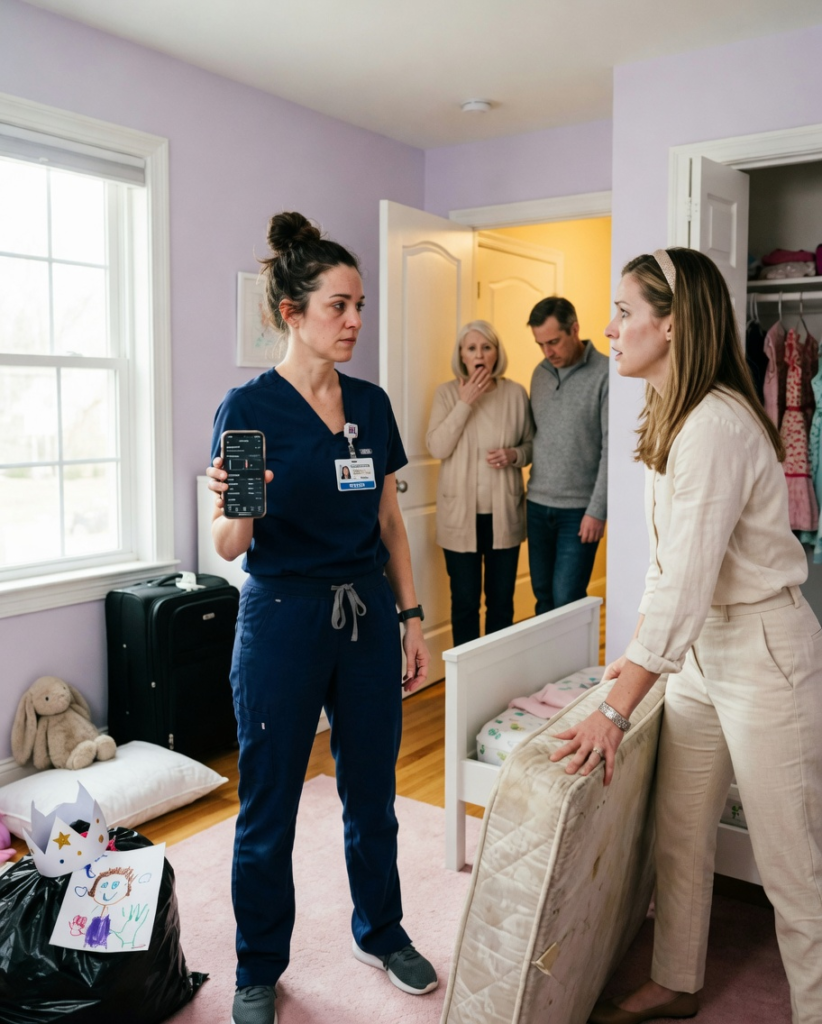
Megan was inside, dragging Lily’s mattress toward the hall.
Her suitcases stood by the window. Lily’s dresses had been shoved aside. A black trash bag swallowed drawings, worksheets, birthday cards, and the paper crown Lily had made in kindergarten.
‘Get out of her room!’ Sarah shouted.
Megan turned slowly, pity arranged across her face. ‘This is my room now, Sarah. Since Lily is being rehomed for her own safety, I’m moving back in to help Mom and Dad manage the house.’
She said rehomed as if Lily were a dog from a shelter. Sarah saw the paper crown slide deeper into the trash bag and felt something inside her go very still.
Her first instinct was violence. Not theatrical violence. The clean animal impulse to grab the bag, shove Megan away, and tear the room back into place with her bare hands.
Instead, she breathed once.
Margaret and Sarah’s father reached the doorway. For a moment, all four adults stood around a child’s dismantled room. The closet light buzzed. A hanger swung slowly. Megan’s suitcase wheel pressed into Lily’s pink rug.
Nobody moved.
Sarah looked at the papers on the desk. Temporary Family Safety Declaration. County Child Welfare Intake Affidavit. Informal caregiving plan. Three signatures. No judge. No order.
Then she looked at her sister’s hand on Lily’s mattress and understood the whole shape of it. This was not panic. Not concern. Not one hard morning gone too far. Paperwork. A plan. A room.
She pulled out her phone.
Megan laughed. ‘What are you doing, calling someone to ask permission?’
Sarah opened the archive dashboard. The files were already uploading: kitchen audio, hallway footage, Lily’s room camera, and the saved clips from the last three weeks.
The emotional anchor of the whole morning was brutally simple: they thought they could vote my daughter away like a piece of furniture.
‘That’s funny,’ Sarah said, her voice steady as a surgeon’s hand. ‘Because while you were voting on my life, I was at the hospital installing the new security server—the one that links my home cameras directly to the District Attorney’s personal cloud.’
Margaret went pale first. Megan followed. Sarah’s father looked suddenly older, as if the bones under his face had shifted.
Then the phone rang.
Sarah put it on speaker. The investigator from the District Attorney’s Office confirmed the upload receipt at 6:27 a.m. He asked whether the child was physically present in the home.
‘No,’ Sarah said. Her eyes stayed on Margaret. ‘My mother says she is safe.’
That was when Sarah noticed Lily’s tablet on the nightstand. The screen was lit. A voice memo sat open, titled Nana, dated the previous afternoon at 4:09 p.m.
Margaret lunged half a step forward. ‘Give me that.’
Sarah pressed play.
Lily’s voice came out small and trembling. Margaret had told her Mommy was too busy to choose her. Megan had said big girls did not cry when families made decisions.
Then Lily whispered that Nana promised it would only hurt until she forgot her old room.
Sarah’s father covered his mouth. Megan sank onto the mattress she had been trying to steal. Margaret made a sound like denial, but no words came with it.
The investigator on the phone asked Sarah to keep the line open. Ten minutes later, two officers arrived with a child welfare supervisor who immediately identified the affidavits as invalid for custody transfer.
Lily was found at the home of Margaret’s church friend less than an hour later. She was unharmed, wearing her yellow sweater, clutching Sarah’s old hospital badge on a lanyard.
When Sarah walked into that living room, Lily did not run at first. She looked at Margaret, then at the social worker, as if she needed permission to believe her mother was real.
Sarah knelt on the carpet and opened her arms. ‘I came home,’ she said.
Lily crossed the room so fast she stumbled. Sarah held her hard enough to feel the child’s heartbeat through both of their shirts.
The next weeks were ugly in the slow legal way. Margaret tried to claim misunderstanding. Megan said she only followed instructions. Sarah’s father said he thought the papers were temporary.
The recordings answered all of them.
There were timestamps, file receipts, hallway clips, and the tablet memo. There were three signatures on unofficial documents and three weeks of conversations about how to make Sarah look unstable because she worked nights.
The court issued a protective order barring Margaret and Megan from contacting Lily. Sarah’s father was allowed supervised communication only after completing counseling and giving a sworn statement.
Sarah changed the locks, replaced the porch camera, and threw away the blue ceramic frog that had hidden the spare key. She kept Lily’s paper crown, flattened it carefully, and placed it in a frame.
Months later, Lily’s drawings changed. The two stick figures came back, but now there was a house around them with a bright yellow door and a sign in purple crayon.
It said: Only Mommy Has The Key.
Sarah still worked long shifts. She still missed some bedtimes. Life did not become magically easy because betrayal was exposed.
But Lily stopped asking whether family could vote someone away. Sarah told her the truth every time: love is not decided by committee, and a child is not furniture.
An entire room had tried to teach Lily that her mother was absent. Sarah spent every ordinary day proving the opposite. Breakfast. School pickup. Nightlights. Hair ribbons. Small promises kept.
The house became quiet again, but this time the silence was different. It was not arranged. It was not heavy. It was the sound of a mother and daughter finally safe inside a life nobody else got to vote on.