The first thing my mother said when I walked into her house that Christmas evening was not “Merry Christmas.”
It was, “Rachel, you look exhausted.”
She said it softly, almost tenderly, in front of everyone, with that careful little smile she wore whenever she wanted to cut me and make sure nobody saw the knife. The kind of smile that made outsiders think she was concerned. The kind of smile I had spent thirty-four years learning to survive.
The entryway smelled of cinnamon candles, roasted ham, and pine needles from the enormous Christmas tree glowing in the living room. Gold ribbon curled around the banister. A wreath hung above the mirror. Somewhere in the kitchen, my sister Eliza laughed in that bright, careless way she had always laughed when she knew she was standing on the safest side of the room.
My seven-year-old daughter, Mia, stood beside me holding my hand.
She was wearing the red velvet dress I had found on clearance at the department store three weeks earlier, the one I had ironed twice that morning because the fabric wrinkled if you looked at it wrong. She had chosen her own white tights and black shoes, and on the drive over, she had asked me four times whether Grandma would like the tiny gift bag she carried on her wrist. Inside was a painted wooden ornament she had made at school: a crooked snowman with glitter on his hat and Mia’s name written carefully on the back.
Now Mia looked up at me, her dark eyes searching my face, waiting to see whether we were welcome.
Children always know before adults admit.
“We’re fine,” I said.
My mother’s gaze moved over me again, taking in my black coat, the faint shadows beneath my eyes, the hair I had pinned up in the car because I had not had the energy to wash and dry it after working the morning shift at the medical billing office. I knew what she saw. Not a widow trying to keep herself and her daughter standing. Not a woman who had spent the day fighting insurance codes and the night before waking from a dream in which her dead husband called from another room.
She saw evidence.
Weakness. Failure. A woman who had not managed grief attractively enough.
Across the dining room, Eliza gave a small laugh into her wineglass.
“Mia’s dress is sweet,” she said. “Very simple.”
Very simple.
The words floated across the room wrapped in sugar, but I heard the bite beneath them. Eliza’s own children were running between the kitchen and living room, dropping cookie crumbs on my mother’s cream carpet while everyone called them energetic. Her oldest son, Caleb, had already knocked a felt reindeer off the mantel and stepped over it. Her twins were shrieking over a plastic dinosaur someone had brought though nobody knew from where. Her youngest had chocolate on his cheek and one sock missing.
They were adored for chaos.
Mia stood beside me with both hands wrapped around the little gift bag, silent as a church mouse, because she had already learned the terrible lesson I had spent my whole life learning: in this family, some children were loved loudly for taking up space, and others were tolerated only if they made themselves small enough not to inconvenience anyone.
My father sat at the head of the dining room table, though dinner had not yet officially started. He was staring into his coffee as if the answer to his entire life might be floating there. I recognized the posture. Shoulders curved inward, one hand around the mug, eyes lowered whenever my mother’s voice sharpened. Dad had been disappearing into cups of coffee, newspapers, television screens, and garage projects for as long as I could remember.
When I was young, I used to think he was peaceful.
Later, I thought he was tired.
Now I knew better. Silence can be a choice. Silence can be a shield. Silence can also be permission.
Eliza’s husband, Connor, lounged in the chair beside him, laughing too loudly at jokes nobody had made. Connor had never liked me. Or maybe it was simpler than that. Maybe he liked what my absence gave him: more space at the table, more influence over my parents, more room to act like he was the son they wished they had raised. He was handsome in a glossy, useless way, always wearing expensive watches while complaining about money, always speaking as if every subject became clearer once he entered it.
“Long drive?” he asked me, lifting his beer.
“Two hours,” I said.
“Brutal.” He said it like I had done something unreasonable by living where I could afford rent.
I looked toward the hallway, toward the front door still open behind us, cold air slipping in around our ankles. For one wild moment, I almost turned around. I almost told Mia we had forgotten something in the car. I almost took her hand, walked back down the porch steps, buckled her into the booster seat, and drove away before the ham was carved, before the first insult became a pile, before my daughter learned one more lesson from people who had no right teaching her what family meant.
But Christmas has a way of making fools out of lonely people.
It makes you believe in warm windows and second chances. It makes you think a lit tree can soften a cruel room. It makes you imagine grief might make people kinder instead of impatient. It makes you carry gifts into houses where you should have carried boundaries.
So I stepped inside.
Mia followed.
My mother closed the door behind us and said, “Well, come in before all the heat gets out.”
Not Merry Christmas.
Not I’m glad you came.
Just another small accusation disguised as household management.
Six months earlier, my husband Daniel had died on a construction site.
One phone call had split my life in half.
I was at work when it happened, sitting in a gray cubicle with a half-eaten granola bar beside my keyboard and a spreadsheet open on my monitor. It was a Tuesday morning. That detail still seemed wrong to me. Tragedy should arrive on stormy nights or holidays or days already marked by some warning sign. It should not arrive at 10:42 a.m. while fluorescent lights buzz overhead and someone down the hall argues with a copier.
My phone rang from an unknown number.
I almost let it go to voicemail.
Then something in my body made me answer.
“Mrs. Harper?” a man asked.
My married name sounded strange in his mouth. Careful. Heavy.
“Yes?”
“This is Michael Trent. I’m with Ashford Construction. There’s been an accident.”
The rest came in pieces. Collapsed platform. Emergency responders. Hospital. Critical. I remember standing so fast my chair rolled backward into the cubicle wall. I remember trying to ask which hospital and not being able to make my mouth work. I remember my supervisor, Diane, appearing beside me, taking the phone gently from my hand, writing something on a sticky note.
I remember driving to the hospital and realizing, halfway there, that I had no memory of stopping at red lights.
By the time I arrived, Daniel was gone.
Thirty-seven years old. Warm that morning when he kissed my forehead before leaving. Gone before lunch.
They led me into a room painted a gentle beige, as if walls could comfort anyone, and a doctor told me what had happened. A platform failure. Severe trauma. They had done everything they could. I nodded because people expect nodding when they are saying impossible things. I remember staring at the doctor’s shoes and thinking Daniel would have noticed the brand. He noticed practical things. Boots, tools, hinges, screw sizes, the way a table wobbled because one leg was an eighth of an inch too short.
Daniel fixed things.
That was the first thought that made me break.
He fixed things, and I could not fix this.
Telling Mia was worse.
She was at summer day camp when I picked her up early. She ran toward me in the hallway holding a paper sun she had made with yellow handprints around the edge.
“Mom! We painted outside!”
I looked at her face, bright and unbroken, and understood that childhood can end in a school hallway while your backpack is still shaped like a ladybug.
I took her home. I sat with her on the couch. I held both her hands.
“Daddy was hurt at work,” I said.
She blinked.
“He was hurt very badly.”
Her small fingers tightened around mine.
“He died, sweetheart.”
For a moment, she stared at me as if I had spoken another language. Then she shook her head once.
“No.”
That was all.
No.
I had no answer that could stand against it.
In the weeks after Daniel died, people arrived with casseroles, flowers, cards, and expressions of stunned sorrow. His coworkers came by with red eyes and rough hands, leaving envelopes of cash they had collected, telling me Daniel was the best of them, telling me he had reported the safety issue twice, telling me everyone knew that platform was overdue for inspection. His brother flew in from Denver. My neighbors mowed the lawn. Diane from work came over and sat with me while I called funeral homes because I could not say the word burial without gagging.
My family came too.
Technically.
My mother arrived at the funeral in a navy dress and pearls, hugged me in front of witnesses, and whispered, “Be strong, Rachel. People are watching.”
My father patted my shoulder and said, “He was a good man,” then stood in the corner drinking coffee from a paper cup.
Eliza cried prettily during the service and posted a photo of the program afterward with a caption about holding family close. Connor asked Daniel’s brother whether construction companies carried “big insurance policies for these things,” as if we were discussing a dented truck.
After the funeral, when everyone gathered at my tiny rental house, Mia disappeared into her room and crawled under her bed with Daniel’s old sweatshirt. I found her there after an hour, clutching the sleeve to her face.
“It smells like him,” she whispered.
I lay down on the carpet beside her because there was not enough room under the bed for both of us.
“I know,” I said.
“Can we keep it forever?”
“Yes.”
“Even if it stops smelling like him?”
The question broke me in a place nothing else had touched.
“Even then.”
For six months, survival became a list.
Funeral bills. Death certificates. Insurance calls. School lunches. Grief counseling for Mia. A lawsuit consultation. Utility payments. Daniel’s boots by the back door. The truck title. His phone bill. Mia’s nightmares. My nightmares. Thank-you notes I never finished. Social Security forms. Medical bills from the hospital where he arrived already beyond saving. The construction company’s lawyers. My attorney, Grace Bell, who had eyes like a hawk and spoke in precise sentences. Settlement negotiations. Liability reports. Safety records.
One ignored report.
That fact became the center of my rage.
Daniel had complained about the platform. Twice. Once by email. Once in a handwritten note to a supervisor because Daniel believed paper forced people to acknowledge things more honestly than apps. The company delayed repair because the project was already over budget. A supervisor signed off on temporary use. The platform collapsed under load less than forty-eight hours later.
Money had killed him.
Not fate. Not God’s will. Not one of those meaningless phrases people offer because they are terrified of a world where preventable things happen.
Money. Negligence. Convenience.
In the end, money came back.
Not enough. Never enough. No number could stand in the place of Daniel’s laugh, his hand on my lower back in the grocery store, his Saturday morning pancakes shaped badly like animals for Mia, the way he sang the wrong lyrics to songs without shame. No check could become the father-daughter dance he would never attend, the birthdays he would miss, the empty side of the bed that remained cold no matter how long I lay awake.
But the settlement was large.
Large enough that the first time Grace said the number, I asked her to repeat it because grief had made me stupid with disbelief.
Two million dollars.
After attorney fees and some immediate obligations, it was still more money than Daniel and I had ever imagined having. Protection money, Grace called it. Future money. Mia’s education. Housing stability. Medical security. A life not built on panic.
I heard something else too.
Family money.
Not because Grace said it. She would have slapped the word family out of the air if she knew what I was thinking. But old conditioning is hard to kill. The moment I knew I would be financially secure, I began thinking of everyone who had not protected me and wondering if protecting them might finally make them love me correctly.
My parents’ mortgage was behind.
Their credit cards were worse than they admitted.
My father’s retirement account had been drained over the years by “temporary problems,” most of which had names like Eliza’s failed boutique, Connor’s investment idea, Eliza’s home renovation, Connor’s tax issue, Eliza’s emergency childcare, Connor’s truck loan, Eliza’s private school deposit.
Eliza had always lived as if consequences were something my parents, then later someone else, should handle. She was two years older than me, prettier in the way our mother valued, louder in a way adults rewarded when she was a child and men rewarded when she was grown. When we were little, she broke things and told stories so charmingly that people laughed while I swept up glass. If I complained, Mom said, “Rachel, don’t be jealous. Your sister has a big personality.”
My personality, apparently, was supposed to be helpful.
Daniel saw it before I did.
Years earlier, when Mia was a baby and my parents called for money because Dad’s hours had been cut, Daniel found me crying at the kitchen table with our checkbook open.
“How much this time?” he asked.
“Two hundred.”
He sat across from me. “We can do it.”
“I know.”
“But?”
I looked at him. “I don’t know why I feel sad giving it.”
Daniel reached across the table and covered my hand with his. His hands were always rough, nicked, steady.
“Because you know they’ll take it like it was owed.”
I tried to defend them. I always did.
“They’re struggling.”
“So are we.”
“Not like them.”
“No,” he said gently. “We struggle quietly. That doesn’t mean it isn’t real.”
Still, we sent the money.
Then we sent more the next month.
And the month after that.
Sometimes two hundred. Sometimes three. Once eight hundred when my mother said the electricity might be shut off. We never posted about it. We never mentioned it at family dinners. Daniel said generosity that needed applause was just vanity wearing a nice coat.
After Daniel died, I asked my parents for help once.
One time.
Mia got sick with a high fever. I missed work. My car needed repairs that same week. The funeral costs had emptied my checking account before the first settlement conversation had even begun. I called my mother from the parking lot of the mechanic’s shop with shame crawling up my throat.
“Could you help me just until payday?” I asked. “I need three hundred to get the car back.”
There was a pause.
“Well,” Mom said, “this is why I always told you to save more.”
I closed my eyes.
“I know.”
“Your father and I aren’t exactly swimming in money.”
“I know. I wouldn’t ask if—”
“I said we’ll help.”
Relief made me cry, which was a mistake.
“Oh, Rachel,” she sighed. “Don’t fall apart. You have a child.”
She sent the money.
That night, she posted on Facebook.
Sometimes family has to step up. Praying Rachel finds her strength again. Widowhood is hard, but with support and faith, she’ll get there.
There were comments. So many comments.
You’re such a good mother.
Rachel is lucky to have you.
Praying for her.
One woman wrote, I can’t imagine having to support an adult child through grief.
My mother liked that comment.
I did not respond.
Daniel would have hated it.
That thought hurt more than the post. Daniel, who had spent years quietly sending them money, would have stared at that public performance and said exactly one sentence: “That’s not help. That’s a receipt with glitter on it.”
Still, six months later, I drove to Christmas dinner with three envelopes hidden in my overnight bag.
Not wrapped boxes. Not candles. Not sweaters.
Signed documents.
Grace had prepared them after arguing with me for nearly an hour.
“Rachel,” she said, sitting behind her desk with a stack of financial projections between us, “I understand wanting to help family. But half a million dollars is not help. It is a structural transfer of wealth to people with no demonstrated respect for you.”
“They’re my parents.”
“I gathered.”
“And Eliza has kids.”
“So do you.”
I looked away.
Grace softened her voice, which somehow made her scarier. “What would Daniel tell you?”
I hated her for that.
“He would tell me not to do it.”
“Then why are you doing it?”
I had no answer I could say aloud without sounding pathetic.
Because maybe if I save them, they will finally see me.
Because maybe if I give enough, they will stop treating Eliza like the child worth protecting and me like the one built to endure.
Because I am tired of being alone.
Because grief has made me want a family so badly that I am willing to pay admission to one I was born into.
Grace watched my face.
“You cannot purchase belonging from people who profit from withholding it.”
I signed anyway.
Three envelopes.
One for my parents: enough to pay off their mortgage, clear their credit cards, and place a modest amount into a managed retirement account they could not immediately drain.
One for Eliza: enough to settle debts, cover the children’s school arrears, and close the financial disasters she kept calling temporary setbacks.
One for my father separately: a smaller, private account meant to help him if he ever chose to separate his life from my mother’s decisions. That was the foolish one. The sentimental one. The one Grace warned me about twice. But some part of me still believed Dad might be reachable if I treated him like a man instead of a shadow.
Nearly half a million dollars.
I brought it to Christmas dinner because I thought generosity might land better beneath a lit tree.
Instead, I watched my daughter shrink beside me and wondered how much money it cost to buy a chair at a table where your child was not welcome.
Dinner began badly and worsened with every course.
Mia sat beside me and carefully counted peas on her plate while Eliza’s children shouted across the table. Caleb used his roll as a drumstick. The twins argued over who got more marshmallows in the sweet potatoes. The youngest spilled juice, and my mother laughed brightly.
“Excited children,” she said. “That’s Christmas.”
When Mia accidentally dropped her napkin, my mother sighed as if my child had shattered crystal.
“Mia, please be careful. Eliza worked so hard on this meal.”
Eliza had brought one pie from a bakery and spent the afternoon taking pictures of it beside my mother’s centerpiece.
“It’s beautiful,” I said.
My voice sounded flat to my own ears.
Eliza smiled. “Thank you. Presentation matters.”
Connor leaned back in his chair, beer in hand, his face already flushed.
“So, Rachel,” he said, “how are things now? Still tight?”
The room went quiet in that hungry way, as if everyone had been waiting for him to ask what they all wanted to know.
Mia’s knee pressed against mine beneath the table.
“We’re managing,” I said.
Eliza tilted her head. “Managing can mean a lot of things.”
My mother dabbed the corner of her mouth with her napkin. “We just worry. That’s all.”
No, they didn’t.
They monitored. They judged. They collected my pain and retold it in ways that made themselves look generous. My mother had asked three times whether the lawsuit had “progressed.” Eliza had texted once asking whether settlements were taxable, then claimed she had been asking for “a friend.” Connor had cornered me at Thanksgiving and said construction companies usually “paid out big when they messed up,” then pretended he meant emotionally.
My father said nothing.
He stared into his coffee, though we were eating dinner and no one else was drinking coffee yet. Dad always found coffee when conversations sharpened. It was his shield. His small brown escape.
“I’m working,” I said. “Mia’s doing well in school. We’re okay.”
My mother made a sound.
“What?” I asked, though I knew better.
“I didn’t say anything.”
“You made a sound.”
“Rachel, must you always be so defensive?”
There it was.
One of the old doors.
I could open it and walk into a familiar hallway: explaining, apologizing, softening my tone, reassuring everyone that I was not angry even when I had every right to be.
Instead, I reached for my water.
Mia watched me.
That mattered more than my mother’s approval.
For a few minutes, conversation moved elsewhere. Eliza talked about her children’s school pageant. Connor complained about property taxes. My mother praised Caleb’s singing voice, though he had apparently refused to sing during the performance and stood with his hands in his pockets. Everyone laughed as if defiance were charming when it came from Eliza’s child.
Mia whispered, “Can I have more potatoes?”
“Of course.”
She passed me her plate carefully, both hands, eyes lowered.
Too careful.
I served her potatoes and smiled.
She smiled back, but it did not reach her eyes.
That was when I decided I would not give the envelopes at the table. I would wait until after dinner. Maybe after dessert. Maybe once Mia was asleep upstairs and I could speak to my parents privately. Maybe Eliza’s gift could be mailed later. Maybe Grace was right. Maybe I needed more time.
Then Eliza set down her fork.
The sound was small, but something in my body went still.
“We need to talk,” she said.
My stomach dropped before she said another word.
“Eliza,” I warned softly.
“No, Rachel. We’re not doing this anymore.”
The dining room air changed.
Eliza looked at Mom, then Dad, then Connor, gathering courage from their silence. She had always done that. As children, she would glance toward Mom before saying something cruel, waiting for permission. If Mom did not stop her, she continued. If Dad looked away, she grew bolder. My family’s cruelty had always been a group project, even when only one person spoke.
“You bring this sadness everywhere you go,” Eliza said. “You make everything heavy. Mom and Dad are tired. We all are.”
Mia stopped counting peas.
My mother looked directly at me.
“Christmas is supposed to be joyful.”
I stared at her.
“My husband died.”
“And we have all been very patient with that,” Eliza said.
The sentence landed so violently that for a second I could not breathe.
Patient.
As if grief were a rude guest overstaying its welcome.
As if Daniel’s death were an inconvenience they had tolerated with admirable restraint.
As if Mia sleeping with his sweatshirt under her pillow was some childish melodrama everyone had politely endured.
My father shifted in his chair.
I looked at him.
He said nothing.
Eliza’s face hardened, as though my silence had encouraged her.
“We think it would be better if you left.”
Mia’s fork clinked softly against her plate.
Connor crossed his arms. “Honestly, it’s healthier for everyone.”
Healthier.
The word was so absurd that I almost laughed. These people had fed on my quiet help for years, and now my grief was unhealthy because it made the room uncomfortable.
My mother’s voice became gentle, almost tender, which made it worse.
“You and Mia should leave, Rachel. And maybe it’s best if you don’t come back for a long while.”
Eliza smiled.
Then she added, “Or ever.”
For one second, the whole room froze.
The candles flickered. The Christmas tree lights blinked red and gold in the window. Somewhere in the living room, one of Eliza’s children laughed at a cartoon, a bright sound from another universe. My father’s chair creaked. Connor lifted his beer and looked away, as if the hardest part were over and he had done his duty.
My daughter looked at me with wide eyes, waiting to see whether I would beg to belong.
That was the moment something inside me finally stopped kneeling.
Not broke.
Not collapsed.
Stopped kneeling.
There was a difference.
I had spent years bending toward them. Bending around my mother’s moods. Bending beneath Eliza’s needs. Bending around Dad’s silence. Bending until my own daughter had learned the shape and begun copying it with her little shoulders.
No more.
I placed my napkin on the table.
“Mia,” I said calmly, “go get your coat and backpack, sweetheart.”
She did not argue. She slid from her chair like a child who had been waiting for permission to escape.
When she disappeared into the hallway, Eliza exhaled with satisfaction.
“Good. Don’t make this dramatic.”
I stood.
My mother frowned. “Rachel.”
“You’re right,” I said. “I shouldn’t make it dramatic.”
I walked into the kitchen.
Behind me, Connor muttered, “Here we go.”
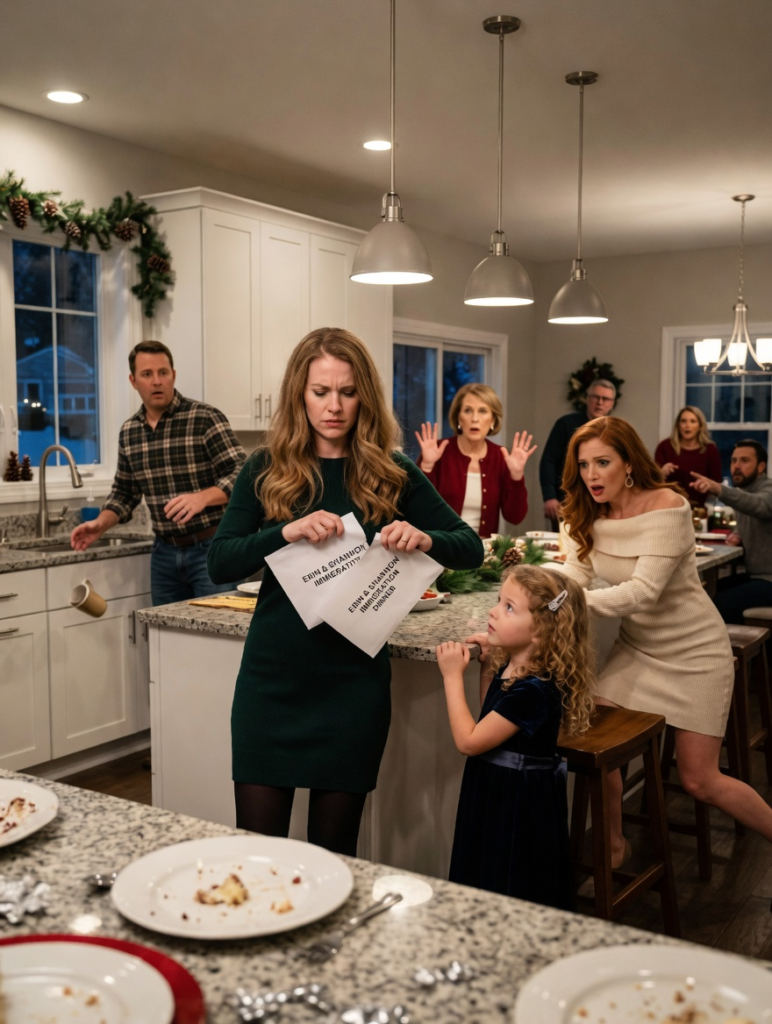
The kitchen was warm and bright, crowded with evidence of the meal I had tried to survive. Pots in the sink. Foil over leftovers. My mother’s holiday platters stacked in the cabinet near the sink, the same cabinet where I had hidden the envelopes earlier when I helped carry in serving dishes. My hands were steady as I opened it.
For a second, I saw myself from outside my body.
A widow in a black sweater. A mother. A daughter who had spent her life waiting to be chosen by people who mistook waiting for weakness. My husband’s death had brought me money. My family’s cruelty had brought me clarity.
My fingers closed around the envelopes.
Thick paper. Legal seals. Three futures I had been foolish enough to offer.
When I came back into the dining room, everyone was watching me.
Eliza laughed. “What, are those apology cards?”
“No,” I said. “Consequences.”
I tore the first envelope in half.
My mother flinched.
The sound of the paper ripping was small, almost delicate. It should not have been satisfying. It was.
I tore the second one slower, straight down the center.
Dad finally stood, his chair scraping backward.
“Rachel, what is that?”
I looked at him.
“Something you don’t need. Since Christmas is better without us.”
Eliza’s smile faltered.
“Stop.”
I held up the third envelope.
Hers.
For the first time all evening, I saw fear enter her face. Not guilt. Not shame. Fear that she was about to lose something she had not yet learned how to name.
I tore it in half.
Then tore the halves again.
I dropped the pieces onto the table beside the gravy boat.
Nobody moved at first.
The torn paper lay among the candles, plates, and half-eaten food like ash from a future that had burned before it could arrive.
Then Eliza snatched one piece, turned it over, and read enough to understand.
Her face drained of color.
Mom grabbed another torn piece. Dad came around the table so fast his chair tipped backward and struck the wall.
“What did you do?” Eliza whispered.
I did not answer.
I went to the hallway, where Mia stood in her coat with her backpack on, clutching her gift bag. Her eyes moved from my face to the dining room behind me.
“We’re leaving,” I said.
She nodded once.
We walked out into the cold.
Behind us, the front door flew open before I even reached the car.
“Rachel!” my mother screamed.
Not my name as a daughter.
My name as a lost lottery ticket.
I opened the back door and helped Mia climb in. My hands moved automatically, buckling her booster seat, tucking her backpack beside her, checking the strap across her chest. My father was coming down the porch steps, pale and shaking. Eliza was barefoot on the icy walkway, holding torn paper in both hands. Connor stood in the doorway, angry now, perhaps because he had finally realized my departure had material consequences.
“Wait!” Eliza cried. “Wait, we can talk!”
Connor yelled, “Rachel, don’t be stupid!”
I got into the driver’s seat, started the engine, and looked once at my daughter in the rearview mirror.
Her face was quiet.
Too quiet.
So I drove away.
For the first ten minutes, neither of us spoke.
Christmas lights blurred past the windows. Inflatable snowmen leaned in front yards. A plastic Santa waved from a porch. Families moved behind glowing curtains, carrying plates, laughing, living inside scenes that might have been real or might have been performances as convincing as my mother’s tree.
My hands were tight on the steering wheel.
My chest burned with a rage so clean it scared me.
I had been angry before. Angry when Eliza borrowed my clothes and ruined them, then cried until Mom made me apologize for “making her feel bad.” Angry when Dad gave Eliza money for a car and told me I was responsible enough to figure out my own. Angry when my mother posted about helping me after Daniel died. Angry when Mia came home from a visit with Grandma and asked why Aunt Eliza’s kids got bigger Christmas presents.
But those angers had been tangled with guilt.
This one was not.
This one had a center.
My child.
Finally, Mia asked, “Are we going home?”
I had planned to sleep at my parents’ house. Our overnight bags were in the trunk. Home was two hours away, and I was too shaken to drive that far in the dark. Snow had begun to drift lightly across the windshield, not enough to stick yet, but enough to make the road shine under headlights.
“No,” I said gently. “We’re going somewhere safe.”
She did not ask if Grandma’s house was unsafe.
That told me too much.
I pulled into a hotel off the highway, one with warm lights and a lobby that smelled like cinnamon and carpet cleaner. A Christmas tree stood near the front desk decorated with silver ornaments and tiny white lights. The woman behind the counter had kind eyes and a red scarf.
“Rough night?” she asked softly after looking at my face.
I almost said no.
Then I said, “Yes.”
She glanced at Mia, then back at me.
“We have a room with two queen beds away from the elevator.”
“Perfect.”
She gave Mia a candy cane. Mia held it like treasure.
In the room, Mia kicked off her shoes and sat on the edge of the bed. The carpet was patterned in blue and beige swirls. The television offered a list of holiday movies. The air smelled faintly of detergent and heat.
I set our bags down.
Mia stared at the candy cane in her hands.
“Grandma doesn’t like me,” she said.
The sentence hit with such quiet force that I sat down beside her before my knees failed.
“Mia…”
“She likes Aunt Eliza’s kids. She hugs them first. She gives them better presents. She laughs when they run around. When I talk, she says I’m interrupting. She looks at me like I’m in the way.”
The truth from a child’s mouth is the sharpest truth in the world because children have not yet learned to cushion it for adults who should already know.
“That is not your fault,” I said.
Mia looked down at her candy cane.
“You act like it’s your fault when they’re mean to you.”
I could not answer.
Because she was right.
For years, I had shrunk myself to fit inside my family’s comfort. I had laughed at insults, forgiven cruelty, hidden generosity, softened truths, and mistaken silence for love. And now my daughter had watched me do it long enough to recognize the pattern.
Worse, she had started learning her place inside it.
I pulled her into my arms carefully, as if my own grief had made me clumsy.
“I’m sorry,” I whispered. “I am so sorry.”
She leaned into me.
“Did I do something wrong at dinner?”
“No.”
“Did Daddy make Christmas sad?”
The question destroyed me.
“No, baby. Daddy didn’t make Christmas sad.”
“But Aunt Eliza said we make things heavy.”
I pressed my face into her hair and smelled hotel soap, cold air, and the faint strawberry conditioner she loved.
“Some people call things heavy because they don’t want to help carry them,” I said.
Mia considered that.
“Daddy would have carried them.”
“Yes,” I said. “He would have.”
That night, my phone buzzed until it went hot.
Mom. Dad. Eliza. Connor.
Then Mom again.
Then Eliza.
Then Dad.
Texts appeared one after another.
Where are you?
Answer the phone.
Rachel, this is enough.
You misunderstood.
You cannot just leave like that.
Mia needs stability.
We are still your family.
Connor sent one message.
You’re acting insane.
I almost laughed at that one.
Mia fell asleep with a Christmas movie playing low on the television, the candy cane unopened beside her pillow. Her face in sleep looked younger than seven. Grief had made her older in daylight, but sleep gave some of childhood back.
I stepped into the bathroom, closed the door halfway so I could still see her, and answered the next call.
“Rachel!” Mom cried. “Thank God. Where are you? Is Mia okay?”
“She’s fine.”
“Come back,” Dad said.
He was on speaker. I could tell from the echo.
“We need to fix this.”
I sat on the closed toilet seat and stared at the patterned tile floor.
“You mean the money.”
There was a beat of silence.
Eliza cut in. “Don’t be disgusting. You tore up legal documents in front of us like a lunatic.”
“You told me and my child to leave and never return.”
“We were upset,” Mom said quickly.
“No. You were honest.”
Another silence.
Then Dad said, “You can have your attorney redo it.”
There it was.
No apology.
No shame.
No What did those documents represent, Rachel?
No Did we hurt Mia?
No I should have spoken up.
Just panic.
The money could be restored, therefore the relationship could be repaired. That was how they thought. That was how they had always thought.
“No,” I said.
Eliza’s voice sharpened. “Rachel, don’t punish everyone because your feelings got hurt.”
“My feelings?” I turned and looked through the cracked bathroom door at Mia sleeping beneath a white hotel blanket. “You humiliated my daughter at Christmas.”
Mom started crying. “Please. We’re family.”
I used to believe that word was a key. If someone said family, doors had to open. Wounds had to close. Debts had to vanish. Boundaries had to become selfishness. Pain had to be swallowed because blood mattered more than dignity.
That night, the word sounded different.
Not like a key.
Like a chain.
“No,” I said again. “Good night.”
I hung up.
The bathroom mirror reflected a woman I barely recognized. Pale. Tired. Eyes red. A widow in a hotel bathroom on Christmas night, shaking with adrenaline, her daughter asleep in the other room, nearly half a million dollars of torn generosity left on a dining room table forty minutes behind them.
For one second, grief rose so high I thought I might drown.
Daniel should have been there.
He would have taken the phone from me. He would have said, “Enough.” He would have carried Mia to the car before the first insult finished landing. He would have refused the envelopes from the beginning.
I pressed both hands to the sink and whispered, “I’m sorry.”
Not to my family.
To him.
To myself.
To my daughter.
Then I washed my face, went back into the room, and climbed into bed beside Mia. She turned in her sleep and curled against me like she had when she was small. I lay awake until morning, watching the Christmas lights blink silently around the television screen.
Three days later, Eliza posted about me online.
She did not use my name at first. That was her way. She preferred implication before accusation, letting sympathy gather before feeding it a target.
Her first post read:
Sometimes the people who demand the most compassion have none to give. Grief does not excuse cruelty. Praying for boundaries this holiday season.
The comments came quickly.
Hope you’re okay.
Family can be so hard.
Some people weaponize trauma.
That last phrase appeared twice, then three times, because people online love language that makes judgment feel therapeutic.
By the end of the day, Eliza posted again.
This time, she named me.
Rachel came to Christmas looking for money. When we finally stood up to her behavior and the way she uses grief to control everyone, she stormed out and hurt our parents deeply. And yes, she received a large settlement after Daniel died. She could help her family. She chooses not to. Please pray for my parents. They have done everything for her.
I stared at the post until the words blurred.
Not because I was surprised.
Because for most of my life, quiet had felt like protection. If I stayed silent, maybe things would not get worse. If I did not defend myself, maybe the lie would pass quickly. If I absorbed the false version, maybe the conflict would end.
But quiet had never saved me.
It had only made me easy to lie about.
I closed Eliza’s post and opened my banking records.
There it was.
Years of transfers to my parents.
Two hundred dollars monthly. Sometimes three. Eight hundred for utilities. Six hundred when Dad’s car needed repairs. One thousand for an insurance premium my mother said “snuck up” on them. I found texts where Mom wrote, Thank you, honey, we’ll pay you back soon. I found replies where Daniel sent the confirmation screenshot and wrote, No rush, just glad we can help.
My throat tightened at the sight of his name.
I kept going.
I found my mother’s post from after Daniel died. The one about family stepping up. The comments praising her. The liked comment about supporting an adult child through grief.
Then I made a folder.
Receipts.
I had learned from grief, insurance companies, lawyers, and construction executives that pain without documentation becomes easy for other people to dispute.
I wrote my own post.
I did not go to Christmas asking for money.
I went intending to give my parents and sister a financial gift large enough to change their lives. Before I could give it, they told me and my seven-year-old daughter to leave and never return because our grief made Christmas less joyful.
For years, Daniel and I quietly helped my parents financially. We never posted about it. We never asked for applause. The one time I asked for help after becoming a widow, my mother publicly used it to make herself look generous.
I am done protecting people who hurt my child and call it family.
Then I posted the receipts.
Not everything. I was not cruel for sport. I blurred account numbers. I hid anything that might expose private addresses. But I showed dates. Amounts. Names. My mother’s old post. Her texts thanking us for “saving” them again and again. Daniel’s transfer confirmations. The truth, clean enough that people who wanted to see could see.
For ten minutes, nothing happened.
Then the internet did what families often refuse to do.
It looked at evidence.
The comments under Eliza’s post changed first.
Wait, Rachel was sending money for years?
You kicked out a widow and her child on Christmas?
Why did your mom post like she was supporting Rachel when Rachel had been helping them?
This is ugly, Eliza.
Where’s the apology to Mia?
Eliza deleted comments.
Then she edited the post.
Then she deleted it completely.
My mother called seventeen times.
I did not answer.
Connor sent a text: You’re going to regret making this public.
I replied once: You made it public.
Then I blocked him.
The next afternoon, my doorbell rang.
I was home with Mia because I had taken a few days off work. She was at the kitchen table drawing while I sorted laundry. The sound of the bell made my body tense before my mind caught up. Some part of me expected police, lawyers, disaster. But when I looked through the peephole, I saw my parents, Eliza, and Connor standing on my porch.
Mom held a cake in a plastic container.
Eliza had flowers.
Connor looked annoyed, as if apologies were something he had been dragged into against his constitutional rights.
Dad stood slightly behind everyone, hands in his coat pockets, eyes on the porch boards.
I opened the door but kept the chain on.
My mother’s smile trembled.
“Sweetheart,” she said, lifting the cake slightly. “Can we come in?”
“No.”
The word was small.
It felt enormous.
Her smile thinned. “We just want to talk.”
Dad cleared his throat. “This has gone too far.”
I looked at him.
“You’re right. It went too far when you watched them throw my daughter out on Christmas and said nothing.”
He flinched.
Eliza stepped forward, thrusting the flowers toward the gap in the door as if carnations could squeeze through a chain lock and repair bloodlines.
“We were emotional. We made a mistake.”
“No,” I said. “A mistake is forgetting someone’s birthday. You looked at a grieving widow and a little girl on Christmas night and decided we were disposable.”
Eliza’s eyes flashed. “I never said disposable.”
“You said never come back.”
Mom began to cry. “Rachel, please. We didn’t mean it like that.”
“How did you mean it?”
None of them answered.
Connor rolled his eyes. “Come on, Rachel. Are you really going to break up the whole family over one argument?”
Mia appeared behind me, holding her stuffed rabbit.
The porch shifted instantly.
My mother’s expression changed into grandmother mode, soft and reaching.
“Mia, baby, come hug Grandma.”
Mia moved closer to my leg.
Not toward the door.
Toward me.
“She doesn’t have to hug anyone,” I said.
Eliza’s mouth tightened. “You’re turning her against us.”
“No,” I said. “You did that all by yourselves.”
Dad finally looked at me fully.
“You’re being cruel.”
I remembered every Christmas where I had cleaned wrapping paper while Eliza posed for photos. Every time my grief had been inconvenient. Every dollar Daniel and I had sent without thanks. Every moment Mia had learned to be quiet so adults would not sigh.
“No,” I said. “I’m being a mother.”
Then I closed the door.
My mother cried harder on the porch.
Eliza shouted once, “Rachel!”
Connor said something I did not catch.
Dad said nothing.
I leaned my back against the door until their footsteps faded.
Mia looked up at me.
“Are we in trouble?”
I knelt in front of her.
“No, sweetheart.”
“Grandma sounded mad.”
“She is.”
“Because we didn’t open the door?”
“Yes.”
Mia thought about that.
“Can people be mad and still not get what they want?”
The question was so simple and so profound that I nearly laughed.
“Yes,” I said. “People can be mad and still not get what they want.”
She nodded slowly.
“Good.”
Eight months passed.
The settlement finalized in full.
Two million dollars.
For a while, I could not say the number aloud. It felt obscene attached to Daniel’s death, like the world had tried to put a price tag on a life beyond pricing. Two million dollars for the laugh I would never hear from the kitchen again. Two million dollars for the hands that would never lift Mia onto his shoulders. Two million dollars for the empty side of the bed I still reached for some mornings before remembering.
But money is not love.
It is not justice.
It is not closure.
It is protection.
Grace helped me build walls with it. Not emotional walls, though those came too. Practical ones. I paid off debts. I established a trust for Mia that no one could touch, including me except under carefully defined conditions. I funded her college account. I bought insurance policies. I set aside emergency funds. I invested conservatively because Daniel would have researched for three straight nights before making any decision and then explained compound interest with salt shakers at the dinner table.
I donated to a construction safety foundation in his name.
The first time Mia and I attended their memorial event, she wore a blue dress and held my hand while they read Daniel’s name. Afterward, she placed a yellow flower near his photo and whispered, “They said your name right, Daddy.”
I had to turn away.
We bought a house too.
Not huge. Not flashy. A modest two-story in a quiet neighborhood with a maple tree in the front yard and a small back porch where Daniel would have complained the railing needed sanding. The first time Mia saw the lavender bedroom, she stood in the doorway with both hands over her mouth.
“Mine?” she asked.
“Yours.”
“Forever?”
“As long as we want.”
She walked into the room slowly, touching the wall as if color could vanish if startled.
That night, after the movers left, Mia slept in her lavender room with Daniel’s sweatshirt folded beneath her pillow.
I slept on a mattress on the floor of my own room and cried into a towel because grief follows you even into safety. But the house was ours. The locks were ours. No one who had told my daughter to leave would ever have a key.
My parents sold their house that summer.
Not because I made them.
Because the mortgage they expected me to erase finally caught up with them.
They moved into a smaller rental on the edge of town, and through relatives, I heard my mother blamed “the economy,” “unexpected expenses,” and “a daughter who forgot where she came from.” Eliza and Connor moved into a rental after another failed business idea collapsed under the weight of Connor’s confidence. Their children changed schools. Eliza posted less often for a while, then returned with vague quotes about resilience.
Through relatives, I heard the number haunted them most.
Five hundred thousand dollars.
That was what I had planned to give them.
That was what they tore up with their own mouths before I ever touched the paper.
My mother sent letters for a while.
Some apologetic.
Rachel, I am sorry things became heated. A mother’s heart breaks when her child misunderstands her intentions.
Some angry.
You have punished this family long enough. Daniel would be ashamed of how hard your heart has become.
That one made me shake so badly I had to put it in the freezer for an hour because I had read once that ridiculous actions can interrupt panic. Later, I burned it in the sink. Daniel would not have been ashamed of me. Daniel would have stood between them and Mia like a locked door.
Some letters were both.
We miss Mia. Your father isn’t well. Eliza cries all the time. I hope the money comforts you at night since family apparently does not matter anymore.
I stopped opening them.
Dad left one voicemail in September.
“Rachel,” he said, voice rough. “I wish I had spoken up that night.”
I believed him.
I also believed that wishing is not the same as changing.
He did not say, I should have protected you.
He did not say, I should have protected Mia.
He wished he had spoken. Even in regret, he centered the moment he failed rather than the people he failed.
I saved the voicemail, not because I wanted to listen again, but because proof had become a language I trusted more than memory.
Mia asked about them less and less.
At first, she asked whether Grandma was still mad. Whether Aunt Eliza’s kids asked about her. Whether Grandpa remembered the puzzle they started last year. I answered as honestly and gently as I could.
“I don’t know.”
“Maybe.”
“That puzzle can stay a memory.”
Children can adapt to absence faster than adults when the absence feels safer than the presence did.
One night in October, while we were carving pumpkins at the kitchen table, Mia looked up from her crooked jack-o’-lantern and said, “Mom?”
“Yeah?”
“Christmas this year can just be us, right?”
My knife paused in the pumpkin lid.
“Just us.”
“And maybe Mrs. Alvarez from next door? She’s nice.”
Mrs. Alvarez was our new neighbor, a widow in her seventies with silver hair, a loud laugh, and a small dog named Captain who wore sweaters against his will. She had brought us tamales the week we moved in and told Mia that lavender bedrooms belonged to artists and queens.
“Maybe Mrs. Alvarez,” I said.
Mia nodded, satisfied, and went back to carving a crooked smile into her pumpkin.
That Christmas, our house was not grand.
The tree leaned a little to one side because I had never assembled an artificial tree by myself and Daniel had always handled the part where patience mattered. The cookies burned around the edges because Mia and I got distracted dancing to old holiday music in the kitchen. Mrs. Alvarez came over with tamales, rice, and a laugh so big it filled corners my family’s absence had left empty.
Mia wore pajamas all day.
Nobody told her to change before dinner.
Nobody sighed when she laughed too loudly. Nobody compared her to another child. Nobody told me I looked tired as if survival were a flaw. Nobody used the word joyful like a weapon. Nobody asked about money. Nobody praised themselves for loving us.
After dinner, we watched movies under blankets while Captain snored near the fireplace. Mrs. Alvarez fell asleep before the second movie ended, one hand resting on her stomach, mouth slightly open. Mia whispered, “She sounds like a tiny bear,” and I laughed so hard I cried a little.
Later, after Mrs. Alvarez went home and Mia brushed her teeth, she handed me a small envelope.
“What’s this?” I asked.
“Open it.”
Inside was a drawing.
Three people stood beneath a yellow star: me, Mia, and Daniel. Daniel was drawn taller than both of us, with big hands and a crooked smile. Mia had colored his shirt blue because that had been his favorite. Around us was a house with a purple room visible through one window. Captain appeared in the corner though he had not technically been part of our family when Daniel was alive.
Underneath, in her careful second-grade handwriting, Mia had written:
Our family is still real.
I cried then.
Not the broken crying from the hotel bathroom.
Not the desperate kind that leaves you hollow.
This was different.
This was grief with a roof over it.
Love with locks on the doors.
A future that did not require permission from people who had mistaken my forgiveness for weakness.
I framed the drawing and placed it on the mantel.
Years have a way of revealing what a single night begins.
In the year after that Christmas, I learned that leaving a family is not a door closing once. It is a thousand small refusals. Not answering the baiting text. Not correcting every lie. Not attending the cousin’s barbecue where someone will ask why you can’t “just let it go.” Not accepting gifts with strings. Not sending money when the emergency sounds suspiciously familiar. Not letting your child become the bridge people use to cross boundaries they burned themselves.
Some relatives chose sides.
Aunt Carol, my mother’s sister, called in February and said, “I don’t want to get involved, but your mother is heartbroken.”
I said, “Then don’t get involved.”
She paused.
“I just think forgiveness matters.”
“So does accountability.”
“Well, people say things when they’re hurt.”
“People also say things when they think they can get away with it.”
She did not call again for months.
My cousin Jeremy sent one message: For what it’s worth, I saw your receipts. Your mom’s version never made sense anyway.
That helped more than I expected.
Eliza tried once through email.
The subject line was: For the kids.
Rachel,
Whatever happened between us, the children are innocent. They miss Mia. Caleb keeps asking why Aunt Rachel hates us. I hope you’re proud of what you’re doing to the cousins.
Eliza
I stared at that email for a long time.
Then I wrote back:
Mia is not responsible for repairing adult cruelty. If your children have questions, you can tell them the truth in an age-appropriate way: that their mother hurt their aunt and cousin, and their aunt needed space.
Do not contact me again unless it is an emergency involving the children’s safety.
Rachel
She did not respond.
Connor tried calling from an unknown number in April.
I answered because Mia was at school and I was foolishly curious.
“You’re really going to keep this up forever?” he asked without greeting.
“Goodbye, Connor.”
“Wait. Eliza’s struggling.”
“She has you.”
He laughed bitterly. “You know what I mean.”
“Yes,” I said. “I do.”
I hung up and blocked the number.
That felt good.
Not dramatic. Not triumphant. Good in the simple way of taking spoiled milk out of the refrigerator and knowing the smell will no longer greet you each morning.
My therapist, Dr. Nguyen, helped me understand the guilt.
I began seeing her after Mia’s school counselor suggested we both needed grief support beyond what I could provide alone. At first, I went for Mia. Then, somewhere around the fourth session, Dr. Nguyen asked why I spoke about my family as though I had been hired by them and failed performance reviews.
“I don’t,” I said.
She tilted her head.
I heard myself in memory.
I should have called more.
I should have handled Christmas differently.
I should have known Eliza would react badly.
I should have given Mom warning about the money.
I should have protected Mia sooner.
Dr. Nguyen said, “Rachel, guilt can be a way of pretending you had more control than you did.”
I hated that sentence.
Then I needed it.
If it was my fault, I could fix it. If my mother was cruel because I had failed to be lovable enough, maybe I could become lovable. If Eliza resented me because I had somehow taken too much space, maybe I could shrink. If Dad stayed silent because I had not pleaded correctly, maybe one perfect sentence would wake him.
But if they chose what they chose because of who they were, not because of what I failed to be, then I had to grieve something larger.
Not a bad Christmas.
A lifetime of conditional belonging.
Mia healed in her own way.
Children’s grief is like weather in spring—sunlight, then sudden storm, then sunlight again, all in the span of an hour. She could cry because Daniel would never see her school art show, then five minutes later ask whether we could make popcorn. She could go weeks without mentioning my family, then ask suddenly whether Grandma ever loved her.
That question came one rainy Saturday while we were building a puzzle on the living room floor.
“Did Grandma ever love me?” she asked.
I placed a puzzle piece down carefully.
“I think Grandma loves in a way that gets mixed up with wanting things her way.”
Mia frowned.
“That doesn’t sound like love.”
“No,” I said. “It doesn’t always feel like love.”
“Do you love me that way?”
The question nearly stopped my heart.
“No. I love you in the way that wants you safe, even when you’re mad at me.”
She considered that.
“Like when I wanted to wear sandals in the snow.”
“Exactly.”
“That was different. My toes wanted freedom.”
“Your toes were wrong.”
She laughed, and the moment passed, but I thought of it often.
Love that wants you safe.
Love that does not require you to disappear.
Love that does not invoice grief.
The second Christmas in our house, we invited more people.
Mrs. Alvarez came again. So did Diane from my old office, who had become more friend than supervisor. Daniel’s brother, Marcus, flew in from Denver with his teenage daughter, Lacey, and spent three days fixing things around the house because grief made him restless and he had Daniel’s same hands. He tightened the porch railing, repaired the laundry room shelf, and cried in the garage when he found Daniel’s old tape measure in a toolbox.
Mia followed him everywhere.
“Uncle Marcus, did Daddy know how to fix everything?”
“No,” Marcus said, wiping his eyes with the back of his hand. “He just acted like it until he figured it out.”
That became one of our sayings.
Act like it until you figure it out.
It applied to grief. Homeownership. Parenting. Assembling bookshelves. Making gravy. Building a family out of survivors, neighbors, old friends, and the dead we still loved.
On Christmas Eve, after Mia went to bed, Marcus and I sat on the back porch wrapped in coats, drinking hot chocolate with too much peppermint schnapps.
“Daniel would be proud of you,” he said.
I looked at the dark yard.
“Sometimes I think he’d be angry I almost gave them so much.”
Marcus sighed.
“He would be angry they made you think you had to.”
That was Daniel’s brother. Blunt where Daniel had been gentle, but cut from the same moral cloth.
“I miss him,” I said.
“I know.”
“It doesn’t get smaller.”
“No,” Marcus said. “But your life grows around it.”
I watched snow begin to fall in the porch light.
“My mother said he would be ashamed of me.”
Marcus turned his head so quickly I heard his neck crack.
“What?”
“She wrote it in a letter.”
He set down his mug.
“Rachel. My brother once refused to speak to a foreman for two weeks because the man called you ‘the wife’ instead of your name. Daniel would have set fire to the moon before he let anyone shame you for protecting Mia.”
I laughed and cried at the same time.
“The moon?”
“He was dramatic about you.”
I did not know how badly I needed someone to say that.
Life continued.
Not cleanly.
Not perfectly.
But it continued.
Mia grew taller. The lavender walls eventually gave way to pale blue because she decided lavender was “a baby color,” though she kept the framed Christmas drawing on her shelf. I changed jobs, moving from medical billing into administration for a patient advocacy nonprofit after realizing I wanted work that felt less like arguing with insurance codes and more like helping people navigate the systems that had nearly crushed me after Daniel died.
Grace remained my attorney and became, in her severe way, a guardian at the gate. Any contact from my family went through her once I made that boundary formal. My mother hated that. Eliza called it “cold.” Connor called it “rich people behavior,” which made Grace laugh for almost six seconds when I told her.
“That man thinks legal boundaries are rich people behavior because poor boundaries have been profitable for him,” she said.
I wrote that down.
My parents’ marriage deteriorated after the house sold.
At least, that was what I heard. Dad moved into a smaller apartment for a while. Then back with Mom. Then out again. Their life became a thing relatives whispered about but did not bring directly to me once they learned I would not reward gossip with access.
Dad sent Mia a birthday card when she turned ten.
No return address. Just a card with a watercolor fox on the front and twenty dollars inside. Mia looked at it for a long time.
“Do I have to call him?”
“No.”
“Do I have to send it back?”
“No.”
“Can I keep the money?”
“Yes.”
“Is that rude?”
“No,” I said. “Sometimes people send gifts because they want connection. You get to decide whether the gift creates one.”
She taped the twenty dollars into her savings jar labeled Horse Someday.
Dad sent cards every birthday after that. Mia kept the money, read the messages, and never asked to call him. That was her boundary, not mine.
My mother tried one last time when Mia was eleven.
She arrived at our house on a Saturday in spring, older-looking than I remembered, thinner, with her hair dyed too dark. I saw her through the front window before she rang the bell. For a moment, my body became the woman on the porch two years earlier, chain lock in place, old fear rising. Then I remembered whose house this was.
Mine.
Mia was at a friend’s birthday party. I opened the door but stepped onto the porch, closing it behind me.
“Mom.”
Her eyes filled immediately.
“Rachel.”
“What do you need?”
That startled her. She had expected softness, perhaps a scene. I gave her logistics.
“I wanted to see my daughter.”
“You’re seeing me.”
“I wanted to see my granddaughter.”
“No.”
Her mouth tightened. “You can’t keep punishing me forever.”
“I’m not punishing you. I’m protecting her.”
“From what? Her own grandmother?”
“From someone who made her feel unwanted.”
Mom looked away.
“I was grieving too, you know.”
“For Daniel?”
“For the way everything changed.”
That was not an answer. Or maybe it was.
“You told my child to leave on Christmas.”
“I know.”
The admission surprised me.
She wiped beneath one eye. “I have replayed that night many times.”
“And?”
“And I was wrong.”
The words arrived stiffly, like furniture delivered through a narrow door.
I waited.
“I was angry,” she said. “I felt you were drowning and pulling us all under. Eliza was upset. Your father was useless. I said things I should not have said.”
There it was. Partial ownership. Shared room. Blame distributed like party favors.
“What did you come here for?” I asked.
She seemed thrown by the question.
“To apologize.”
“Then apologize without explaining why your cruelty made sense at the time.”
Her face flushed.
For a moment, I saw the old mother rise: offended, sharp, ready to accuse me of disrespect. Then she swallowed it.
“I am sorry,” she said. “For telling you to leave. For letting Mia feel unwanted. For the things I posted. For using that money after Daniel died to make myself look good.”
That last one sounded like it cost her.
I looked at her carefully.
“Thank you.”
Hope flashed across her face too quickly.
“So we can—”
“No.”
The hope vanished.
“I accept that you said the words,” I said. “That does not reopen my home.”
“Rachel.”
“No.”
“I’m your mother.”
“I know.”
“Doesn’t that mean anything?”
I thought of Mia’s question about love. I thought of Daniel’s sweatshirt under her pillow. I thought of every transfer Daniel and I sent. Every silence from Dad. Every smile from Eliza. Every time I had mistaken endurance for devotion.
“It means you had more responsibility, not less.”
My mother’s face crumpled then, but I no longer knew whether the tears were for me, for herself, or for the fact that motherhood had stopped being a master key.
She left without seeing Mia.
When Mia came home, I told her Grandma had stopped by and that I had not let her in.
Mia nodded slowly.
“Was she mad?”
“Sad.”
“Are you sad?”
“A little.”
“Do you want a hug?”
“Yes.”
She hugged me in the hallway, smelling like birthday cake and grass, and I realized that the child I had tried to protect was also learning how to offer comfort without becoming responsible for someone else’s healing.
That mattered.
By the time Mia turned twelve, our Christmases had become famous among the people we chose.
Not fancy. Never fancy. But warm.
Mrs. Alvarez brought tamales every year until her knees made walking difficult, then Mia and I brought Christmas to her house instead. Marcus came when he could. Diane brought pies. Grace attended once and scared everyone by labeling leftovers with legal precision. Neighbors drifted in. Friends from Mia’s school stopped by. Sometimes people stayed all day. Sometimes they came for one cup of coffee and left with cookies.
Nobody asked why my parents weren’t there anymore.
Or if they did, I said, “We’re not close,” and let that be enough.
One Christmas, Mia invited a classmate whose father had recently left. The girl, Harper, hovered near the tree with the same careful quiet Mia once carried everywhere. I watched Mia hand her a mug of cocoa and say, “At our house, you can be sad and still have whipped cream.”
I went into the pantry and cried for two minutes.
Not because I was broken.
Because healing sometimes shows up wearing your child’s voice.
Years after the Christmas dinner, long after the torn envelopes had yellowed in memory, I found one remaining copy of the documents in an old file Grace had given me. It was not signed, just a draft. The page listed intended distributions in cold legal language.
Parents: mortgage satisfaction, revolving debt elimination, retirement account contribution.
Sibling: debt settlement, educational support for minor children, emergency reserve.
Father: separate protected account.
I sat at my kitchen table reading the numbers.
The house was quiet. Mia was at a sleepover. Rain tapped softly against the window. I had a glass of tea beside me and Daniel’s old sweatshirt folded in a memory box upstairs because one day Mia stopped needing it under her pillow but did not want it gone.
For the first time, the numbers did not hurt.
They did not feel like lost possibility.
They felt like evidence of the woman I had almost betrayed.
I had nearly handed my daughter’s future to people who had no tenderness for her present. I had nearly converted Daniel’s death into comfort for those who found our grief inconvenient. I had nearly mistaken generosity for healing.
I took the draft outside to the fire pit Daniel’s brother had built during one restless Thanksgiving visit.
Then I burned it.
No audience.
No dramatic speech.
Just flame taking paper, curling edges, turning numbers into ash.
Mia came home the next morning and noticed the smell.
“Did you burn something?”
“Yes.”
“Important?”
“Not anymore.”
She accepted that with the easy wisdom of children who have been told the truth often enough not to fear it.
Now, when people ask about family, I answer carefully.
I have learned that some people ask because they want a simple story. They want villains and heroes, reconciliation or estrangement, forgiveness or bitterness. They want to know if I am “still not speaking” to my mother, as if distance is a tantrum with unusual stamina. They want to know whether Eliza and I ever made up, whether my father ever became brave, whether money changed everything.
Money did not change everything.
It revealed everything.
Grief did too.
Christmas did most of all.
It revealed who saw my daughter as a child and who saw her as an extension of my inconvenience. It revealed who moved when I was wounded and who moved only when money was torn in half. It revealed that my father could stand quickly when a document was at stake but not when his granddaughter was being pushed out into the cold.
Most importantly, it revealed me to myself.
For years, I believed being chosen by them would heal me.
If Mom finally praised me without cutting afterward. If Dad finally stood up and said, “Enough.” If Eliza finally admitted I had carried more than my share. If they saw Daniel’s death and softened. If they saw Mia’s quietness and loved her louder. If I gave enough, helped enough, forgave enough, endured enough.
But the real healing began the night I stopped waiting to be chosen and chose my daughter instead.
Mia is older now. Old enough to ask sharper questions. Old enough to remember Daniel in fragments and stories more than daily ache. Old enough to understand that love can exist with grief, and grief can exist with laughter, and family can be both blood and the people who show up with tamales, legal advice, repaired railings, and room for sadness at the table.
Every year on Christmas Eve, we hang the crooked snowman ornament she made for my parents that last Christmas.
The first year, she found it in the little gift bag, still unopened, after we came home from the hotel. She held it up and said, “Should we throw it away?”
I said, “Only if you want to.”
She thought about it for a long time.
Then she shook her head.
“I made it. It can be ours.”
So it became ours.
Now it hangs near the top of the tree, glitter flaking, snowman smile uneven, Mia’s seven-year-old handwriting still visible on the back. Sometimes, when the lights catch it just right, I think of the little girl who carried it into a house where she hoped to be loved. I wish I could go back and take her hand sooner. I wish I could whisper, You do not have to earn warmth from cold people. I wish I could tell her that one day she would wear pajamas all Christmas, laugh too loudly, burn cookies, and never again wonder whether she was in the way.
But I cannot go back.
I can only keep choosing her now.
And myself.
Because the truth is, that Christmas night did not destroy my family.
It showed me which parts had already been rubble.
My mother told us to leave.
My sister told us never to come back.
My father stood only when he saw what my absence would cost him.
So we left.
We did not return.
And for the first time in my life, leaving felt like coming home.