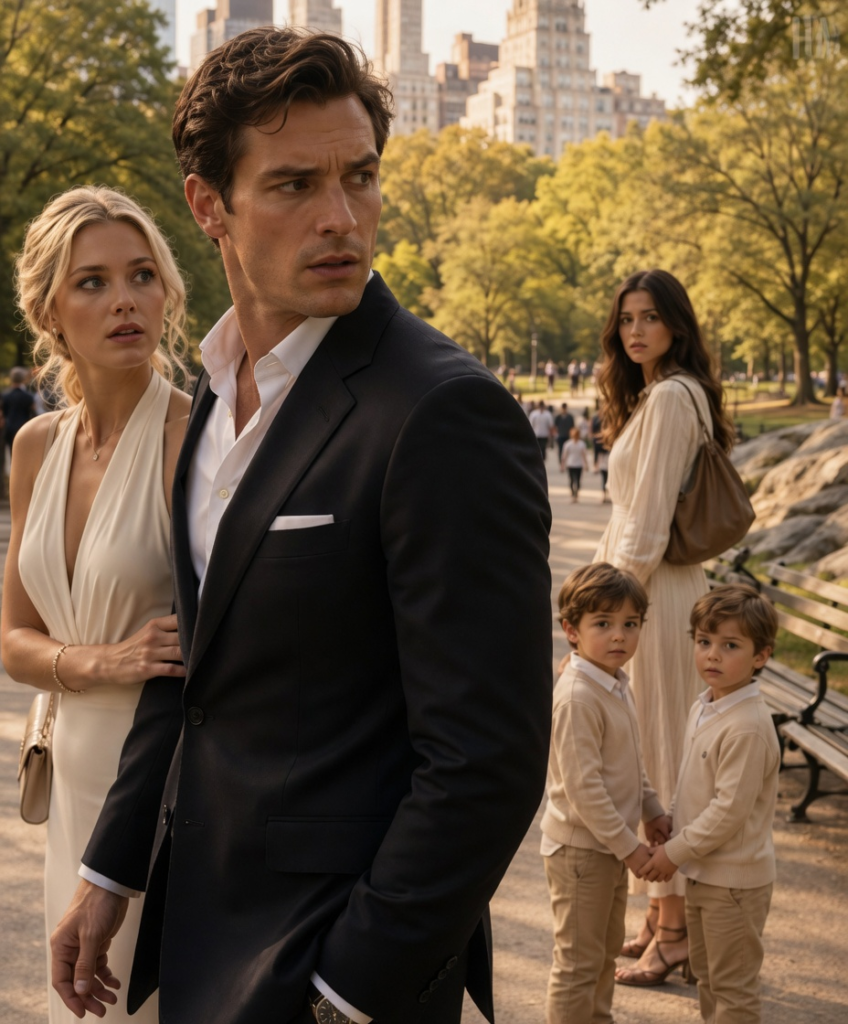
“I’m sorry.”
“No, Harrison, you are absent. There is a difference.”
He turned around.
Victoria was beautiful. Immaculate. Platinum hair swept back, diamond earrings, cream wool coat, lips painted a deep red his mother called “classic.” Their engagement had made sense to everyone. Two families. Two fortunes. A merger dressed up as romance.
He wondered if he had ever truly looked at her.
“I have children,” he said.
The words fell into the room like glass breaking.
Victoria blinked.
“What?”
“Twins. A boy and a girl. I didn’t know.”
Her face emptied.
“With who?”
Harrison looked down.
“Maeve Collins.”
Victoria’s silence was worse than screaming.
Then she whispered, “The woman from the gala.”
He nodded.
“The inappropriate one,” Victoria said, but there was uncertainty now.
His jaw tightened. “She was never inappropriate. She was humiliated. By my family. By their friends. By me.”
Victoria removed her gloves slowly, finger by finger.
“How sure are you?”
“Sure enough.”
“You need a test.”
“I need to talk to her.”
Victoria stared at him as though he had become a stranger in front of her.
“And what am I supposed to be while you do that? Patient? Understanding? Convenient?”
“I don’t know.”
“You don’t know.” Her voice shook. “Our wedding is in May.”
“I know.”
“Your mother has already sent invitations.”
“I know.”
Victoria stepped closer. “Do you love her?”
Harrison could have lied. He had lied for years. To Victoria. To his mother. To himself.
But after seeing Emma’s eyes, he had no energy left for lies.
“I never stopped.”
Victoria’s face cracked—not dramatically, not loudly. Just enough for Harrison to see that beneath all the polish, she was human too.
“You coward,” she said quietly.
He accepted it.
“Yes.”
She picked up her purse.
“I hope those children are worth the empire you’re about to burn down.”
Harrison watched her leave.
For the first time in his adult life, the empire did not matter.
Part 2
Maeve Collins did not sleep that night.
She sat on the floor beside Lucas and Emma’s bunk bed, listening to their breathing and trying not to fall apart.
Emma slept with one hand tucked under her cheek, auburn curls spilling across her pillow. Lucas clutched Spark, his stuffed dragon, like a shield against the world. They were safe. They were warm. They were loved.
And their father had found them.
Maeve pressed her hands against her mouth.
She had always known this day might come. New York was too big until it wasn’t. Harrison Blake was too powerful to disappear from completely. Still, after four years, she had started to believe she had escaped the orbit of his name.
Then Central Park had happened.
His face when he saw the twins haunted her. Not anger. Not entitlement. Shock. Grief. Recognition.
That almost made it worse.
The next morning, she took the twins to Sanctuary early. Routine was armor. Pancakes at six-thirty. Shoes by seven-ten. Coffee shop by eight. Payroll, suppliers, employee schedules, preschool forms, spilled milk, customer complaints, bedtime stories.
Survival had become rhythm.
At nine-fifteen, the bell above the shop door chimed.
Maeve knew it was Harrison before she looked up.
The entire room seemed to notice him. Even dressed down in dark jeans and a navy sweater, Harrison Blake carried wealth like weather. Tall, broad-shouldered, controlled, with a face made for magazine covers and boardroom intimidation.
But his eyes were different today.
Raw.
“Maeve,” he said.
She wiped her hands on a towel.
“Not here.”
“I just need five minutes.”
“You lost the right to need anything from me.”
He flinched.
Good, she thought.
Then Emma looked up from the children’s table.
“Mama, is that the man from the park?”
Lucas turned too, dragon in hand.
Harrison’s face changed completely.
Maeve saw the exact moment he stopped being a billionaire and became a man staring at his children.
Emma hopped down from her chair and approached him with fearless curiosity.
“You’re tall,” she announced.
Harrison crouched immediately, bringing himself to her level.
“So are you,” he said gently.
Emma giggled. “I am not tall. I’m almost four.”
Lucas came slower. He stood beside Maeve, half-hidden, studying Harrison.
“You have our eyes,” Emma said.
Maeve’s heart stopped.
Harrison looked at her helplessly.
Maeve stepped forward. “Emma Rose.”
“What?” Emma asked. “He does.”
Lucas squinted. “Are you a cousin?”
Harrison swallowed.
Maeve felt the room tilting. Customers were beginning to glance over. Sophia, her assistant manager, had gone still behind the espresso machine.
“Office,” Maeve said.
Harrison stood.
She led him into the small back office barely big enough for a desk, two chairs, and a filing cabinet. She closed the door but left the blinds open enough to see the twins.
For a moment, neither spoke.
Then Harrison said, “Are they mine?”
Maeve looked at the man who had once made her believe she could be loved without apology. The man who held her hand in bookstores, ate dollar pizza with her on sidewalks, listened to her dream about opening a coffee shop, and kissed her like she was the only real thing in his life.
The man who had failed her when failure mattered most.
“Yes,” she said.
He closed his eyes.
The pain on his face was almost unbearable.
“When were you going to tell me?” he asked.
“After your mother finished calling me a gold-digging social climber? After Patricia Worthington poured wine over my head? After you asked me why I made a scene?”
His eyes opened.
“I was wrong.”
“Yes.”
“I should have listened.”
“Yes.”
“I should have protected you.”
Her laugh came out broken. “You should have believed me.”
Harrison lowered his head.
“I know.”
Maeve hated how much that hurt. She had spent years imagining this confrontation. In some versions, he yelled. In others, he blamed her. In the cruelest version, he demanded access like she was an obstacle and the children were assets.
But this Harrison stood in front of her looking ruined.
“I found out six weeks after I left,” she said. “I was sick every morning. I thought it was stress. Then the nurse told me there were two heartbeats.”
His hand tightened around the back of the chair.
“Maeve.”
“No. You don’t get to say my name like that.” Her voice rose, and she forced it back down. “I was twenty-eight, alone, broke, pregnant with twins, and terrified. I called you once.”
His head snapped up.
“What?”
“I called your office. I asked for you. Your assistant said you were unavailable. Then your mother called me back.”
Harrison went pale.
Maeve nodded slowly. “You didn’t know.”
“What did she say?”
“She said if I was calling to extend my humiliation, I should have more dignity. She said women like me always mistook kindness for commitment. She said if I tried to contact you again, your legal team would handle it.”
Harrison looked like someone had punched him.
“I never knew.”
“I figured that out later.” Maeve looked through the glass at Emma showing Lucas a crayon drawing. “But by then I had already learned the most important lesson of my life.”
“What lesson?”
“That love without courage is just another way to get hurt.”
The words landed between them.
Harrison covered his face with one hand.
“I’m sorry,” he whispered.
Maeve had imagined those words for years. She thought they would satisfy something in her.
They didn’t.
“Sorry doesn’t get me back the night I delivered them in a blizzard while Mrs. Chen held my hand because no one else was there. Sorry doesn’t get you Lucas’s first steps or Emma’s first word. Sorry doesn’t explain why my son drew a family picture with an empty space beside me.”
Tears filled Harrison’s eyes.
“Tell me what to do.”
The question disarmed her.
“I don’t know.”
“I’ll take a test. I’ll sign anything. I’ll pay support from birth. I’ll—”
“This is not a merger,” Maeve cut in. “You do not solve children with paperwork.”
He nodded quickly. “I know. I’m trying not to say the wrong thing.”
“For once, try saying the true thing.”
Harrison looked at the twins.
“The true thing is I am terrified,” he said. “I am terrified they’ll hate me. I am terrified you should hate me. I am terrified that I already love them and have no right to.”
Maeve’s anger faltered.
Outside the office, Emma pressed her face to the glass.
“Mama, can the tall man have a muffin?”
Maeve wiped her eyes fast and opened the door.
“His name is Harrison.”
Emma looked him up and down. “Do you like blueberry?”
“I do,” Harrison said.
“Good. Lucas only likes chocolate chip, but Mama says we have to try new things or our taste buds get lazy.”
Harrison almost smiled. “Your mama is smart.”
“She knows everything,” Lucas said from the table.
Maeve felt the knife twist.
Not everything, baby, she thought.
Sometimes Mama was scared too.
That afternoon, after the lunch rush, Maeve allowed Harrison to sit with the twins at a corner table. Not alone. Never alone. But close enough.
Emma asked him twenty-seven questions in twelve minutes.
“Do you have a dog?”
“No.”
“Why not?”
“I travel too much.”
“That’s sad. Dogs need people.”
“Yes, they do.”
“Do you have a castle?”
“No.”
“Mama said rich people have elevators inside their houses.”
“Some do.”
“Do you?”
“Yes.”
Emma gasped. “Lucas, he lives in a building with a tiny train.”
Lucas was less easily impressed.
“Do you know anything about dragons?”
“A little.”
“What kind?”
Harrison hesitated. “The kind that guard treasure.”
Lucas narrowed his eyes. “That’s basic.”
Maeve turned away to hide a laugh.
For an hour, Harrison sat in a coffee shop he did not own, wearing a sweater that probably cost more than Maeve’s monthly grocery bill, listening as two preschoolers dismantled him completely.
When he finally stood to leave, Emma grabbed his hand.
“Are you coming back?”
Maeve froze.
Harrison looked at her first.
That mattered.
“If your mama says it’s okay,” he said.
Emma turned. “Mama?”
Maeve wanted to say no. Not because it was best for the children, but because it was safer for her.
Lucas watched silently.
Maeve saw something in his face that frightened her. Hope.
“Saturday morning,” she said carefully. “For pancakes. One hour.”
Emma cheered.
Lucas nodded as if approving a treaty.
Harrison looked at Maeve like she had handed him a miracle.
“Thank you.”
“Don’t thank me yet,” she said. “You miss one visit, you disappear once, you let your family near them without my permission, and I promise you, Harrison, no amount of money will help you.”
“I understand.”
“No,” she said softly. “You don’t. But you will.”
Saturday came with rain.
Harrison arrived at Maeve’s apartment at 8:00 a.m. sharp holding a paper bag from a bakery and looking more nervous than he had before Senate hearings.
Maeve opened the door.
“You brought croissants to a pancake breakfast?”
“I panicked.”
Despite herself, she smiled.
Emma shouted from inside, “Harrison is here!”
Lucas appeared in dinosaur pajamas. “You’re on time.”
“I am.”
“That’s good. Mama says being late means you think your time matters more than other people’s.”
Harrison looked at Maeve.
“She’s right.”
Breakfast was chaos. Flour on the counter. Syrup on the table. Emma insisted Harrison make a butterfly pancake, which came out looking like a wounded bat. Lucas declared it “scientifically inaccurate.” Harrison laughed—a real laugh that made Maeve turn away because it sounded too much like the past.
Then his phone rang.
The screen flashed Evelyn Blake.
His mother.
The kitchen went quiet.
Maeve’s stomach tightened.
Harrison looked at the phone, then at Maeve, then at the children.
He declined the call.
It rang again.
He turned the phone off.
Emma whispered, “Was that a bad person?”
Harrison crouched beside her chair.
“No. But she is someone who hurt your mama, and I didn’t stop it. So before I talk to her, I need to be brave enough to tell the truth.”
Lucas held up Spark. “You can borrow him.”
Harrison stared at the stuffed dragon.
Then he took it with both hands like it was sacred.
“Thank you.”
Maeve had to leave the room.
In the hallway, she pressed her palm against the wall and tried to breathe.
Harrison found her there a minute later.
“I ended the engagement,” he said quietly.
Maeve looked up.
“What?”
“Victoria knows. I told her everything.”
“You told her about them?”
“Yes. Not their details. Not where they live. Just that they exist and that I can’t marry her.”
Maeve folded her arms. “And your mother?”
“Not yet.”
“She’ll come.”
“I know.”
“You don’t know what she’s capable of.”
His face darkened. “I’m beginning to.”
“No, Harrison. You are not beginning. You are late.”
He took that without defending himself.
“I am.”
The softness in his voice made her angrier because it made it harder to keep hating him.
“Why now?” she demanded. “Because you saw them? Because they look like you? What if they didn’t? What if Emma had brown eyes? What if Lucas looked nothing like you? Would you still care?”
The question struck him.
He stepped back.
“I don’t know what I would have seen,” he said honestly. “But I know what I see now. I see you. I see them. I see what my cowardice cost.”
Maeve’s eyes burned.
“And what do you want? Forgiveness? A family? Me?”
His silence answered too much.
“Harrison.”
“I want to earn whatever you are willing to let me earn,” he said. “Nothing more.”
For the first time, Maeve believed he might understand the difference.
Part 3
Evelyn Blake arrived at Sanctuary Coffee on a Monday morning wearing pearls, winter white, and the expression of a woman accustomed to doors opening before she touched them.
Maeve saw her from across the shop and felt the past crawl up her throat.
Evelyn did not look older. Women like Evelyn Blake aged through maintenance, not time. Her silver-blonde hair was perfectly shaped, her coat immaculate, her smile sharp enough to cut.
“Maeve Collins,” she said, as if tasting something unpleasant.
The shop quieted.
Maeve set down the milk pitcher in her hand.
“Evelyn.”
Evelyn glanced around the café. “So this is what you built.”
“Yes.”
“How quaint.”
Maeve felt Sophia tense beside her.
“What do you want?”
Evelyn’s smile thinned. “My son has apparently lost his mind.”
“That sounds like a family issue.”
“You have children.”
Maeve’s heart turned to ice.
Behind Evelyn, Harrison walked in.
He must have run. His coat was open, hair wind-tossed, eyes blazing.
“Mother,” he said.
Evelyn turned, irritated. “Harrison, thank God. We need to end this circus before it becomes public.”
He moved to stand beside Maeve.
Not in front of her.
Beside her.
Maeve noticed.
“This is not a circus,” he said.
Evelyn lowered her voice. “She hid children from you.”
Maeve flinched.
Harrison did not look away from his mother.
“You hid her phone call from me.”
For the first time, Evelyn’s face changed.
Only a fraction.
Enough.
Harrison saw it too.
“You knew,” he said.
Evelyn sighed, almost bored. “I knew a desperate girl was trying to attach herself to you after embarrassing our family.”
Maeve’s hands shook.
Harrison’s voice went deadly calm.
“She was pregnant.”
“She claimed nothing of the sort.”
“Did you ask?”
Evelyn’s silence was answer enough.
Customers stared. Someone’s spoon clinked against a cup. Outside, a delivery truck rumbled past, oblivious.
“You threatened her with lawyers,” Harrison said.
“I protected you.”
“No,” he said. “You protected your idea of me.”
Evelyn’s eyes hardened. “Do not humiliate me in public.”
Harrison laughed once, cold and broken. “That is exactly what your friends did to Maeve. In public. While I let it happen.”
Maeve’s throat tightened.
Evelyn stepped closer. “Think carefully. Verde’s board meets Friday. Investors are nervous after your broken engagement. Victoria’s father is furious. If this scandal reaches the press—”
“Then they’ll learn I have children,” Harrison said. “Not a scandal. A truth.”
“You would throw away everything?”
Harrison looked around Sanctuary Coffee. At parents balancing laptops and toddlers. At baristas pretending not to listen. At Maeve, standing pale but unbowed. At the children’s corner where Lucas and Emma’s drawings covered the wall.
“No,” he said. “I’m done throwing away what matters.”
Evelyn’s mouth opened.
A small voice interrupted.
“Mama?”
Emma stood at the hallway entrance from the back room, holding Lucas’s hand. Mrs. Chen, who had been watching them upstairs, appeared behind them looking apologetic.
“They wanted you,” Mrs. Chen said softly.
Evelyn stared at the twins.
For one fragile second, something human crossed her face. Shock. Recognition. Maybe even regret.
Emma looked from Evelyn to Harrison.
“Is she the person who hurt Mama?”
No one breathed.
Harrison crouched beside his daughter.
“Yes,” he said gently. “And I did too, because I didn’t stop it.”
Emma frowned at Evelyn. “That was mean.”
Lucas lifted Spark. “Very mean.”
Evelyn looked horrified. “Harrison, control this.”
Harrison stood slowly.
“No.”
Maeve’s eyes filled.
It was one word. A small word.
The word he should have said four years ago.
No.
Evelyn stepped back as if he had struck her.
“You will regret this.”
Harrison shook his head. “I already regret enough.”
She left without another word, the bell above the door ringing violently behind her.
For a moment, the café stayed silent.
Then Mrs. Patterson, an elderly regular from the corner table, lifted her coffee cup.
“Well,” she said, “that woman could use a muffin and a therapist.”
The room erupted in nervous laughter.
Maeve laughed too, though tears were running down her face.
Harrison turned to her.
“I’m sorry,” he said again.
This time, it sounded different.
Not like a request.
Like a responsibility.
The months that followed were not simple.
There were lawyers, because children deserved protection more than adults deserved comfort. There was a paternity test, though no one needed it by then. There were custody agreements built slowly, with Maeve’s rules at the center. No surprises. No press. No Blake family visits without consent. Therapy for Harrison. Therapy available for the twins if needed. Support paid into accounts Maeve controlled for their future.
Harrison agreed to all of it.
More importantly, he showed up.
Every Tuesday afternoon, he picked the twins up from preschool with Maeve beside him until they felt safe. Every Saturday, he came for pancakes, improving from wounded bats to recognizable butterflies. He learned Emma hated tags in her shirts, Lucas got quiet when overwhelmed, and both children believed monsters could be defeated with nightlights, songs, and Spark.
He sold the penthouse.
Maeve thought it was dramatic until he bought a brownstone fifteen minutes from her apartment, with a small backyard, a playroom, and no marble floors.
“Kids fall,” Lucas explained during his first inspection. “Marble is bad.”
“Excellent point,” Harrison said.
Victoria, unexpectedly, became the least cruel person in the aftermath. Three weeks after the engagement ended, she sent Maeve a handwritten note.
I was raised to see women like you as threats. I am ashamed of how easily I accepted that story. I am sorry for my part in a world that made you feel small. You were never small.
Maeve cried over it in the office at Sanctuary.
She never became Victoria’s friend, but she stopped making Victoria a villain in her mind.
Evelyn did not come back for a long time.
When she finally did, it was not to Sanctuary, but to Harrison’s brownstone on a snowy December afternoon. Maeve was there because the twins had asked for “family cocoa,” which meant everyone had to stir their own marshmallows.
Harrison answered the door and found his mother standing without her usual armor. No pearls. No perfect coat. Just an older woman with red eyes and a white envelope in her hand.
“I wrote a letter,” Evelyn said.
Harrison did not move. “To me?”
“To Maeve.”
Maeve stood in the hallway, arms folded.
Evelyn looked at her.
“I cannot fix what I did.”
“No,” Maeve said.
“I cannot ask you to forgive me.”
“No.”
Evelyn swallowed. “But I can tell the truth. I was cruel because I was afraid my son would choose a life I could not control. I called that love. It was not.”
Harrison’s face tightened.
Maeve took the envelope but did not open it.
“Thank you,” she said. “That does not give you access to my children.”
“I know.”
Emma peeked around Harrison’s leg.
“Is that Grandma?”
Maeve and Harrison both froze.
Evelyn’s eyes filled instantly.
Harrison looked at Maeve.
Maeve looked at her daughter, then at Lucas standing behind her with Spark.
“That is Harrison’s mother,” Maeve said carefully. “She is learning how to be kinder.”
Emma considered this.
“Does she want cocoa?”
Evelyn covered her mouth.
Maeve closed her eyes.
Children were terrifying in their mercy.
“One cup,” Maeve said. “At the kitchen table. With all of us here.”
It was not forgiveness.
It was a beginning.
A year after Harrison saw Maeve in Central Park, Sanctuary Coffee opened its fifth location in Brooklyn. Maeve refused Harrison’s investment three times before finally accepting a structure that gave employees ownership shares and funded childcare at every branch.
“You’re impossible,” Harrison told her after the opening party.
“You knew that before you loved me,” she said.
They stood outside under string lights while inside, Emma danced with Mrs. Chen and Lucas explained dinosaurs to a patient venture capitalist.
Harrison smiled.
“I did love you.”
Maeve looked at him.
The past stood between them still, but it no longer blocked the whole road.
“And now?” she asked.
His answer came quietly.
“Now I love you better.”
Maeve’s eyes softened.
“That’s a dangerous thing to say.”
“I know.”
“You can’t buy your way through this.”
“I know.”
“You can’t undo what happened.”
“I know.”
She studied him for a long time.
Then she took his hand.
It was not a promise of marriage. Not yet. Not a fairy tale ending wrapped in diamonds and applause.
It was better.
It was real.
Two years later, on a bright spring morning, Harrison walked through Central Park with no photographer, no fiancée chosen by family, no performance waiting to be approved.
Emma ran ahead in purple sneakers, shouting at pigeons like they were disobedient employees. Lucas walked beside Harrison, reading facts from a dinosaur book and correcting his pronunciation.
Maeve carried coffee in one hand and held Harrison’s hand with the other.
Near the playground, Harrison stopped.
Maeve noticed.
“What?”
“This is where I saw you,” he said.
She looked toward the swings.
“I know.”
“I thought my life ended that day.”
Maeve squeezed his hand. “No. That was the day it finally started telling the truth.”
Emma came running back. “Daddy! Push me!”
Daddy.
The word still struck him like grace every time.
Lucas added, “Not too high. Last time she screamed like a police siren.”
“I did not!” Emma yelled.
“You did,” Maeve said.
Harrison laughed and lifted Emma onto the swing. Lucas climbed onto the one beside her, Spark tucked safely under his arm.
“Ready?” Harrison asked.
“Ready!” Emma shouted.
He pushed them gently, then higher, their laughter rising into the New York morning.
Maeve stood beside him, shoulder against his arm.
“I’m still scared sometimes,” she admitted.
He nodded. “Me too.”
“But you stayed.”
“I’ll keep staying.”
She looked at him then, really looked, and Harrison saw not the girl he had lost, but the woman she had become. Stronger than his world. Braver than his name. The mother of his children. The love he had not deserved but had been allowed, slowly and painfully, to earn his way back toward.
From the swings, Emma shouted, “Higher!”
Lucas yelled, “Not too high!”
Maeve laughed.
Harrison pushed carefully, one hand on each swing, learning the balance.
Not too much.
Not too little.
Present.
That was love, he had learned.
Not perfection.
Presence.
And under the same trees where he had once watched his past walk away, Harrison Blake finally understood that family was not something you possessed, inherited, or controlled.
It was something you chose.
Again and again.
Especially after you had failed.
Especially when staying was hard.
Especially when two children with your eyes looked back and trusted you to mean it.
THE END