Oakhaven was the kind of suburb that believed silence was the same thing as peace. Its lawns were trimmed, its flags were straight, and its neighbors knew exactly when to look away.
Maya Thorne had learned that lesson before she ever learned strategy, command chains, or survival under pressure. She learned it at 11, when her mother Linda married Officer Silas Vane.
Silas was a local cop with a polished badge and a voice people obeyed before they even understood why. In public, he shook hands. At home, he corrected posture, tone, appetite, ambition.
Maya grew up measuring rooms before entering them. She knew which floorboards creaked, which neighbors would pretend not to hear yelling, and how long Linda’s smile lasted before becoming a warning.
When Maya left Oakhaven at 18, she told almost no one the whole truth. There was a scholarship. There was service. There was a path that moved her through military intelligence, operational command, and places nobody in town could pronounce.
Linda told people her daughter had “some office job overseas.” Silas repeated it with a laugh, making the phrase smaller each time, until Oakhaven pictured Maya behind a desk, filing paperwork for men who mattered.
Fifteen years later, Maya returned with one duffel bag, a faded grey hoodie, and a phone that almost never left her hand. She did not come back for comfort. She came back because the past had unfinished edges.
By then, General Maya Thorne had become one of the most trusted names in the nation’s tactical response network. Her work lived in secure briefings, encrypted channels, and rooms where people did not waste words.
But in Oakhaven, titles did not matter if Silas refused to believe them. To him, Maya was still the girl who had once stood in his kitchen and swallowed every insult because Linda needed peace more than truth.
The dinner invitation came through Linda. “Just come by,” she said, too bright. “Silas wants to make peace. We’re family, Maya. You don’t get another mother.”
That sentence told Maya more than Linda meant it to. Family, in Linda’s mouth, had always meant surrender. Peace had always meant letting Silas win without a witness.
Maya accepted anyway. She arrived at 13:41, according to the timestamp on her secure device log. She parked two houses down, documented the street, and entered through the side gate Linda had left unlocked.
The hoodie she wore looked ordinary. The top button was not. It was a high-grade optical lens, part of a secure relay authorized for a classified live line Maya had opened at 13:57.
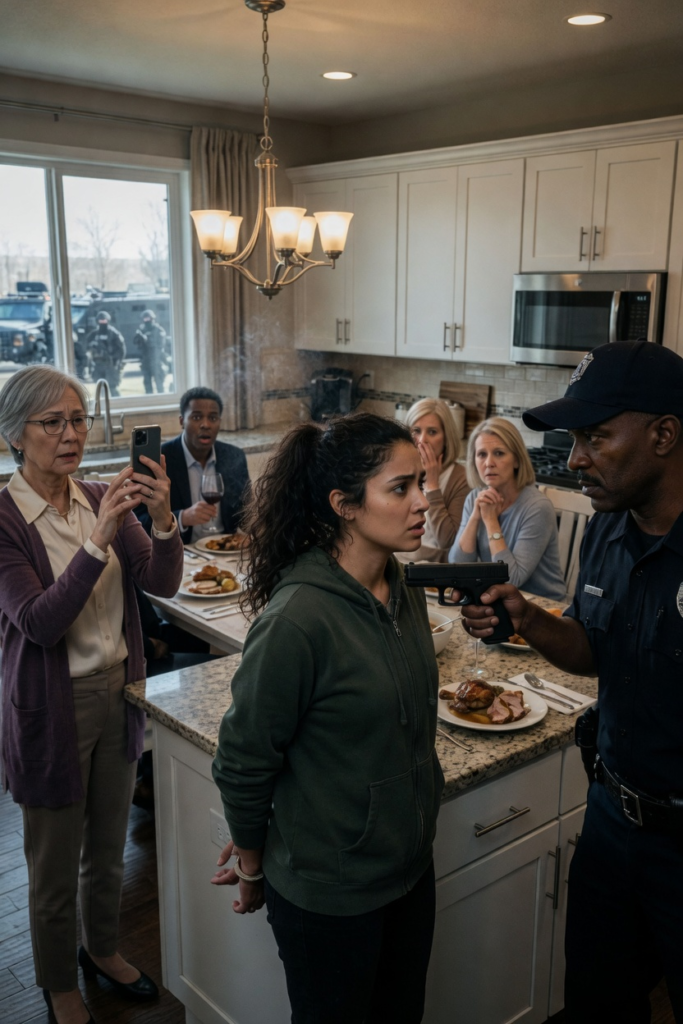
Inside the house, the kitchen smelled like cheap cigars and cooling roast. Linda had set out wine glasses. Two neighbors, Mr. Calder and his wife, sat near the dining room archway. Linda’s sister hovered near the pantry.
Silas greeted Maya in uniform, which told her everything. A man did not wear a badge to family dinner unless he planned to use it as furniture, weapon, and shield.
“You look different,” he said, leaning one hip against the counter. “Still dressing like the help, though.”
Linda laughed too quickly. “Don’t start, Silas.” But her eyes moved toward Maya’s hoodie and then toward her own phone, already face-up on the counter.
The first twenty minutes were small cruelties dressed as jokes. Silas asked if the military had taught Maya to fetch coffee. Linda said, “She was never really combat. More administrative.”
Maya ate almost nothing. She listened. She kept her breathing slow. Every sentence entered the live packet with timestamped audio and location metadata. At 14:02, Silas stopped pretending.
The argument began when Maya corrected him. He had called her “Miss Thorne,” slowly, with a smirk, as if her name itself were a costume.
“General Thorne,” Maya said, calm enough to make the room colder.
The fork in Linda’s hand paused. Mr. Calder gave a faint nervous laugh. Silas stared at Maya as if she had slapped him with the word.
“You think you’re important in that uniform?” he asked.
Maya was not in uniform. That made the insult stranger, and more revealing. Silas was not responding to cloth. He was responding to authority he had not granted.
He crossed the kitchen too fast for Linda to keep pretending this was dinner. His hand hit Maya’s shoulder first. Then her back struck the counter hard enough to rattle the plates.
The edge of the granite bit into her hip. Cold metal circled her wrists as Silas cuffed her behind her back with the practiced efficiency of a man who enjoyed procedure when it humiliated someone.
Linda did not scream. She picked up her phone.
That was the first betrayal the room could not disguise. She raised the camera, not to gather evidence against Silas, but to capture what she believed would be his victory.
“You’re just a secretary,” Linda said.
Maya looked at her mother then. Not with shock. Shock required expectation. This was something colder, older, and clearer.
Some people do not choose the abuser because they are fooled. Some choose him because standing beside power feels safer than standing beside the wounded.
Silas pressed the muzzle of his service Glock against Maya’s temple. The weapon smelled faintly of oil and metal. His breath smelled like coffee and cigar smoke.
“You think your city uniform makes you special?” Silas hissed into her ear. “To me, you’re just a girl who needs to learn her place.”
The room froze into a tableau of cowardice. Mr. Calder stared at his wineglass. Linda’s sister watched gravy tremble on her fork. Mrs. Calder’s hands folded into her lap so tightly her knuckles paled.
The refrigerator kept humming. The ceiling fan clicked. Somewhere outside, a sprinkler ticked across a lawn that would still look perfect tomorrow.
Nobody moved.
Silas continued, louder now, performing for the phone. “I could pull the trigger right now and tell the department you reached for my weapon. Linda will testify. The neighbors will believe me. You are nothing, Maya.”
At the Pentagon, the live feed had already filled a secure War Room monitor. The classified line carried video, audio, GPS position, and a mirrored record no local device could erase.
The Chairman of the Joint Chiefs stood without speaking. The Secretary of Defense stared at the screen with the kind of stillness that meant decisions were already moving underneath it.
A duty officer tagged the incident packet: unlawful restraint, armed threat, identity confirmed, officer involved, civilian witnesses present. At 14:03, the closest federal tactical support unit received the coordinates.
Maya knew none of the room’s exact reactions in that moment. She did not need to. She knew protocol. She had built enough of that network to understand what would happen once certain thresholds were crossed.
For one second, rage offered her a simple solution. She could break Silas’s wrist against the counter, disarm him, and make the kitchen remember the difference between a bully and a soldier.
Instead, she stayed still. Her jaw locked. Her shoulders remained loose. Her heart rate held steady, trained down through years of places where panic got people killed.
“Silas,” she said, “you have ten seconds to lower that weapon before your world collapses.”
He laughed. It was jagged, ugly, and too loud. “Let’s see how a ‘General’ handles a real bullet!”
That sentence ended whatever fantasy Linda had been filming. The word “General” hung in the kitchen differently now. Not like a joke. Like a locked door someone had just heard opening.
At 14:07, five black armored SUVs turned into the driveway. Their engines rolled through the house before the vehicles fully appeared. Glassware trembled on the dining table.
Silas looked toward the window. It was only a flicker, but Maya saw it. Men like him knew the sound of authority when it was larger than theirs.
Linda’s phone chimed. She glanced down, irritated, then went pale.
The screen showed a notice she could not swipe away: LIVE FEDERAL INCIDENT LOG — RECORDING MIRRORED — DEVICE PRESERVED AS EVIDENCE.
Her filming hand started to shake.
Mr. Calder set down his wineglass with a small, careful click. Linda’s sister whispered, “Silas… what did you do?”
The first knock landed on the front door hard enough to vibrate through the kitchen wall.
Maya turned her head as far as the gun allowed and spoke with the same calm that had carried her through briefings, raids, evacuations, and rooms full of men who mistook volume for command.
“Officer Vane,” she said, “before you decide whether to pull that trigger, you should know who is listening on this line.”
Silas did not lower the weapon immediately. That was the part later reports would note with particular interest. Even with armored vehicles outside, even with federal officers at the door, he hesitated.
The second knock came with a voice. “Officer Vane. Federal authority. Put the weapon down and step away from General Thorne.”
General Thorne.
Linda made a small broken sound. The title did what Maya’s face, pain, and truth had never done. It made Linda understand there were witnesses she could not charm.
Silas’s mouth opened, but the old scripts had nowhere to go. He could not call it a misunderstanding with the gun still raised. He could not call Maya unstable while her cuffs were on her wrists.
He could not call himself the law when the law was now standing outside his door.
His finger moved away from the trigger first. Then the muzzle lowered half an inch. Maya did not exhale. Neither did anyone else.
The entry team came through with controlled precision, not the chaos Silas would later claim. One voice commanded. One officer secured the weapon. Another moved Linda back from the phone she still held.
Maya felt the cuffs unlock from her wrists at 14:09. The skin beneath them was red, ridged, and hot. A medic checked her temple where the barrel had pressed.
Silas was restrained in his own kitchen, in front of the people who had spent years believing his badge made him untouchable. He kept saying, “You don’t understand,” which was the closest he came to the truth.
The official incident report would later include the weapon contact, the threat statement, the unlawful restraint, Linda’s recording, the mirrored federal log, and the identities of every witness at the table.
Maya gave her statement once. Cleanly. Chronologically. She did not embellish. She did not need to. The evidence had done what evidence does best when protected from cowards: it stayed exact.
Linda tried to speak to her before the agents escorted her out for questioning. “Maya, I didn’t know it was that serious.”
Maya looked at the phone in Linda’s hand, then at the kitchen where the roast had gone cold and the gravy had skinned over on the plates.
“You filmed it,” Maya said. “You knew exactly how serious it was. You just thought he would win.”
That was the sentence Linda would remember. Not the vehicles. Not the federal notice. Not even the title. She would remember that her daughter finally named the bargain she had made.
The department suspended Silas within hours. The state opened an investigation by the next morning. Federal authorities preserved the live feed, Linda’s video, the Glock, the cuffs, and the full timestamped relay.
Oakhaven tried to talk afterward, because towns like that always do. Some said Silas had been under stress. Some said Maya should have warned them who she was. Some said family matters should remain private.
But family privacy had been the wallpaper hiding violence for too long.
In court, the video played without music, filters, or Linda’s caption. Just the kitchen. The gun. The cuffs. The witnesses. The sentence: “You are nothing, Maya.”
The jury watched Silas’s confidence drain frame by frame. They heard Maya warn him once. They heard him threaten a federal officer on an open classified line.
Linda testified because the subpoena left her no room for performance. Her voice shook. She admitted she recorded because she believed Silas was “handling” Maya.
The prosecutor asked what she meant by handling. Linda stared at the table for so long the judge told her to answer.
“I thought she needed to be put in her place,” Linda whispered.
That was the last time Maya looked at her mother during trial.
Silas was convicted on the charges that stuck hardest: assault, unlawful restraint, aggravated threat, evidence obstruction attempts, and civil rights violations tied to his use of badge and weapon.
The sentencing did not feel like victory. It felt like a door closing on a room Maya had lived in too long.
Afterward, people asked how she stayed so calm. They wanted a heroic answer, something clean enough to print beside a headline.
The truth was less glamorous. Fifteen years away had taught her how to stand still when men wanted fear from her. That steadiness did not mean she felt nothing.
It meant she refused to spend her fear where Silas could enjoy it.
Maya did not return to Linda’s house again. The property went quiet. The neighbors stopped mentioning dinner. The lawn stayed trimmed, because Oakhaven had always been better at surfaces than repair.
But something had changed. A whole room had taught Maya, once again, that silence could be chosen. This time, the silence was documented.
And once the truth had a timestamp, a recording, and witnesses who could no longer look away, Silas Vane finally learned the one lesson he had spent his life avoiding.
A badge can frighten a town.
It cannot outrank the truth.