My mother looked me in the eye on the night I graduated from university and said, “I wish you had never been born.”
For most people, a sentence like that would be the moment everything broke.
For me, it was the moment everything finally made sense.
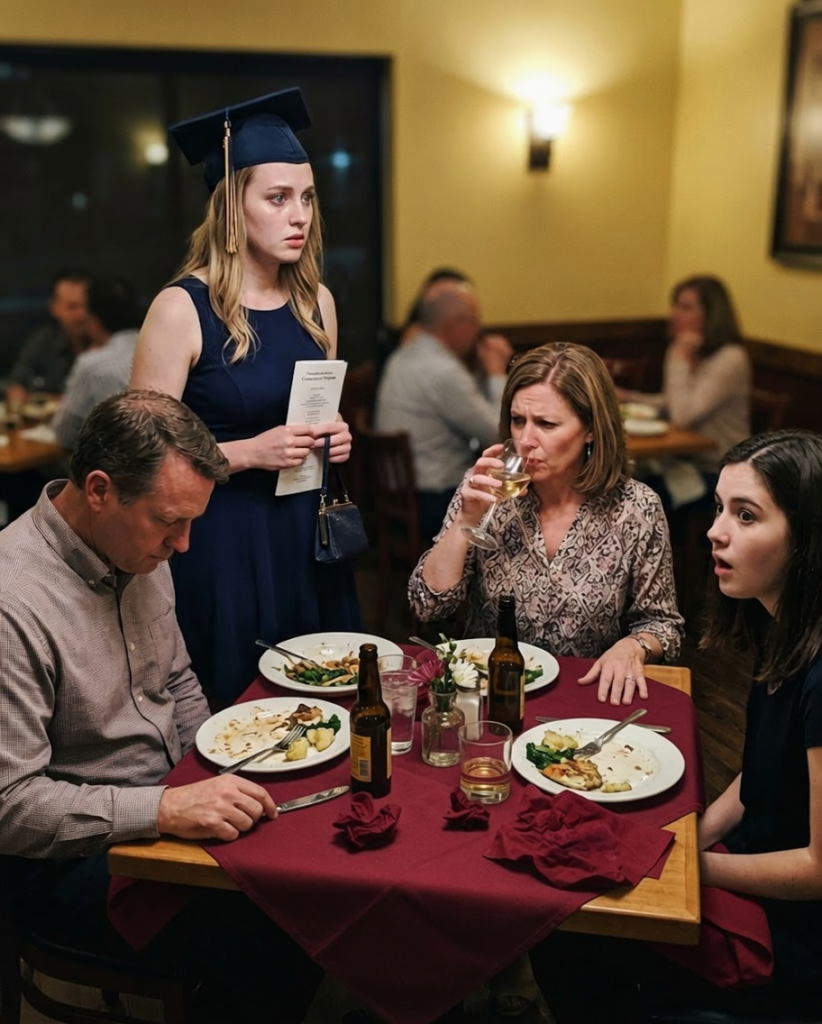
The restaurant was small and warm, tucked between a bookstore and a dry cleaner near campus.
The windows glowed amber against the evening.
Inside, people laughed over pasta and clinked glasses under soft hanging lights.
It was the kind of place that tried to look nicer than it was, with paper napkins folded into triangles and menu descriptions that used words like “artisan” for ordinary bread.
My mother had chosen it because it was, as she said, “good enough.”
Not special.
Not memorable.
Just good enough that nobody could accuse her of ignoring my graduation.
I had spent the morning trying not to hope too much.
That was the rule I had learned early: hope quietly, so disappointment would not humiliate you.
I ironed my navy dress until the fabric looked almost new.
I pinned my hair back twice, then took it down, then pinned it back again.
In the mirror, I practiced the kind of smile people make when their family is proud of them.
I wanted one normal night.
One dinner where my mother did not measure my worth by how inconvenient I had been to her.
One evening where my father did not disappear behind silence.
One photograph where my sister Lily smiled like standing next to me was not an obligation.
I was the first person in my family to graduate from university.
That sentence had carried me through more nights than I could count.
It had been the little fire in my chest while I wiped tables at the campus café after closing.
It had followed me through scholarship applications, secondhand textbooks, instant noodles, unpaid internships, and long walks home because bus fare mattered.
It had comforted me when other students casually complained about their parents calling too often, visiting too much, caring too loudly.
No one in my family had ever cared too loudly about me.
My older brother, Daniel, was the miracle son.
My mother spoke his name with a softness I used to study like a foreign language.
If Daniel forgot something, he was stressed.
If Daniel snapped, he was under pressure.
If Daniel failed, he needed support.
His trophies stayed on the mantel long after the brass turned dull.
My younger sister, Lily, was the baby.
She could cry and get held.
She could quit things and be told she was finding herself.
She had my father’s gentleness and my mother’s protection.
I was Lisa, the middle child, the mistake in the margins.
My mother never said she hated me when I was little.
She was smarter than that.
She told stories instead.
She told relatives that her pregnancy with me had been terrible.
She said I had ruined her body.
She said she had been about to go back to school before I came along.
She said I was the baby who cried too much, needed too much, cost too much.
She said these things while stirring soup, folding laundry, driving me to the dentist, always in the same factual tone people use for
weather.
“You don’t understand what I gave up because of you,” she would say.
At eight years old, I would apologize without knowing what for.
My father heard all of it.
He heard her sigh when I entered a room.
He heard her compare me to Daniel.
He heard her tell me not to be dramatic when I cried.
He heard her say, on my sixteenth birthday, that some children were harder to celebrate.
He never stopped her.
He loved silence more than he loved peace.
Silence allowed him to sit at the table and pretend he was not choosing a side.
But silence is not neutral to the person being hurt.
Silence has weight.
Silence presses down until a child learns to breathe shallowly.
By high school, I had perfected the art of shrinking.
I did not ask for rides.
I did not ask for money.
I did not invite friends over.
I kept my grades high because praise from teachers was the only kind that did not arrive with a hook hidden inside it.
University was not a dream at first.
It was an exit sign.
When my acceptance email came, I read it again and again until the words stopped looking real.
I waited until dinner to tell my parents.
My mother glanced at the screen, nodded once, and asked whether I expected them to pay for everything.
My father said, “Good,” without lifting his eyes from his plate.
I told myself it did not matter.
For four years, I built a life on that sentence.
It does not matter.
It did not matter when my mother forgot my birthday but posted a long paragraph for Daniel’s promotion.
It did not matter when Lily borrowed my coat and returned it stained, then called me uptight for being upset.
It did not matter when my father mailed me a check once with no note inside, just his name on the signature line like a business transaction.
But it did matter.
That was why I invited them to graduation.
Some part of me still believed love might be earned at the finish line.
I imagined my mother seeing me in my gown and realizing I had survived despite her.
I imagined my father clearing his throat, awkward but sincere, and saying he was proud.
I imagined Lily asking for a picture.
I imagined Daniel showing up late with flowers, pretending he had been busy but unable to miss it.
Daniel did not come.
Lily texted that she was busy, then appeared at dinner anyway because my mother told her there would be food.
At the ceremony, when my name was called, the world narrowed to the stage, the applause, and the weight of the degree folder in my hands.
For one bright second, I felt separate from all of them.
I felt real.
I turned toward the audience and found my family.
My mother clapped slowly, her expression flat.
My father held up his phone, but he watched me through the screen instead of with his own eyes.
Lily was typing.
Still, I smiled.
At dinner, I waited for the moment I had rehearsed in my heart.
We ordered.
We made small talk.
My mother complained about parking and the length of the ceremony.
Lily asked whether I planned
to get a “real” job now.
My father ate in silence.
Then my mother lifted her glass.
My whole body went still.
She looked almost tender under the yellow light.
Her mouth curved.
Her eyes fixed on mine.
“We really wish you were never born,” she said.
Then she laughed.
The table stopped moving.
My fork rested beside my plate.
My water glass sweated in my hand.
Lily released a small, nervous laugh, not because it was funny, but because my mother had trained all of us to laugh when cruelty wanted company.
My father looked down.
That was what undid me.
Not my mother’s sentence.
Not Lily’s laugh.
My father’s downward glance.
He knew she had gone too far.
I saw it in the tightening of his jaw.
But he chose the napkin, the plate, the quiet.
He chose himself.
All at once, I stopped begging.
I set my glass down carefully and stood.
My mother’s smile faltered.
“Oh, sit down, Lisa.
Don’t be so sensitive.”
I looked at her and saw, with painful clarity, that I had been waiting twenty-two years for a woman who was never coming.
“Then live your life as if I never existed,” I said.
“Pretend there was never a daughter named Lisa.”
The music seemed to disappear.
A waiter froze near the next table.
Lily’s mouth opened.
My father’s knife slipped from his fingers and struck his plate with a sound that made people turn.
My mother’s face hardened.
“You are embarrassing us.”
“No,” I said.
“I am finally believing you.”
I took my purse, my graduation program, and the envelope containing a copy of the honors letter no one had asked to see.
I placed cash beside my untouched meal because I refused to let my mother turn even dinner into a debt.
Then I walked out.
The night air was cold enough to make my eyes water.
I kept walking until the restaurant lights blurred behind me.
My phone buzzed again and again.
Lily: “Mom is furious.”
Lily: “You ruined dinner.”
Lily: “Dad says come back.”
Then my father’s name appeared on the screen.
For the first time in my life, I let it ring.
By midnight, I had blocked my mother.
By morning, she had found ways around it.
Emails.
Voicemails from unknown numbers.
Messages through relatives who had never once called to ask how I was, but now had speeches ready about respect and forgiveness.
“Your mother was joking.”
“You know how she is.”
“Family is family.”
No one asked how it felt to be told, in public, that your existence was a regret.
Three days later, a thick envelope arrived at my apartment.
There was no return address.
Inside were hospital records, a faded photograph, and a handwritten letter from my father.
The first line made my hands go cold.
“Lisa, before you erase us completely, you need to know what your mother never told you about the night you were born.”
I sat on the floor and read until the room seemed to tilt.
According to the records, my mother had gone into labor early after an argument.
There were notes about distress, about her asking repeatedly whether her husband knew the timing.
There was another name written in the margin of one page: Michael Reyes.
I did not know that name.
The photograph showed my mother in a hospital bed, pale and hollow-eyed, holding newborn me as if I weighed more than a baby should.
My father stood beside her, younger and thinner, his face unreadable.
In the doorway, half hidden by shadow, stood a man I had never seen before.
On the back of the picture, someone had written, “He came back.”
My father’s letter explained what my mother never had.
Before she married him, she had been engaged to Michael Reyes.
Michael had left town suddenly after a fight with his family.
My mother, heartbroken and angry, married my father less than a year later.
Daniel was born soon after.
By every outside measure, they became the respectable young family everyone expected them to be.
Then Michael returned.
My mother saw him once.
Only once, my father wrote.
She swore it was a mistake born from grief, confusion, and old pain.
Weeks later, she learned she was pregnant with me.
My father found out before I was born.
He did the math.
He confronted her.
She begged him not to leave.
She said Daniel needed a family.
She said the baby might still be his.
She said a scandal would destroy them.
So he stayed.
But staying was not the same as forgiving.
My father wrote that my mother looked at me and saw the one mistake she could not bury.
He wrote that he looked at me and saw the question he was too afraid to answer.
He admitted that he had allowed me to be punished for a secret I had not created.
I read that sentence five times.
Then I threw the letter across the room.
The next message came from an unknown number.
“Don’t believe only your father.
Ask your mother who paid your tuition.
Ask her why she kept every letter.”
A second message followed.
“This is Michael.
I think I may be your father.”
I did not sleep that night.
By morning, I had three choices: ignore the message, ask my father, or confront the woman who had spent my life making me pay for her shame.
I chose the third.
My mother agreed to meet only after I told her I had the hospital records.
She arrived at a quiet park near my apartment wearing sunglasses though the sky was cloudy.
She looked smaller outside the house, less powerful without a table to rule over.
“You had no right to dig through private things,” she said before sitting.
“Dad mailed them to me.”
Her mouth tightened.
“Of course he did.
Coward.”
I laughed once, bitterly.
“That’s the first honest thing you’ve said about him.”
She flinched, then recovered.
“What do you want, Lisa? An apology?”
“I want the truth.”
For a long moment, she stared at the grass.
When she finally spoke, her voice had lost its sharp edge.
“Michael was my first love,” she said.
“I thought I would marry him.
Then he left without fighting for me.
Your father was kind.
Stable.
Everyone said I was lucky.
So I did what I was supposed to do.”
“And then Michael came back.”
Her eyes filled, but I refused to soften too quickly.
“One afternoon,” she whispered.
“One stupid afternoon.
I hated myself before it was even over.
When I found out I was pregnant, I prayed you were your father’s.
I prayed every day.”
“And when you weren’t sure, you punished me.”
She looked at me then.
Really looked at me.
For once, there was no performance in her face.
“Yes,” she said.
The word landed harder than any excuse could have.
“Your father wanted a test after you were born,” she continued.
“I refused.
I told him if he demanded proof, he could leave and explain to everyone why.
He stayed, but he never touched the subject again.
He resented me.
I resented him.
And you…”
“I became the evidence.”
She covered her mouth.
I waited for anger to rise hot and clean, but what came was colder.
Grief.
Exhaustion.
The ache of a child who had finally found the locked room and discovered nothing inside but adults protecting themselves.
“Who paid my tuition?” I asked.
She closed her eyes.
“Michael sent money after you turned eighteen.
He found me through an old friend.
He said he didn’t want to disrupt your life, but he wanted to help.
I told your father it was from a scholarship fund.”
I stared at her.
“You let me thank Dad for that money.”
“I know.”
“You let me feel like a burden while taking money from the man you thought might be my father.”
Her face crumpled.
“I know.”
There was no satisfaction in hearing her admit it.
Only a deeper kind of sadness.
I met Michael two weeks later in a coffee shop across town.
He was tall, gray at the temples, with nervous hands and eyes that looked unsettlingly like mine.
He did not rush to hug me.
He did not call me his daughter.
He simply stood when I arrived and said, “Lisa, I am sorry I did not know how to be brave sooner.”
A DNA test confirmed what everyone had spent twenty-two years avoiding.
Michael was my biological father.
My father, the man who raised me without ever really raising me, asked to meet after the results.
He looked older than I remembered, shoulders rounded, voice thin.
“I should have protected you,” he said.
“Yes,” I answered.
He cried then.
I had never seen him cry.
Part of me wanted to comfort him out of habit.
Another part remembered every dinner table where his silence had sat beside my pain like a second parent.
“I don’t know how to fix it,” he said.
“You don’t,” I told him.
“You tell the truth.
You stop letting other people call me dramatic.
You stop hiding behind quiet.
And you accept that forgiveness is not something I owe you because you finally feel guilty.”
He nodded, broken but listening.
My mother took longer.
Her first apology came in a letter that sounded too much like a defense.
I returned it unread.
Her second was shorter.
Her third had only four words.
“I was cruel.
I knew.”
That one I kept.
I did not move back into the family.
I did not pretend the past had been healed because secrets had been named.
Daniel was furious when he learned the truth, mostly because it disturbed the version of our family where he never had to question his place.
Lily cried and apologized for laughing at the restaurant. I believed she was sorry.
I also knew sorry did not erase the sound.
Months passed.
I started my first job.
I rented a brighter apartment.
I learned Michael slowly, carefully, without handing him the empty father-shaped space in my chest too quickly.
He showed up when he said he would.
He listened more than he spoke.
He never asked to replace anyone.
On the one-year anniversary of my graduation, I returned to the same restaurant alone.
I ordered the meal I had barely touched that night.
I sat by the window.
The amber lights still glowed.
People still laughed over ordinary bread pretending to be artisan.
For a moment, I saw myself standing at that table in my navy dress, voice steady, heart breaking open.
Then I lifted my glass of water.
Not to my mother.
Not to my father.
Not to the family that had taught me love was something I had to earn by disappearing.
To the girl who walked out.
The truth did not give me a perfect ending.
It did not erase the years I spent apologizing for being alive.
But it gave me back the one thing my mother had tried hardest to take from me: the knowledge that I had never been the shame.
I had only been born into it.
And some families do not break because one person leaves.
They break because, for the first time, that person stops holding the lie together.